

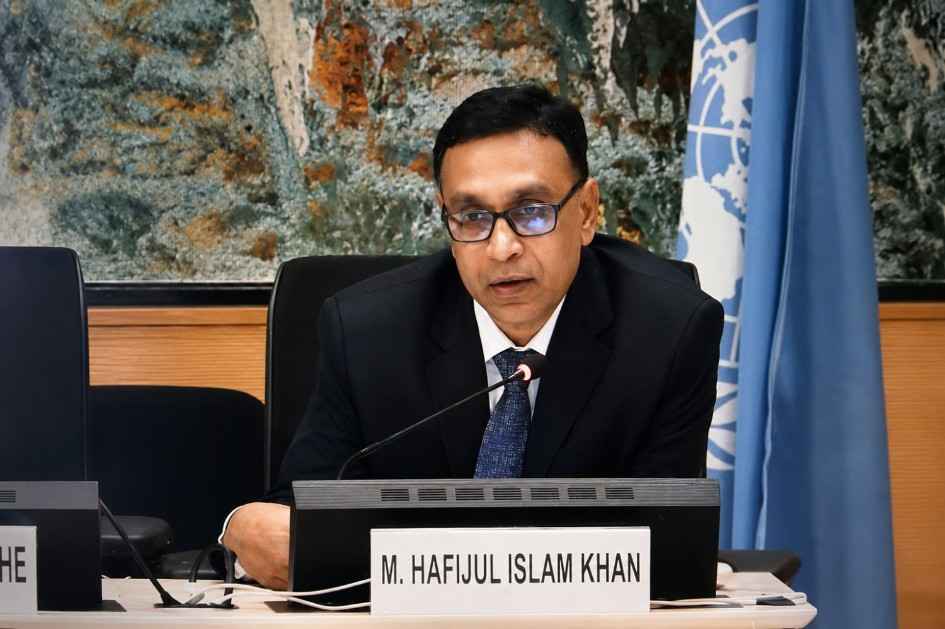

Environmental lawyer Mohammad Hafijul Islam Khan urged the UN Human Rights Council to treat climate finance as justice, not charity, warning that loan-based funding deepens debt for vulnerable nations and calling for grants, direct access and fossil fuel subsidy reforms.
Bangladeshi prominent environmental lawyer and loss-and-damage negotiator Mohammad Hafijul Islam Khan on Friday called for a fundamental reform of global climate finance, urging a shift from a charity-based approach to a justice-oriented system grounded in legal responsibility.
He also outlined a three-point reform proposal calling for grant-based climate finance instead of loans, simplified direct access for vulnerable communities, and an end to fossil fuel subsidies. He warned that continued reliance on loan-based climate funding is deepening inequality and pushing climate-vulnerable nations into unsustainable debt cycles.
Speaking as a distinguished panelist at the United Nations Human Rights Council’s (UNHRC) annual discussion on climate change and human rights, Khan argued that the current global climate finance system places a disproportionate burden on countries least responsible for emissions but most affected by climate impacts. He stressed that climate finance must be treated as a binding obligation rooted in human rights principles rather than voluntary assistance.
The high-level panel was held at the Assembly Hall of the Palais des Nations during the ongoing 62nd session of the Council under the theme “actionable pathways for climate financing to address the adverse impacts of climate change on the full realisation of human rights for all people.” The discussion brought together experts and practitioners to examine policy responses linking climate finance, human rights protection, and global climate governance.
The panel discussion, guided by Human Rights Council resolution 59/25, forms part of the broader 62nd UNHRC session running in Geneva until 7 July 2026, where climate justice and human rights remain central themes of global deliberations.
Khan, Executive Director of the Centre for Climate Justice–Bangladesh (CCJ-B), was invited by UNHRC President Sidarto R. Suryodipuro, reflecting growing recognition of frontline and climate-vulnerable country perspectives in international policy discussions.
Debt burden and climate justice
Opening his remarks, Advocate Khan said climate-vulnerable nations are increasingly forced to rely on borrowing to respond to climate impacts they did not create. “The $100 billion promise was never fully delivered. What arrived came mostly as loans, not grants. We are asking victims of climate change to borrow money to survive a crisis they did not cause,” he said, adding that such financial arrangements undermine both climate justice and the credibility of global multilateral commitments.
Loss and damage and the legacy of Prof. Saleemul Huq
Invoking the legacy of late Bangladeshi climate scientist Professor Saleemul Huq, Khan said the global response to climate change must move beyond charity-based thinking and recognise the historical responsibility owed to vulnerable communities. He described Prof. Huq as a leading voice who consistently argued that climate-affected populations are not passive recipients of aid but rights-holders in an unequal global system shaped by historical emissions and structural injustice.
“Following the legacy of Professor Saleemul Huq, we must understand that those on the frontlines of climate change are not begging for assistance; they are asserting a legitimate claim to justice, dignity, and compensation for loss and damage,” Khan said, stressing that loss and damage must be anchored in rights-based accountability rather than discretionary goodwill.
He also highlighted Bangladesh’s continued investment in cyclone shelters, early warning systems and adaptation infrastructure, while noting that global financing structures continue to push Least Developed Countries (LDCs) and Small Island Developing States (SIDS) into repeated debt cycles.
Legal and human rights dimensions
Khan referred to emerging international legal discussions, noting that advisory opinions of the International Court of Justice have been referenced in debates on state responsibilities in addressing climate impacts. He said that under the International Covenant on Economic, Social and Cultural Rights (ICESCR), developed countries are required to mobilise the “maximum of available resources,” stressing that this obligation cannot be met through loan-based financing that increases debt burdens.
Reform proposals for global climate finance
Outlining a set of structural reforms, Khan proposed three key measures for global climate finance governance. He called for grant-based climate finance instead of loans to prevent worsening sovereign debt. He urged simplified systems for direct access so that women, Indigenous peoples, coastal communities and local actors can benefit without bureaucratic barriers. He also called for an end to fossil fuel subsidies, arguing that governments cannot claim climate leadership while continuing to support industries driving the crisis.
Structural exclusion as a rights concern
He warned that exclusionary climate finance systems themselves constitute a human rights concern, as adaptation funding often fails to reach the most affected communities. “Our documentation shows adaptation finance, when it arrives, still bypasses women, displaces coastal communities, and excludes Indigenous voices,” he said.
Climate Justice Imperative: A Call for Systemic Reset
Concluding his intervention, Khan urged the Human Rights Council to align climate finance mechanisms with human rights obligations and accelerate justice-based solutions. “The people I represent cannot wait for the architecture to be perfected. Their homes are already underwater,” he concluded.




