

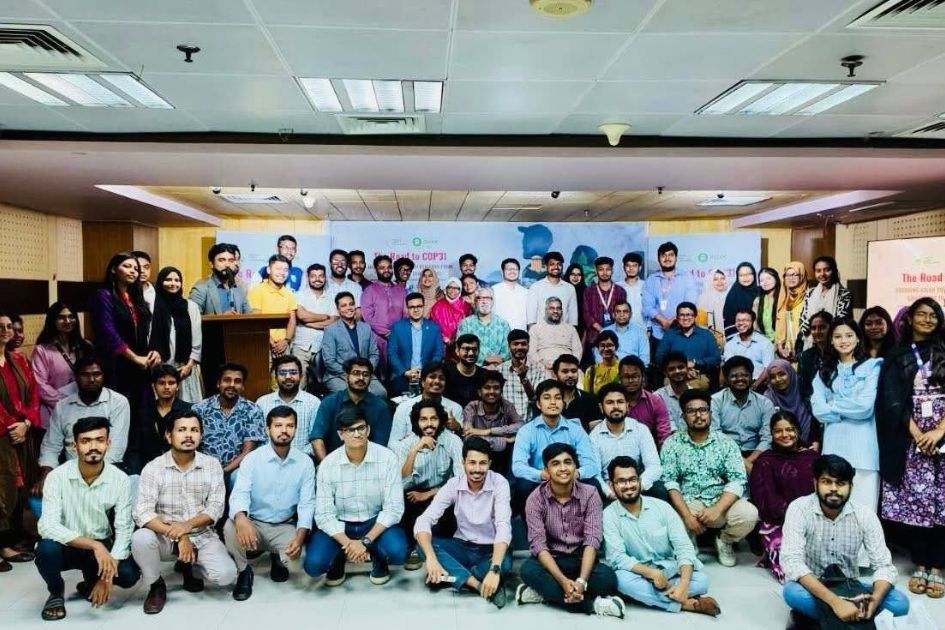

At a Dhaka dialogue, experts and youth leaders called for stronger youth influence in climate finance, technology transfer and policymaking, stressing grant-based funding and grassroots action ahead of COP31.
Youth leaders, climate experts and policy practitioners have called for placing young people at the centre of global climate finance and technology transfer negotiations, stressing that meaningful participation is critical to addressing escalating climate risks in vulnerable countries.
The call came at a policy dialogue titled “The Road to COP31: Bridging Asian Youth Demands from Grassroots to Global Level,” jointly organised by Oxfam in Bangladesh and Mission Green Bangladesh (MGB) on Thursday at The Daily Star Centre in Dhaka.
Eminent climate scientist Professor Dr Ainun Nishat of BRAC University highlighted persistent structural barriers to accessing international climate finance.
“Developed countries may agree in principle to grant-based climate finance, but in reality, we lack the capacity and systems to directly access these funds,” he said. “Often, we are excluded due to procedural complexities and indirect application processes.”
He added that climate finance must be “fair, fast, grant-based, accessible and accountable, without bureaucratic bottlenecks or empty promises.”
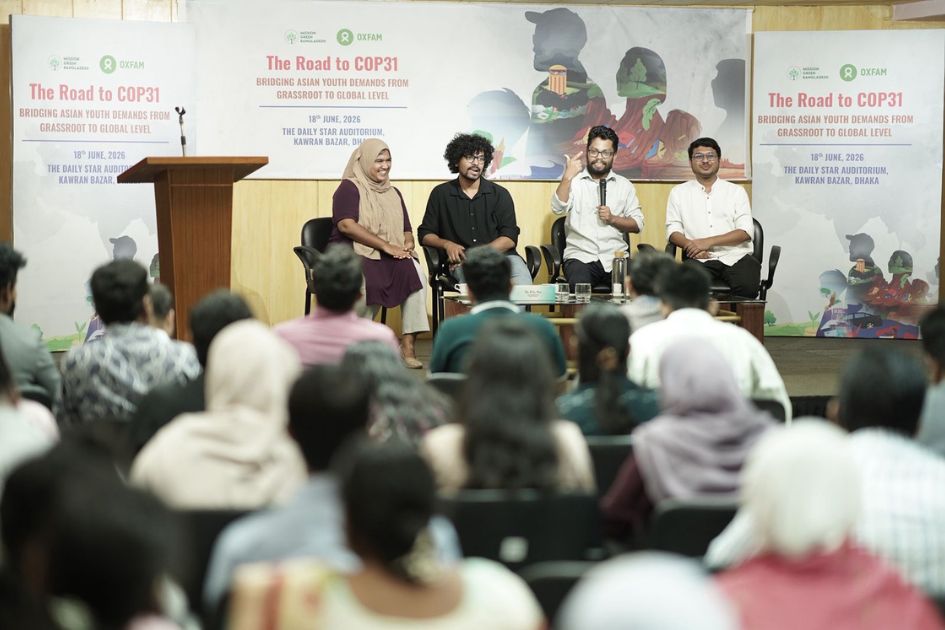
Speaking at a youth panel, YouthNet Global Executive Coordinator Sohanur Rahman said youth engagement must go beyond international visibility and be rooted in domestic policy influence.
“Going to COP or international spaces is not enough for us. What matters more is how we influence our own government and ensure youth priorities are reflected in national climate policy frameworks,” he said, adding that grassroots realities must guide both national and global advocacy.
He stressed that youth participation must move beyond visibility to sustained policy engagement and data-informed action at the national level.
The youth panel also featured Brighters Chair Faria Ami, founder Saidur Rahman Siam and Youth4NDC Executive Director Amanullah Parag. The speakers called on young people to focus more on grassroots climate action rather than excessive COP-related publicity while also addressing internal inequalities within the climate movement.
The session opened with field reflections from youth fellows Nuhail Kabir and A J Sagar, who shared experiences from climate-affected communities in Dhaka’s informal settlements, Rajshahi and Cox’s Bazar. They warned that large parts of Bangladesh face long-term inundation risks due to climate change, while Indigenous communities such as the Munda population in Rajshahi continue to suffer from severe shortages of safe drinking water and access to education. They called for direct grant-based climate finance, rejecting loan-based assistance models.
Speakers stressed that the upcoming UN Climate Summit COP31, scheduled for November in Antalya, Türkiye, is expected to be a key milestone in global climate negotiations and presents an opportunity to bridge the widening gap between climate commitments and real-world delivery, particularly for climate-vulnerable countries facing mounting loss and damage.
Water governance expert Sharif Jamil said youth engagement in global platforms must be backed by technical and evidence-based capacity.
“COP is a major global platform, but youth cannot remain mere observers. If we want to influence policy, we must come with strong data, technical knowledge and evidence from the ground,” he said.
Professor Dr Kamruzzaman Majumder of Stamford University Bangladesh emphasised the role of scientific modelling in global negotiations.
“Local climate impacts must be translated into rigorous data modelling and scientific evidence if we want them to influence international policy spaces,” he said.
SM Saikat, Executive Director of C3ER Bangladesh, warned that climate change poses an existential threat requiring urgent global action.
“Climate change is an existential threat. The world must act now and climate issues must remain at the centre of global political and financial priorities,” he said.
Media professionals at the event said climate impacts are often reported as isolated incidents rather than structural crises, calling for stronger investigative journalism to highlight climate injustice and accountability gaps.
Shariful Islam, Head of Influencing, Communications, Advocacy and Media at Oxfam in Bangladesh, said increased national climate budget allocations must be matched by predictable, substantial and grant-based international climate finance.
“Budget increases alone are not enough. What we need is predictable, substantial and grant-based international climate finance that matches the scale of the crisis,” he said.
Other speakers from academia, research and civil society echoed calls for inclusive governance, improved access to climate finance, stronger youth engagement and enhanced collaboration between institutions, media and grassroots actors.
The event brought together policymakers, climate scientists, economists, journalists and youth representatives, who urged structural reforms in global climate finance, particularly expanding grant-based funding and ending debt-creating loan mechanisms for climate action.
The programme concluded in an environmentally conscious manner, with organisers avoiding plastic and souvenir materials. Participants were instead presented with potted plants as symbolic gifts, reinforcing messages of sustainability and climate responsibility.




