


From Armenia to Bangladesh, speakers highlight how armed conflict, militarised conservation and unequal access to resources threaten ecosystems and local livelihoods.
Speakers demand community funding, stronger Indigenous rights and conservation that avoids fuelling conflict.
Governments must place peacebuilding and human rights at the centre of biodiversity action as conflict destroys ecosystems and undermines conservation, experts urged at the UN biodiversity summit in Armenia on Tuesday.
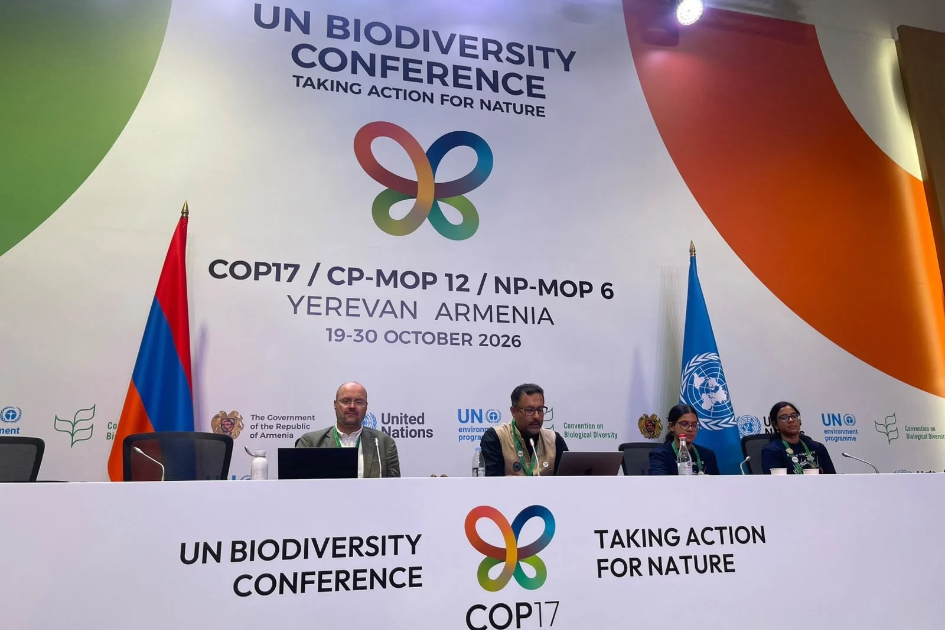
Speaking at a COP17 press briefing in Yerevan, youth and conservation representatives called for direct support for conflict-affected communities and warned against approaches that treat nature protection primarily as a national security concern.
“Attention on nature and security is long overdue, but the way we frame it will determine whether it helps or harms,” said Doug Weir, director of the Conflict and Environment Observatory.
“Securitisation can be risky and we have a short window to get this right before the narrative hardens.”
Global biodiversity and nature loss are threats to national security, but they need to be addressed by tackling the root drivers. If we wait and only address the impacts, it’ll be too late. Conflict-sensitive conservation in fragile and conflict-affected settings is a win-win for national security everywhere.
The speakers urged governments to turn the message “Peace for Nature and Nature for Peace” into practical measures protecting ecosystems, community rights and livelihoods.
They said the Kunming-Montreal Global Biodiversity Framework, which guides international action through 2030, does not explicitly address peace and security or include dedicated indicators to track them.
Political recognition, practical gaps
The Yerevan Declaration, presented at the Leaders for Nature Summit on October 16, recognises biodiversity and ecosystem services as foundations of prosperity, peace and human wellbeing.
But speakers said that recognition must translate into funding, safeguards and measurable commitments.
Sudha, representing the Global Youth Biodiversity Network’s Peace and Conflict Working Group, urged governments to recognise that nature can encourage cooperation while decisions over land and resources can also fuel exclusion and conflict.
Conflict and fragile institutions disrupt conservation, monitoring, financing and international cooperation, she said.
Her colleague Shruthi Kottillil welcomed the first draft of the global progress report for identifying those barriers. She called for practical support and highlighted growing interest in an informal coalition of states exploring links between nature, peace and security.
Their appeal follows UN Secretary-General António Guterres’s warning on October 15 that the “war on nature has not yet ended”, as he launched a global report showing insufficient progress towards biodiversity commitments.
Address the ‘justice gap’
Sushil Raj, executive director of the Wildlife Conservation Society’s Rights and Communities Global Program, urged policymakers to address what he described as a “justice gap” in conservation.
Countries and communities face unequal conditions, he said, with conflict adding to historical injustice, dispossession of land and resources, denial of self-determination and systemic inequality.
Raj called on conservation organisations to adopt a “do no harm” approach, assessing local tensions before introducing programmes that could aggravate disputes or create new ones.
He urged them to place community governance and Indigenous methods of resolving disputes at the centre of their work.
A pastoralist participant from northern Kenya called for the demilitarisation of conservation, warning that communities are too often treated as enemies of wildlife.
The participant said militarised ranger forces and fenced conservation areas can heighten tensions and urged donors to fund Indigenous and grassroots organisations directly.
Bangladesh concerns bring local realities into focus
A question from The Climate Watch at the briefing drew attention to concerns that fencing along the Bangladesh-India frontier restricts elephant movement, highlighting the consequences of political boundaries for wildlife and neighbouring communities.
It also raised the stigma and social exclusion faced by some women in Bangladesh and India’s West Bengal whose husbands have been killed by tigers.
Often described as “tiger widows”, these women can experience discrimination alongside bereavement and the loss of household income.
Responding, Raj stressed that solutions must reflect local conditions, particularly where population pressure is high and land and resources are scarce.
He cited community fencing as one possible way to reduce dangerous encounters between people and wildlife, distinguishing such measures from the border barriers raised in the question.
Security for whom?
Weir urged governments to speak directly with rights holders about what security means in their daily lives.
Treating biodiversity loss chiefly as a national security issue risks overlooking the underlying causes of environmental destruction and the experiences of communities living with insecurity, he warned.
His intervention highlighted the need to address the drivers of nature loss before their consequences deepen, while ensuring conservation programmes account for local conflict and support community safety.
Speakers called for approaches that strengthen community rights and livelihoods, with safeguards against exclusion and violence.
War and accountability
War’s environmental consequences also entered national statements at COP17 on October 27.
Lithuania condemned Russia’s invasion of Ukraine, linked it to biodiversity destruction and called for accountability, compensation and support for ecosystem restoration.
Exercising the right of reply, Russia’s representative rejected accusations against the country and objected to singling out states for blame at the biodiversity conference, The Climate Watch’s correspondent reported.
The State of Palestine, represented by Zaghloul Samhan, head of the Environment Quality Authority, highlighted extensive environmental damage and nature loss caused by the ongoing conflict.
Samhan said the war in Gaza had destroyed or restricted access to approximately 97 percent of agricultural land, degraded ecosystems and contaminated soil, water and the marine environment.
He warned that these conditions threaten biodiversity and food security while obstructing environmental recovery efforts.
Earlier, at the October 16 Leaders’ Summit, Iranian President Masoud Pezeshkian described environmental destruction caused by conflicts in Gaza and the wider Middle East as “ecocide”.
He accused the United States and Israel of causing severe ecological damage through military action, including damage to industrial and energy facilities that released pollutants.
Pezeshkian urged the establishment of international mechanisms to protect biodiversity during armed conflict. War destroys forests and wetlands, contaminates soil and water and damages wildlife habitats, he said.
Armenia’s experience
Armenian Prime Minister Nikol Pashinyan also linked environmental protection to his country’s experience of conflict.
Addressing the Leaders’ Summit, he described COP17’s timing as symbolic, saying Armenia was entering an era of peace after more than three decades of conflict with Azerbaijan.
He recalled how conflict and the economic and energy crises of the early 1990s drove forest felling and placed severe pressure on Lake Sevan’s fish stocks.
Pashinyan also warned that unplanned construction of military fortifications along borders damages natural habitats.
Reporting from Shikahogh State Reserve near the Azerbaijan frontier, Inter Press Service documented gaps in forest cover near military positions and accounts of restricted access affecting livelihoods and wildlife monitoring. It noted that the full extent of alleged forest clearance had not been independently verified.
The report also highlighted conflict-related environmental damage in Lebanon and Ukraine. George Mitri, an environmental sciences professor at Lebanon’s University of Balamand, called for scientific documentation and coordinated restoration involving specialists and affected communities.
‘Nature doesn’t recognize’ borders
At a separate COP17 session on transboundary conservation and “peace parks”, WWF International President Adil Najam urged neighbouring countries to begin conversations with nature rather than politics.
“Borders are political structures, but nature doesn’t recognize them,” Najam said.
Peace parks are shared conservation areas intended to protect ecosystems and encourage cooperation across borders.
Najam argued that cooperation across even tense borders often goes unnoticed while political differences dominate public discussion.
The session explored how shared conservation efforts could build trust and encourage joint action between neighbouring countries.
Funding and accountability needed
GYBN representatives said preliminary findings from an ongoing review of national biodiversity strategies and reports suggest that war-affected countries refer more frequently to peace and instability. Countries without recent conflict tend to focus on human-wildlife conflict and food insecurity.
Looking towards the post-2030 agenda, speakers urged governments to fund conflict-affected communities, train conservation practitioners to avoid aggravating tensions and introduce indicators measuring results for both nature and people.
They called for those measures to become part of future biodiversity commitments, ensuring that ecosystem protection also upholds community rights, sustains livelihoods and supports lasting peace.