

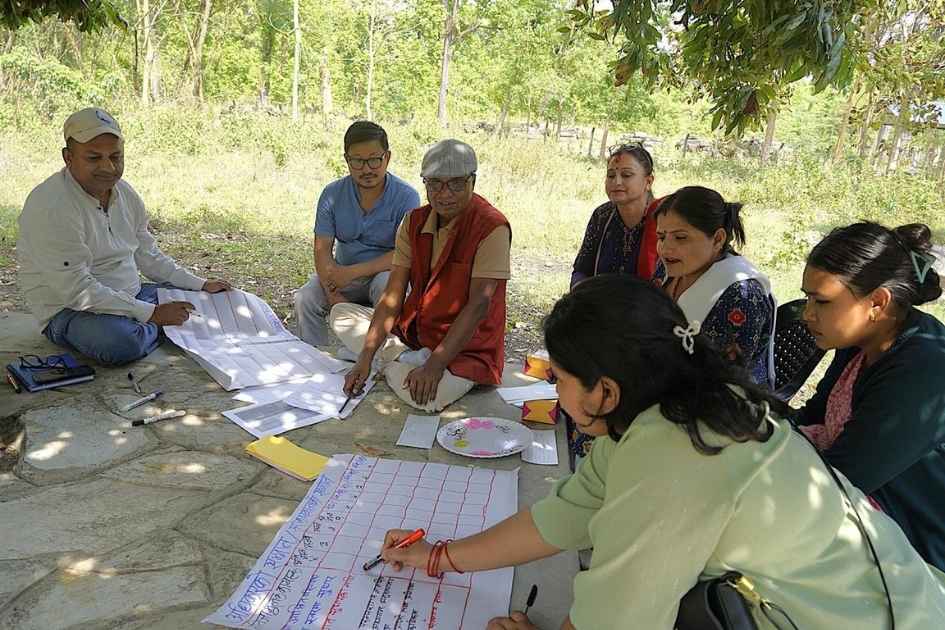



Local communities play a frontline role in protecting forests and biodiversity around Nepal’s national parks, but women, Indigenous people and poor families remain largely excluded from leadership and decision-making in buffer zone consumer committees, raising concerns over inclusive and effective conservation.
Two years ago, a fire spread in the Suga Bhanjyang Community Forest, located under the Lahare Pawau Buffer Zone Consumer Committee in Rasuwa District.
“It was evening time and we saw a fire in the forest,” said Kamala Pudasaini, a consumer of the Lahare Pawau Community Forest. “We could not wait and immediately gathered to control the fire. If the fire had spread, it would have reached Langtang National Park.”
With the efforts of local people throughout the night, the fire was controlled and did not spread into the national park.
Nepal has 13 national parks. Human settlements are located around all of them. These settlements are closely connected to the national parks.
Still, in rural areas of Nepal, many people depend on forests. Their daily needs are fulfilled from forest areas. Women, poor families and Indigenous people have a strong attachment to forests, as they go there every day to collect grass, firewood and fodder.
Suntali Bankariya, a resident of Manahari-4 in Makawanpur district, spends much of her time in the nearby forest. She collects grass and firewood from the forest. During winter, she also clears bushes to help control forest fires.
She needs wood to build a shed at a cheaper rate. “We don’t have money to buy wood. I would need to spend Rs 15,000, but I don’t have the money to buy it,” she said. “Many times we told the chairperson of the forest, but our voices were not heard.”
She said that after her demands were ignored, she stopped raising the issue. “Many people like me look for wood from the forest to build sheds because they cannot afford to buy it.”
The Bankariya are an endangered community in Nepal. Their population is only about 90 people across the country.
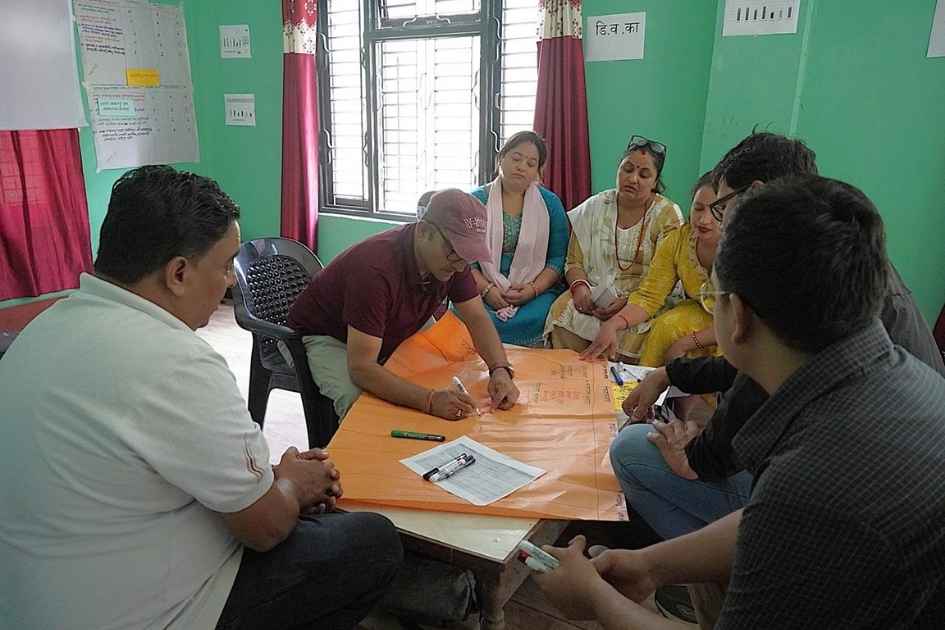
Many people who live near the forest and are attached to natural resources are not part of the decision-making process.
Kamala Thapa, an expert in natural resource management, said that most people living around national parks are from Dalit, Indigenous, and marginalized communities.
“The relationship between Indigenous communities and natural resources is cultural and social,” she said. “However, they are not in a position to participate in the decision-making process, so their voices are always ignored. But when problems arise in national parks and forest areas, such as wildfires, it is the marginalised community people who are mobilised to control them.”
Always dominated
These people are close to natural resources; however, they are dominated when it comes to the mainstream, such as the leadership of consumer committees at the local level.
Binda Biswokarma, a member of the Lahare Pawau Buffer Zone Committee, said that people who are not directly related to natural resources and are considered part of the elite class have captured leadership positions.
“There should be women, Dalit and Indigenous people in leadership, not just as members to fulfil quotas,” she said. “We know the problems and conservation issues because we go to the forest regularly. How can those who do not go there understand the issues?”
Manju Aryal, a resident of Manahari in Makawanpur, said everything has become politicised.
“There is political division between parties and leadership usually goes to men,” Aryal said. “It should be mandatory to have 50 percent women and marginalised communities in intermediate management user committees outside the park.”
According to the Department of National Parks and Wildlife Conservation, there are 76 buffer zone consumer committees around five national parks, including Koshi Tappu Wildlife Sanctuary in the Tarai region. Unfortunately, only two of them have women in leadership positions.
Pardeep Budhathoky, Deputy Director of RECOFTC Nepal, said the buffer zone concept has been implemented to advance conservation work through Indigenous Peoples and Local Communities participation under the equitable governance framework, aligning with the Kunming-Montreal Global Biodiversity Framework 2022 Targets 3, 21, 22 and 23.
RECOFTC has implemented an applied research project called Scaling-up Equitable Governance in Area-Based Conservation (SEGA), which enables site-level actors to achieve better social and conservation outcomes. The SEGA project mainly uses the Site-level Assessment of Equity and Governance (SAGE) tool. As a participatory assessment methodology, it was developed by the International Institute for Environment and Development to assess the quality of governance and equity in protected and conserved areas.
SAGE is grounded in 10 globally recognised principles of equitable governance, ranging from respect for rights and participation in decision-making to transparency, accountability and equitable benefit sharing. It is a process-based tool structured into three phases. The first phase, preparation, involves introducing tools, building site profiles and identifying stakeholders through community meetings.
Chitwan National Park has a buffer zone area of 729.37 square kilometres with 21 buffer zone user committees. Likewise, Bardiya National Park has 507 square kilometres, Suklaphanta 243 square kilometres, Parsa 285 square kilometres, Koshi Tappu 173 square kilometres and Banke National Park 344 square kilometres of buffer zone areas.
“To support biodiversity conservation in the core areas of national parks, the buffer zone concept was introduced, where people can fulfil their needs from natural resources while supporting conservation,” Budhathoki said. “Unfortunately, those people who are marginalised, Dalit, women and forest-dependent community members are not really included in the decision-making process. When the real users, those directly involved with natural resources, cannot participate in leadership, it ultimately hinders effective conservation and management of biodiversity.”
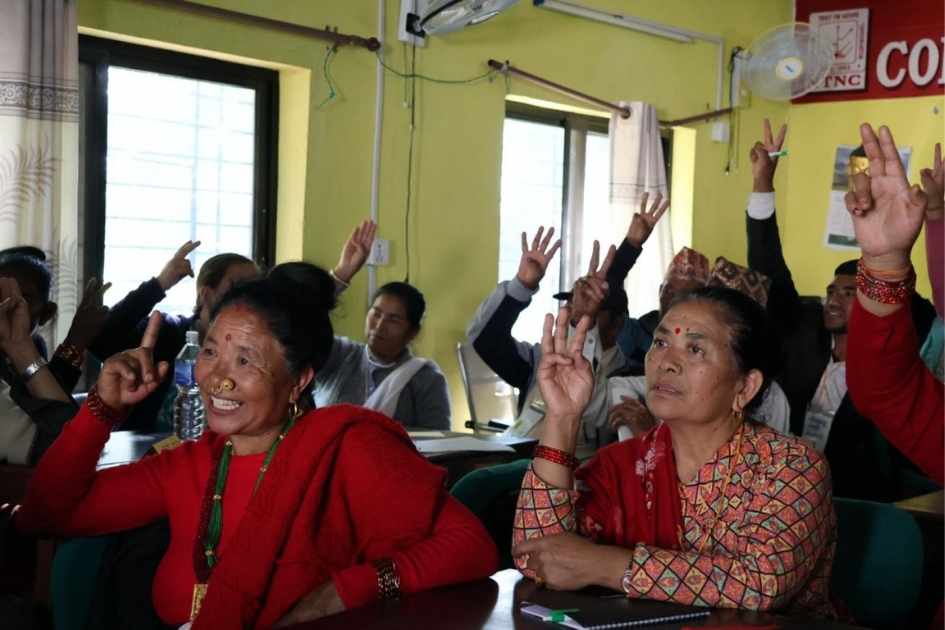
Ganesh Raj Panta, Warden of Chitwan National Park, acknowledged that there are many hurdles for women to come into leadership positions.
“There must be mandatory provisions to ensure women and marginalised communities are included in leadership,” he said.




