

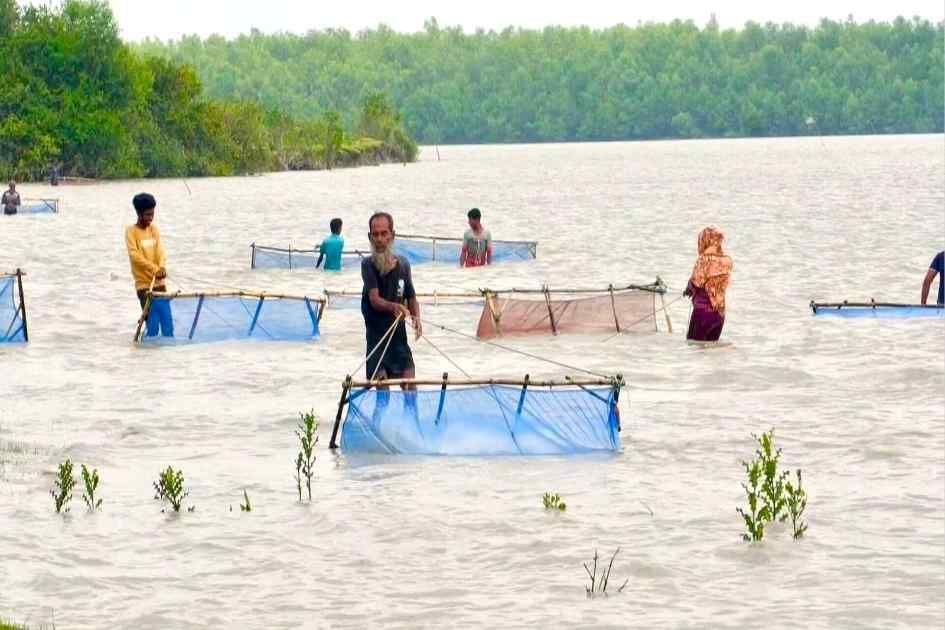



Widespread illegal shrimp fry collection is destroying marine larvae in Bangladesh’s coastal waters, threatening biodiversity, weakening fisheries sustainability and exposing deep livelihood, governance and climate adaptation challenges.
Bangladesh’s coastal shrimp belt, a key part of the global seafood supply chain, is under increasing ecological stress as widespread illegal harvesting of shrimp fry continues to destroy marine biodiversity and weaken coastal ecosystems.
Experts caution that continued destruction of marine larvae could disrupt natural regeneration cycles in the Bay of Bengal, leading to declining fish populations and long-term damage to coastal ecosystems.
While shrimp remains an important export commodity for Bangladesh, experts say its long-term sustainability is increasingly at risk.
Without urgent intervention combining enforcement and livelihood diversification and ecosystem-based management, the coastal fisheries sector may face irreversible ecological decline with significant economic and social consequences.
A recent fisheries assessment shows alarming levels of collateral damage. At least 38 species of shrimp, 6 species of fish and nearly 100 types of marine organisms are being destroyed during the collection of shrimp post-larvae using fine-mesh illegal nets.
Despite restrictions, the practice is widespread across coastal districts including Kalapara and Southkhali near the Sundarbans. Fishers, often driven by economic hardship, drag fine nets through tidal rivers and estuaries to collect shrimp fry. While target species such as tiger shrimp bagda and giant freshwater prawn golda are retained, large quantities of fish larvae and marine organisms are discarded on shore and quickly die.
Ecological collapse at the larval stage
Marine scientists warn that this practice is destroying the foundation of coastal ecosystems by targeting species at their most vulnerable stage.
Associate Professor Mir Mohammad Ali, former chairman of the Department of Marine Fisheries at Sher-e-Bangla Agricultural University, said harvesting at the larval stage disrupts the entire reproductive cycle of marine species. He warned that continued destruction at this scale could severely reduce fish stocks and undermine long-term food security in Bangladesh.
Poverty climate stress and informal market networks
In coastal communities, many fishers say they are compelled to engage in shrimp fry collection due to a lack of livelihood alternatives. Increasing salinity, cyclones and declining fish availability have further deepened economic insecurity in the region.
However, the value chain is largely controlled by intermediaries. Fishers typically sell 1,000 shrimp fry for between 900 and 1,100 taka. The same fry are later sold in regional markets in Khulna and Satkhira for 3,000 to 5,000 taka per thousand. Reports also suggest that parts of this trade move through informal and unregulated channels.
Enforcement gaps and regulatory challenges
Authorities acknowledge that despite periodic crackdowns, illegal fry collection continues.
Bijon Kumar Nandi, District Fisheries Officer of Patuakhali, said regular drives and awareness campaigns are being conducted in coordination with NGOs. He added that enforcement alone is not sufficient and stressed the need for alternative livelihoods and stronger multi-agency coordination to address the issue sustainably.
Climate vulnerability intensifying pressure
Coastal districts near the Sundarbans are increasingly exposed to climate-related stress including sea level rise, salinity intrusion and frequent cyclones. These pressures are reducing agricultural output and fish availability, pushing vulnerable communities further into environmentally harmful livelihood practices.
Environmental experts and civil society actors warn that the crisis is no longer localized and could have national implications for Bangladesh’s blue economy and food systems.
Sohanur Rahman, Executive Coordinator of YouthNet Global, said Bangladesh is losing its future marine wealth at the larval stage. He added that this is not only an issue of illegal fishing but a deeper governance and climate adaptation failure that threatens coastal livelihoods and the country’s blue economy if urgent action is not taken.




