

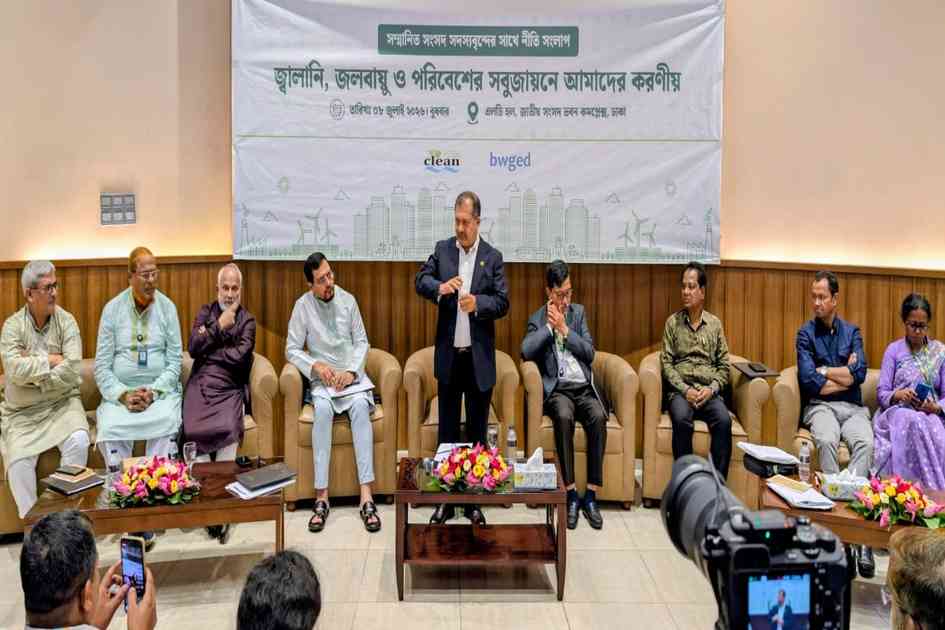



The group says targeted subsidies, low-interest financing, unused coal land and mandatory storage could mobilize households, farmers and entrepreneurs to help Bangladesh reach 10,000MW renewable capacity by 2030.
Bangladesh Working Group on Ecology and Development on Wednesday called for urgent policy reforms to expand renewable energy, cut dependence on imported fossil fuels, strengthen national energy security and create 1 million green jobs.
The call was made at a high-level National Parliament dialogue in Dhaka on July 8, 2026, with H.E. Zahir Uddin Swapon, MP, Honorable Minister, Ministry of Information and Broadcasting, and members of parliament.
BWGED presented a seven-point policy roadmap for what it called a just and sustainable energy transition, including a Tk 25,000 subsidy per kilowatt for household and agricultural solar systems up to 3 kW capacity.
“Energy security is not merely about ensuring power supply, it is about safeguarding Bangladesh’s economic independence and development aspirations. We must move forward with strong political commitment and accelerate our transition toward clean, renewable energy for a sustainable future,” Swapon said.
BWGED said growing geopolitical uncertainty and fossil fuel price volatility had made Bangladesh’s import-dependent energy system increasingly vulnerable. Renewable energy, it said, was no longer only an environmental priority, but a national economic necessity that could strengthen energy security, save foreign currency, boost competitiveness and create future jobs.
According to a BWGED study, installing every single kW of solar power in Bangladesh reduces fuel oil imports by BDT 30,000 annually, saving the exchequer BDT 550,000 over a 20-year operational life.
The group said the national savings would heavily outweigh any localized subsidy costs.
BWGED proposed establishing a dedicated renewable energy fund of Tk 25,000 crore, approximately USD 2 billion, under Bangladesh Bank to provide affordable financing through commercial banks. It recommended a pre-financing mechanism with loans available at a maximum 5 percent interest rate for renewable energy entrepreneurs.
To encourage citizen participation in clean energy generation, BWGED urged the government to provide a direct subsidy of Tk 25,000 per kilowatt for residential and agricultural solar systems up to 3 kW capacity.
The organization estimated that achieving Bangladesh’s 2030 renewable energy target would require approximately Tk 21,750 crore annually, including at least Tk 6,750 crore, around USD 563 million, in direct government allocation.
“Supporting rooftop solar is not a government expense; it is a strategic investment that can reduce fuel import costs, empower citizens and strengthen energy independence,” said Hasan Mehedi.
BWGED also recommended an additional 10 percent incentive for projects led by women, Indigenous communities and marginalized groups to ensure an inclusive energy transition.
The group called for the immediate withdrawal of a National Board of Revenue SRO that it said restricted tax benefits on solar equipment only to selected companies with long-term Power Purchase Agreements.
It said household rooftop solar, solar irrigation, solar-powered water supply systems and agricultural solar initiatives should receive equal tax benefits to ensure fair access to clean energy.
BWGED also proposed allocating 14,166 acres of unused land acquired for coal-based power projects for solar and wind energy development.
Using these lands could enable the development of approximately 6,000 MW of renewable energy capacity without additional land acquisition, it said.
The group recommended introducing pilot “Green District” programmes in smaller districts without existing power plants to demonstrate community-based renewable energy development and establish Bangladesh as a regional leader in clean energy innovation.
It also called for coordinated renewable energy skills development programmes involving youth development agencies, the Department of Women Affairs, cooperative institutions and manpower development authorities.
The initiative aims to build a skilled domestic workforce, reduce dependence on foreign technicians and create up to one million environmentally sustainable employment opportunities.
BWGED further recommended that all newly approved utility-scale solar projects include at least 20 percent battery energy storage capacity to maintain grid stability and ensure reliable renewable power integration.
Bangladesh currently has approximately 1,679 MW of installed renewable energy capacity, while the government has set a target of achieving 10,000 MW renewable capacity by 2030.
BWGED said the target could not be achieved by relying only on large-scale investors, and that households, farmers, small entrepreneurs, local governments and communities must become active partners in renewable energy generation.
The organization said Bangladesh has enormous potential to become a clean energy leader in South Asia, adding that the right policy support, affordable financing and inclusive participation could transform the national economy while protecting people and the planet.
It said renewable energy expansion could significantly reduce fossil fuel import dependency, stabilize the economy, improve industrial competitiveness and support Bangladesh’s pathway toward a 100 percent clean energy future by 2050.
BWGED’s seven demands are to cancel the discriminatory NBR SRO and ensure equal tax benefits for all renewable energy users and investors; establish a Tk 25,000 crore renewable energy pre-financing facility under Bangladesh Bank with loans available at a maximum 5 percent interest rate; allocate direct subsidies of Tk 25,000 per kW for rooftop and agricultural solar systems up to 3 kW, with additional incentives for women and marginalized communities; allocate 14,166 acres of unused coal project land for renewable energy development and install at least 6,000 MW solar and wind capacity; introduce pilot “Green District” programmes across Bangladesh; launch nationwide renewable energy skill development programmes to create one million green jobs annually; and require battery energy storage systems in all newly approved utility-scale solar projects.




