

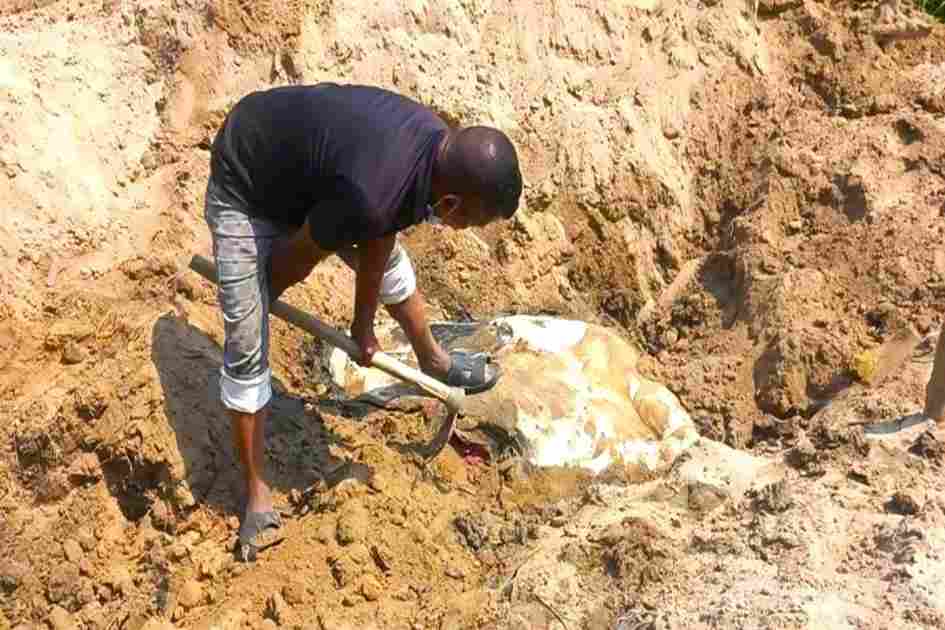



Forest officials in Chakaria unearthed a buried wild elephant, with preliminary evidence pointing to a planned killing amid worsening human-elephant conflict, habitat loss and growing pressure on Bangladesh’s southeastern forests.
Forest officials in southeastern Bangladesh have unearthed the skeleton and decomposed remains of a wild elephant that had been secretly buried in a hilly forest area of Chakaria upazila in what authorities believe was a planned killing.
The shocking discovery was made on Thursday in the Muslimnagar area under Kakara Union after patrol teams from the Forest Department detected a strong foul smell during routine monitoring in the hills.
According to forest officials and local residents, the elephant is believed to have been killed at least a month ago. In an apparent attempt to conceal the crime, the perpetrators buried the carcass inside the forest and constructed a small makeshift hut over the burial site to avoid suspicion.
Forest workers from the Nolbila Beat traced the source of the stench to the suspicious structure. After demolishing the hut, they discovered the buried skeleton and decomposed remains of the elephant beneath the soil.
Later in the day, a veterinary surgeon from Dulahazara Safari Park reached the scene and conducted a post-mortem examination in the presence of local residents, forest officials and law enforcement personnel. Officials from the Fashiakhali Range, Chakaria Police Station and patrol teams from the nearby Faitong police outpost in Lama were also present.

Fashiakhali Range Officer Sadekur Rahman said preliminary evidence suggests that the elephant was deliberately killed.
“Initial evidence suggests the elephant was killed either by gunfire or by a high-voltage electric shock, possibly generated using a machine,” Rahman said.
Forest officials said they suspect the elephant may have been targeted after entering nearby cultivated land and damaging crops on the hill slopes, a recurring source of tension between local communities and wildlife.
A general diary has already been filed against unidentified individuals and preparations are underway to file a formal case once those involved are identified, Rahman added.
The incident has once again highlighted the growing human-elephant conflict in Bangladesh’s southeastern forest belt, where habitat loss, deforestation and agricultural expansion are increasingly forcing wild elephants into villages and farmland.
Conservationists warn that continued encroachment on elephant corridors and forest habitats is intensifying such deadly encounters, raising urgent concerns over wildlife protection and coexistence in one of the country’s most ecologically sensitive regions.




