


Citing field reports and newspaper reviews, DHORA said floods across 17 districts exposed deeper failures in river management, infrastructure planning and protection of natural drainage systems.
Recent floods in Bangladesh are not merely a natural disaster but the combined result of climate change, unplanned development, encroachment on rivers, canals and wetlands, hill cutting and obstruction of natural water flows, Dhoritri Rokhhay Amra, or DHORA, said on Saturday.
The environmental platform called for emergency relief to be accompanied by science-based, environmentally sustainable and long-term planning to address the root causes of flooding.
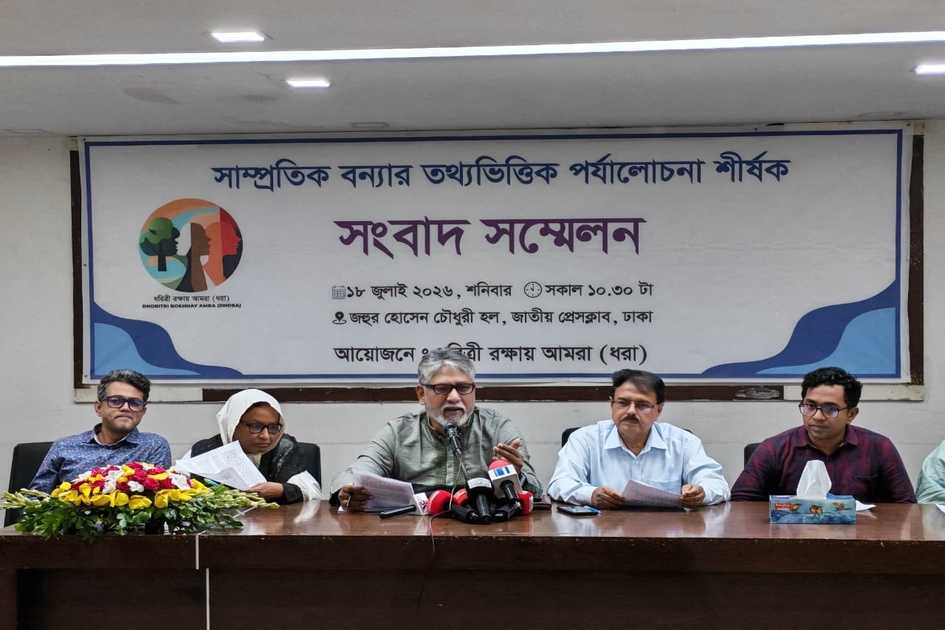
The call came at a press conference titled “A Data-Based Review of the Recent Floods”, held on July 18 at the Zahur Hossain Chowdhury Hall of the National Press Club in Dhaka.
The event was chaired by M. S. Siddiqui, Co-Convener of DHORA. Sharif Jamil, Member Secretary of DHORA, delivered the keynote presentation, while Foysal Ahmed, Editor of River Bangla and a member of DHORA, moderated the session.
In his opening remarks, Siddiqui said the recent floods were not caused solely by natural factors. Their severity had been intensified by unplanned development, the filling of rivers and canals, obstruction of natural water flow and the impacts of climate change, he said.
He said DHORA had prepared a comprehensive review based on field-level information and news reports published in five national daily newspapers between July 6 and July 16.
Siddiqui urged the government to adopt effective and long-term solutions to address flood risks, saying national interests must take precedence over individual or vested interests in flood management.
Presenting the keynote, Jamil said continuous heavy rainfall from July 7 to July 12, combined with upstream hill runoff and abnormal rises in the water levels of transboundary rivers, caused severe flooding and waterlogging across at least 17 districts of Bangladesh.
More than one million people were directly affected, including approximately 600,000 people in the southeastern port district of Chattogram, 158,000 in Cox’s Bazar, 108,000 in the hill district of Rangamati, 83,500 in Bandarban and 136,000 in Kurigram, he said.
Thousands of hectares of agricultural land, fish farms, roads, bridges and other critical infrastructure were also damaged.
Jamil said the disaster was not simply the result of heavy rainfall or hill runoff. Encroachment on rivers, canals and wetlands, declining navigability, unplanned road and infrastructure development, hill cutting, deforestation and climate change had collectively worsened the situation, he said.
He also said a significant share of the floods and waterlogging experienced in the three hill districts, Chattogram and Cox’s Bazar between 2023 and July 2026 could be attributed to the Chattogram-Cox’s Bazar railway project.
Jamil stressed the need for integrated river basin management, modern early warning systems, enhanced transboundary river cooperation, restoration of rivers and canals, climate-resilient infrastructure and rapid rehabilitation of affected communities.
“Flooding is not a new disaster for Bangladesh. However, minimizing losses requires coordinated preparedness from the national to the local level, rapid logistical support, and stronger local capacities are essential as it will further worsen down the path,” said Jafor Siddique, Convener of Haor Rokkhay Amra-DHORA.
Other speakers included Mir Mohammad Ali, Assistant Professor at Sher-e-Bangla Agricultural University and a member of DHORA; Sanjida Rahman, Coordinator of Chunati Rokhhay Amra-DHORA, representing flood-affected communities; Faridul Alam Shahin, a DHORA member from Cox’s Bazar; and Badrun Nahar Koli, a DHORA member from Matamuhuri.
They shared first-hand experiences and field observations from disaster-affected areas and underscored the urgent need for proper management of polders and sluice gates.
DHORA called on the government and relevant authorities to adopt an integrated river basin management approach, restore natural water flows, ensure environmentally sustainable development and formulate long-term flood management strategies that take into account the realities of climate change.
The press conference was attended by DHORA leaders, representatives of environmental movements, researchers, development professionals and journalists from print, electronic and online media.




