

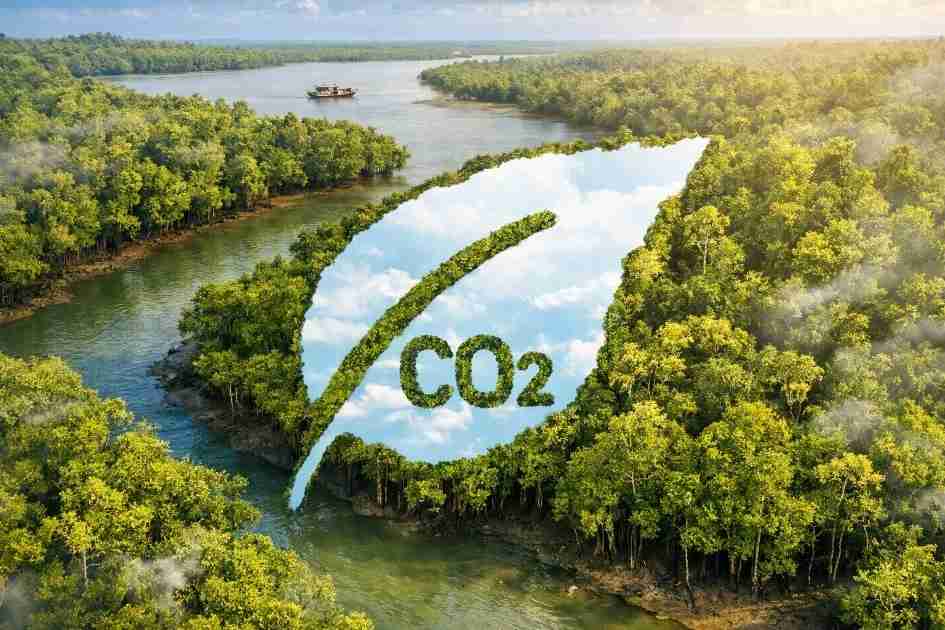



Bangladesh’s push to build a billion-dollar carbon market has triggered debate among environmentalists over governance, climate justice and whether carbon trading can deliver real emissions cuts and equitable climate finance.
A renewed policy discussion around carbon trading has sparked debate within Bangladesh’s environmental community after remarks linked to the policy direction of Tarique Rahman and the Bangladesh Nationalist Party (BNP) indicated plans to generate up to $1 billion from carbon credits in the future.
The proposal, referenced in BNP’s election manifesto, envisions Bangladesh gradually building a carbon market capable of attracting international climate finance by selling verified carbon credits generated through emission reduction and ecosystem protection initiatives. The discussion has triggered mixed reactions among environmentalists, with some welcoming the opportunity for climate financing while others caution about governance risks.
Carbon trading allows countries or organizations to earn credits for reducing greenhouse gas emissions. These credits can then be sold in international markets to entities seeking to offset their own emissions. Experts note that although the system has faced criticism globally, the regulatory framework around carbon markets has been evolving, allowing emissions reductions to be tracked with greater accuracy.
Government’s position
Bangladesh is preparing to enter the rapidly growing global carbon market as the government explores carbon trading as a new source of climate finance. Analysts estimate the emerging market could generate more than $1 billion annually while supporting the country’s transition toward low-carbon development.
Following the 12 February national election, the new government led by the Bangladesh Nationalist Party has placed growing emphasis on carbon trading as part of its broader economic strategy. After a 4 March meeting between Prime Minister Tarique Rahman and senior officials of the Ministry of Environment, Forest and Climate Change, government representatives said carbon trading could become one of the country’s major future revenue sources.
State Minister for Environment, Forest and Climate Change Shaikh Faridul Islam said the government intends to link climate action with economic opportunity.
“Carbon markets can help Bangladesh turn climate action into economic opportunity,” he said. “Our goal is to build a transparent system that attracts international investment while protecting our environment.”
He noted that while the ready-made garment sector currently dominates Bangladesh’s export economy, carbon trading could emerge as another important pillar by connecting environmental protection with international climate finance.
If implemented transparently and with strong safeguards, analysts say carbon markets could help Bangladesh move beyond traditional donor-based climate finance toward a more sustainable and investment-driven model while ensuring benefits for both people and the planet.
Global carbon markets evolving
Bangladesh’s policy push comes as global carbon markets enter a new phase. On 26 February, the United Nations approved the first carbon credits under a mechanism created by the Paris Agreement, marking a major step toward establishing an international system where countries and companies can trade verified emissions reductions.
The UN-run Paris Agreement Crediting Mechanism allows governments and corporations that exceed emissions limits to offset them by financing projects that reduce greenhouse gases in other countries. Supporters argue such markets can channel billions of dollars into climate mitigation projects in developing economies, while critics warn that poorly regulated systems may allow major polluters to continue emitting while claiming environmental progress.
The first credits under the new system came from a project in Myanmar distributing improved wood-burning cookstoves. The stoves use biomass more efficiently, reducing fuel consumption, household air pollution and pressure on forests.
Jacqui Ruesga, vice chair of the UN body supervising the mechanism, said the initiative aims to build confidence in the global carbon market.
“Our focus is on building confidence in this market from the outset, and this first issuance shows that the system is working as intended,” she said.
Simon Stiell, executive secretary of the UN Framework Convention on Climate Change, highlighted the social and environmental benefits of clean cooking initiatives.
“Clean cooking protects health, saves forests, cuts emissions and helps empower women and girls who are typically hardest hit by household air pollution,” he said.
Bangladesh building its carbon market framework
Bangladesh is working to establish its own carbon credit framework in line with Article 6 of the Paris Agreement. The government is developing a national carbon registry to track and verify emissions reductions and prevent double counting, with support from the World Bank’s Partnership for Market Implementation.
The registry will allow Bangladesh to issue and trade carbon credits in both voluntary and compliance markets while ensuring transparency and international credibility. Bangladesh already has some experience in the sector. Infrastructure Development Company Limited has previously sold more than 2.5 million carbon credits through renewable energy and clean cooking initiatives.
According to the country’s updated climate commitments, national greenhouse gas emissions could reach more than 418 million tonnes by 2035. Under its Nationally Determined Contribution, Bangladesh has pledged to reduce emissions by 6.39 percent unconditionally and up to 20 percent with international support. Officials believe carbon trading could contribute to 40 to 50 percent of emission reductions.
Investment opportunities emerging
The government has identified priority sectors for carbon credit projects, including renewable energy, forestry, land restoration, waste-to-energy, sustainable agriculture and green mobility initiatives such as electric vehicles and improved public transport. Coastal afforestation programmes are expected to create 116,000 hectares of new land over the next five years, offering significant opportunities for carbon sequestration.
International investors have already expressed interest. Companies from Australia, Japan and South Korea are exploring projects in forestry, agriculture and clean energy. Japanese firms Mitsui & Co. and Sumitomo Corporation are studying methane reduction from gas infrastructure and improved agricultural water management. Australian companies have reportedly indicated potential investments of up to $75 million.
Experts say strong governance will be essential for ensuring credibility in the emerging market.
Keisuke Iyadomi, senior climate change specialist at the World Bank, said, “Carbon pricing can both reduce emissions and generate revenue,” noting that more than 80 jurisdictions worldwide have already adopted such mechanisms.
However, weak monitoring and verification systems could undermine the credibility of carbon projects if reductions are not accurately tracked.
Debate among environmental community
The growing emphasis on carbon trading has sparked important conversations and some controversy among Bangladesh’s environmental community. Advocates say that while the system has limitations, regulations are gradually improving. Advances in monitoring technology mean emissions reductions can now be tracked with increasing accuracy.
When properly designed, carbon projects deliver two critical benefits: providing incentives for local communities to protect ecosystems while ensuring real and measurable reductions in greenhouse gas emissions.
Supporters argue that high-quality projects should operate within an ethical and humanitarian framework that respects both people and nature. Well-designed initiatives can generate local income, strengthen environmental stewardship and encourage long-term conservation.
At the same time, global experience has revealed cases where project developers exaggerated impacts or used inflated baselines. Analysts emphasize that these issues reflect flawed implementation, not the concept of carbon trading itself.
Sohanur Rahman, executive coordinator of YouthNet Global, said, “Carbon markets must prioritize climate justice. Projects should protect indigenous land rights and ensure local communities are part of decision-making. Bangladesh now has an opportunity to become a credible player in the global carbon market while ensuring climate solutions are equitable, participatory and sustainable.”
Expert perspectives
Dr Sakib Bin Amin, professor of economics at North South University, cautioned, “Without strong institutions, governance and public awareness, a carbon market cannot function efficiently. Policy design must address existing market distortions, and starting with the fossil fuel sector and renewable energy investment can build early momentum.”
Mr Tanul Chakraborty of Ha-Meem Group said, “A clear and consistent carbon credit policy along with robust monitoring systems is needed to make corporate emission trading viable.”
Mr Shafiqul Alam of IEEFA added, “A carbon tax may suit Bangladesh better than an emissions trading scheme, given its industrial structure. Pilot projects in high-emission sectors like brick kilns are essential alongside transparent carbon revenue management.”
Mr Shashish Shami Kamal of BUP said, “Bangladesh has significant potential for blue carbon credits through mangrove restoration in the Sundarbans along with feed-in tariffs and technology transfer partnerships to encourage green industry growth.”
Ms Aparna Sharma of CEEW, India, said, “Flexibility, transparency and robust MRV systems are key. Bangladesh could follow a similar path to India by linking its carbon pricing strategy with national development goals.”
Mr Alomgir Morshed, CEO of IDCOL, concluded, “Without a unified framework we risk missing major global opportunities. Dialogue, branding and stakeholder alignment are essential to make Bangladesh a credible climate leader.”
The new government is now finalizing the carbon market framework, building on public consultation conducted under the interim administration. Officials say the final framework will integrate transparency, strong safeguards and ethical principles to ensure climate finance delivers tangible benefits for both people and the planet.
“Bangladesh now has the opportunity to become a credible player in the global carbon market while ensuring climate solutions are equitable, participatory and sustainable,” concluded Sohanur Rahman.




