

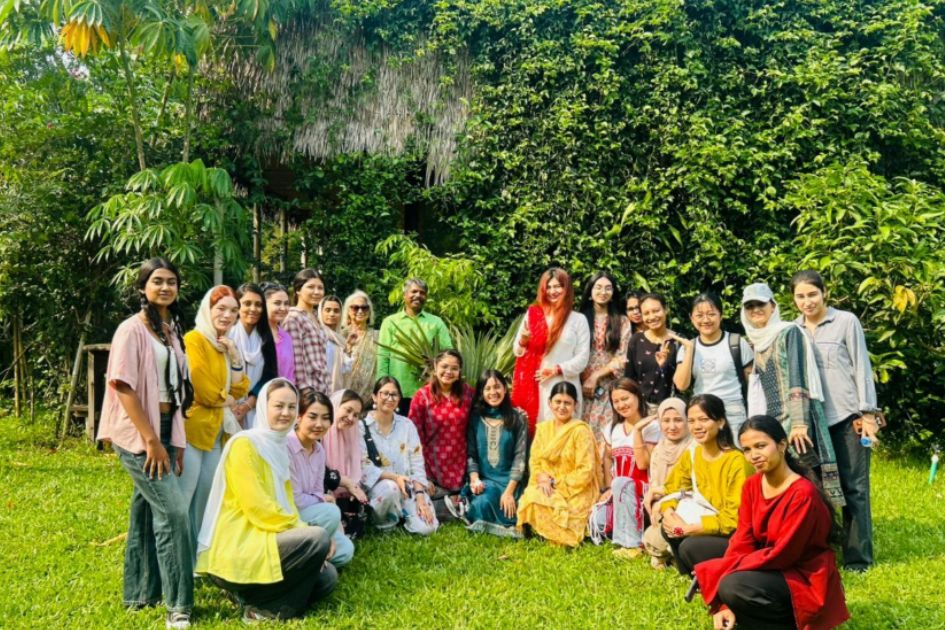



A quiet Boishakh celebration at Shonapahar highlights ecological restoration, cultural heritage, and sustainable living, transforming a former brick kiln into a thriving green sanctuary in Mirsharai.
A once-polluted industrial site in Mirsharai has been transformed into a thriving ecological sanctuary where this year’s Bengali New Year was celebrated with a focus on sustainability, culture and global harmony.
At Shonapahar Eco Resort, the Boishakh 1433 festival unfolded in a setting far removed from the noise and crowds that typically define celebrations across Bangladesh. The six-acre site, once marked by brick kiln smoke and excavated pits, now echoed with birdsong and the soft strains of the traditional two-stringed dotara.
Organisers opted for a smaller, intimate gathering to preserve the resort’s guiding principles of environmental protection and harmony with nature. Visitors experienced a quieter celebration that emphasised cultural authenticity over spectacle.
Students from the Asian University for Women joined the festivities, contributing to a diverse cultural exchange. One student from Nepal performed a song in her native language to welcome the New Year, reflecting a blend of global and local traditions.
Food offerings highlighted Bangladeshi heritage, with breakfast including gurer khoi and murir moa. Lunch featured panta bhat accompanied by fried eggplant, dried loitta fish, mango curry and other traditional dishes.
The festival grounds also hosted small village-style stalls displaying locally grown vegetables such as purple cabbage and sweet potatoes, alongside handmade soaps and traditional accessories. In one corner, women gathered for alta and mehendi applications.
Environmental considerations shaped every aspect of the event. Organisers enforced strict no-litter policies and promoted local produce to minimise the ecological footprint.
Shonapahar’s transformation follows years of environmental degradation when the land functioned as a brick kiln, later serving as a poultry farm and industrial warehouse. Deep pits and deforestation had left the area barren.
The initiative to restore the site was led by founder Md. Amzad Hossain, who was troubled by pollution along nearby highways. Working with architect Rizvi Hasan and team members Delowar Jahan, Shaon Siraj, Shamim Sheik and Paulak Paul, he sought to create a carbon-offsetting green space.
The restoration relied on the Miyawaki method, developed by Japanese botanist Akira Miyawaki. Using this approach, the team cultivated a dense forest of 254 tree species, which grows significantly faster and absorbs far more carbon dioxide than conventional forests.
Today, the landscape includes rare medicinal plants such as ashwagandha, stevia, karipata and mahua, as well as flowering trees like raktapalash and krishnachura. Former excavation pits have been converted into four clear lakes spanning nearly two acres, forming the centrepiece of the ecosystem.
Sustainability extends to the resort’s architecture. Structures are built with bamboo and hogla leaves, while wooden pathways use reclaimed ship materials. Designers avoided cutting trees and minimised concrete use, incorporating large windows and open balconies to maximise natural light and airflow.
Despite its appeal, Shonapahar’s founders say the project is not driven by tourism. Instead, they prioritise farming and environmental sustainability to maintain their long-term vision.
Their goal is to inspire visitors to adopt similar carbon-neutral practices in their own communities. Organisers say the site demonstrates that with time and care, degraded land can recover and flourish, offering a model for environmentally conscious celebrations of tradition.




