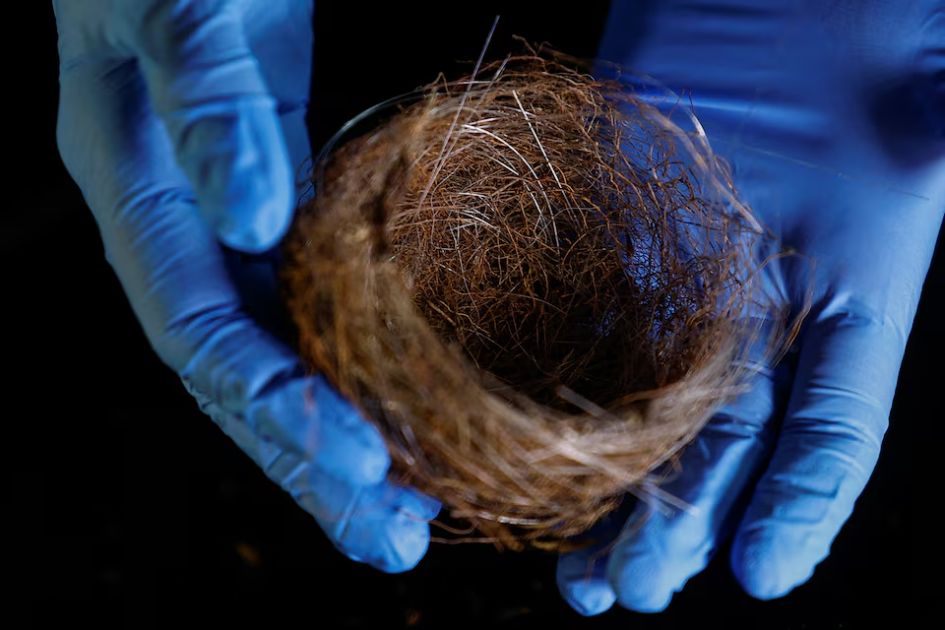


Bird nests woven with fibre-optic cables reveal Ukraine war impact

spot_imgspot_imgspot_imgspot_img

Fibre-optic lines used to guide battlefield drones are finding an unexpected second life in bird nests, offering researchers evidence of war’s changing environmental footprint.

A small bird’s nest woven from fibre-optic cable and grass near the front line in Ukraine is offering researchers an unusual glimpse of how the more than four-year-old conflict is reshaping the natural environment.

Ultra-thin fibre-optic cables now cover areas along the 1,200-km (746-mile) front line, where Ukrainian and Russian troops use them to guide aerial attack drones and make the aircraft impervious to electronic jamming.

The cables can stretch for 20 km and are left tangled in trees, scattered across fields and draped over rooftops in Ukraine’s frontline regions, where they glisten in the sunlight like giant spider webs.

Birds have begun using the discarded cables to build their nests, according to Yana Hrynko, a senior researcher at Kyiv’s War Museum, who cautiously examined two delicate nests sent to the museum from the front line by the armed forces.

“Objects such as bird nests with fragments of optic fibre demonstrate the change in the nature of war,” Hrynko said.

Russia invaded Ukraine in February 2022 with tanks, armoured vehicles and artillery. Seeking to counter Russia’s advantage in such conventional equipment, Ukraine has poured resources into developing aerial drones, which now dominate the battlefield.

Researchers do not yet know which bird species built the nests or how they managed to collect the long cables, Hrynko said.
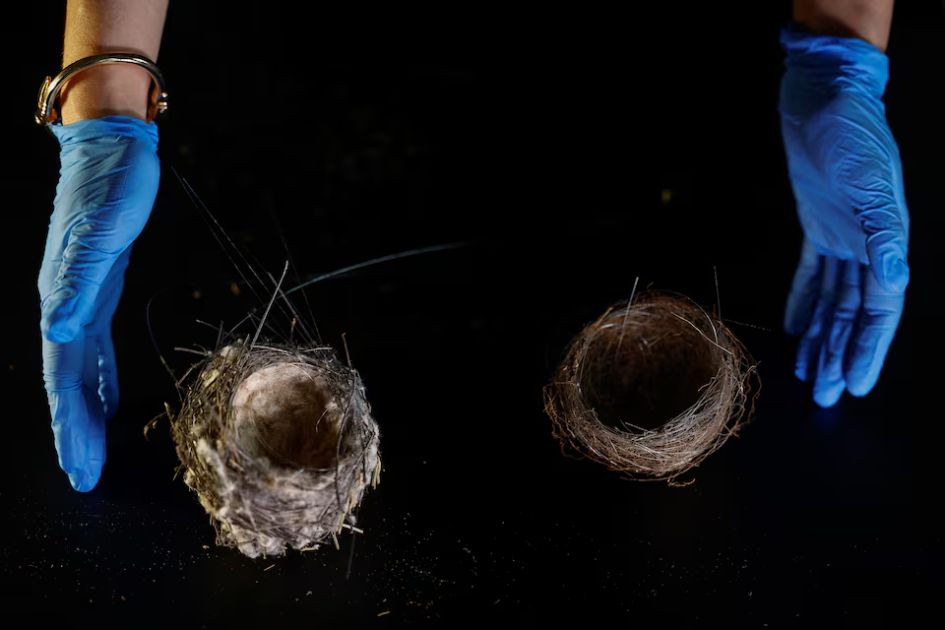
Bird nests woven with fibre-optic cables reveal Ukraine war impact
Yana Hrynko, senior researcher of The National Museum of the History of Ukraine in the Second World War, shows bird’s nests made with fragments of optic fibre which were found by a Ukrainian serviceman on the front line and then passed to the museum, amid Russia’s attack on Ukraine, in Kyiv, Ukraine June 23, 2026. Both Ukrainian and Russian troops use drones controlled via optic fibre to bypass…

“The first nest mainly contains dry grass and fibre-optic cable. And it’s pretty tightly twisted,” she said.

Several Ukrainian servicemen in the frontline regions of Donetsk, Kharkiv and Zaporizhzhia have also found such nests and posted photographs and videos of them online.

One of the two nests will remain in Kyiv as part of the War Museum’s war collection, while the other will be sent to the Netherlands for study before being returned, researchers said.
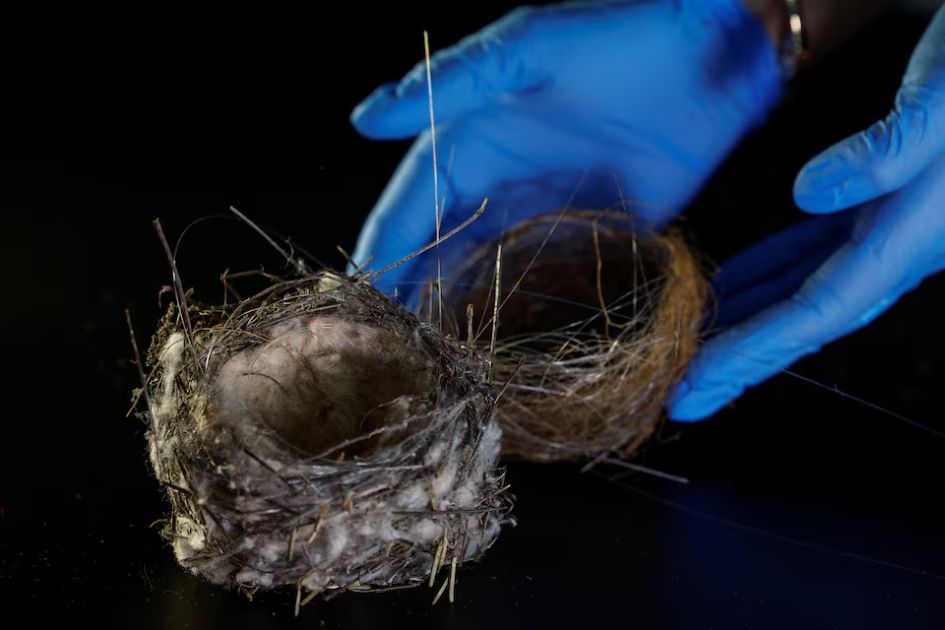
Bird nests woven with fibre-optic cables reveal Ukraine war impact
Yana Hrynko, senior researcher of The National Museum of the History of Ukraine in the Second World War, shows bird’s nests made with fragments of optic fibre which were found by a Ukrainian serviceman on the front line and then passed to the museum, amid Russia’s attack on Ukraine, in Kyiv, Ukraine June 23, 2026. Both Ukrainian and Russian troops use drones controlled via optic fibre to bypass…

Auke-Florian Hiemstra, a 33-year-old biologist based in the Dutch city of Leiden who specialises in artificial nest materials, said Ukraine’s rich avian biodiversity meant many species could have constructed the nests.

“We’re going to look for DNA traces still in a nest to determine who actually made the nest,” Hiemstra said. “I have never seen nests like this before – and I have seen many, many bird nests.”
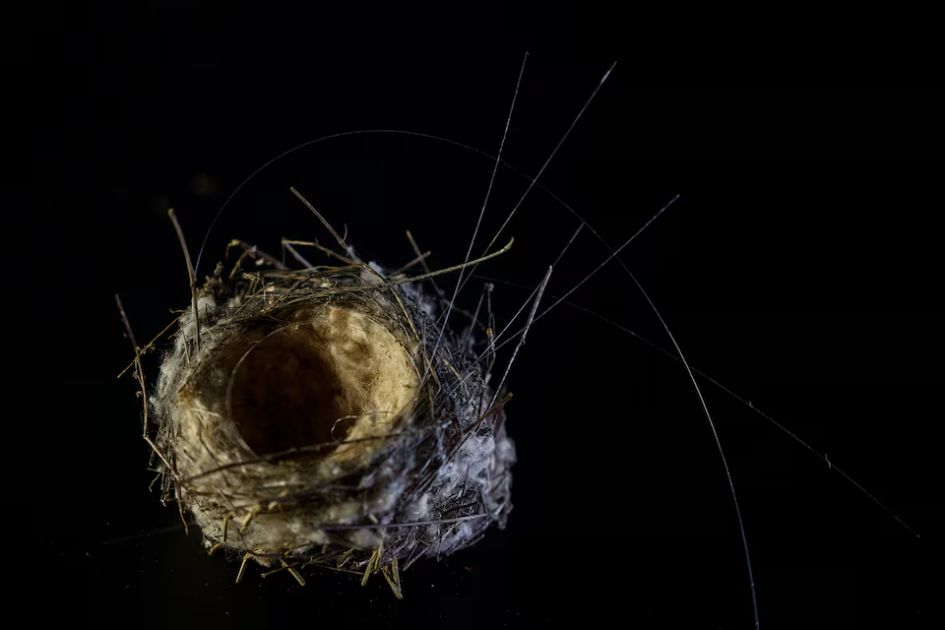
Bird nests woven with fibre-optic cables reveal Ukraine war impact
A bird’s nest made with fragments of optic fibre which was found by a Ukrainian serviceman on the front line and then passed to The National Museum of the History of Ukraine in the Second World War, lies on a table in a museum, amid Russia’s attack on Ukraine, in Kyiv, Ukraine June 23, 2026. Both Ukrainian and Russian troops use drones controlled via optic fibre to bypass electronic warfare…

The effect of fibre-optic cable on birds could be mixed, Hiemstra said. Birds could be harmed if they become entangled in the material, but the cables could also help them construct stronger nests.

“And by documenting this nest, we’re also documenting the impact of war on nature in Ukraine,” Hiemstra said.

This post is republished from Reuters.

Latest News

Barishal’s Manta community calls for services and social protection

Climate pressures and institutional barriers are deepening livelihood insecurity...

Barishal’s Tk 647.5 crore budget puts climate adaptation in spotlight

From canal restoration and flood protection to safe water...

Green Coalition workshop in Netrakona focuses on sustainable farming

Farmers, environmental activists and community representatives explored local challenges...

Bangladesh discusses integrating non-economic climate losses into policy

Researchers, policymakers and development partners called for stronger evidence,...

Bangladesh’s Green-Finance Paradox: Why Banks Prefer Efficiency to Renewables

Bangladesh’s green-finance portfolio has expanded rapidly, but lending patterns...
spot_img
spot_img

Editor's Choice

Bangladesh’s wind power push stalls amid fossil fuel dependence and grid failures

“Catching the Wind: Why Bangladesh Still Fails to Harness...

The Climate Watch part of EJN project wins SOPA 2026 environment reporting award

The recognition marks another international milestone for The Climate...

The Climate Watch among 14 Asian newsrooms recognised in 2026 Osborn Elliott Prize citation

The Climate Watch has been internationally recognised through a...

Germany to give 52.5m euros to Bangladesh for climate change adaptation

Germany will provide Euro 52.5 million to Bangladesh for...
spot_img

Related Articles

Popular Topics
