

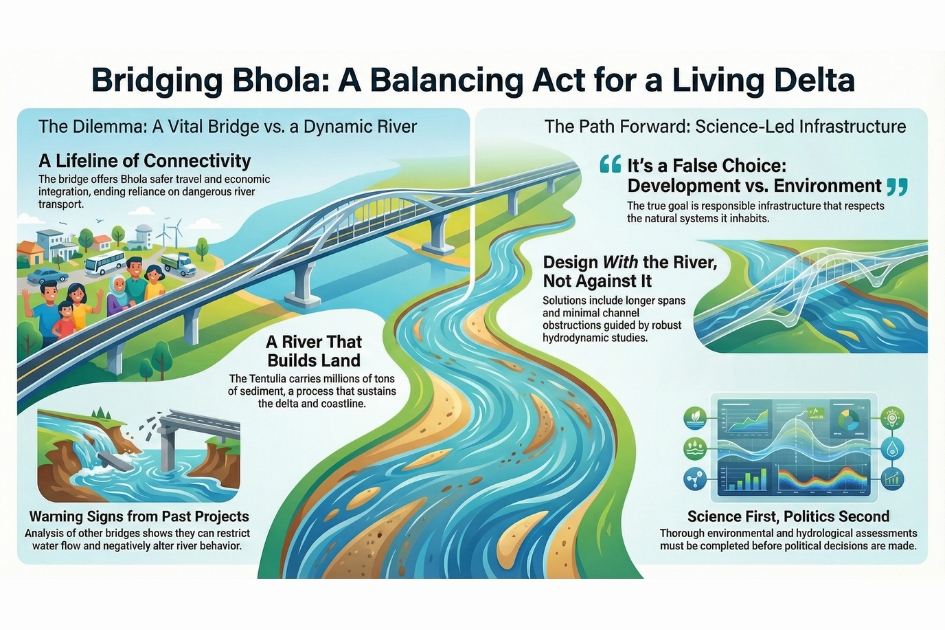



Bhola residents seek safer connectivity to Barishal, yet experts warn a Tentulia River bridge may alter sediment transport, fisheries, and delta ecology, demanding science-led infrastructure planning.
A very recent news report shows that people from the Bhola district are raising concerns about constructing a bridge from Bhola to Barishal. For decades, the people of Bhola have depended almost entirely on engine-driven water transport across wide and often turbulent rivers, facing dangerous crossings, particularly during the monsoon season. From a development perspective, a bridge promises more efficient movement, economic expansion and stronger social integration not only for Bhola but also for the wider coastal region.
However, recognizing this demand does not mean ignoring ecological reality. The proposed bridge would cross the Tentulia River, a major distributary of the Meghna River system. Though often referred to broadly as the Meghna, the Tentulia is an integral part of the lower Ganges-Brahmaputra-Meghna delta. It carries a substantial share of sediment flowing toward the Bay of Bengal. This is not a static river; it is one of the most sediment-active river corridors in the world.
Studies show that the Ganges-Brahmaputra-Meghna system transports hundreds of millions of tonnes of sediment annually, much of which is deposited in the lower Meghna estuary through monsoon-driven floods and intense tidal action. This sediment movement is not a problem to be solved; it is the very process that sustains delta formation, supports fisheries and stabilizes Bangladesh’s fragile coastline. Any permanent structure introduced into such a dynamic system can alter flow velocity, sediment transport and channel behaviour.
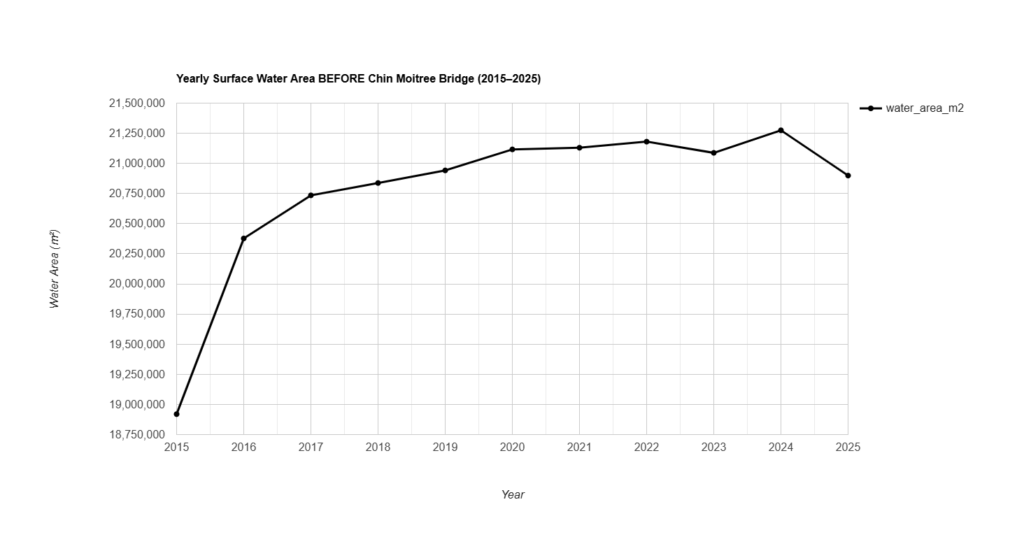
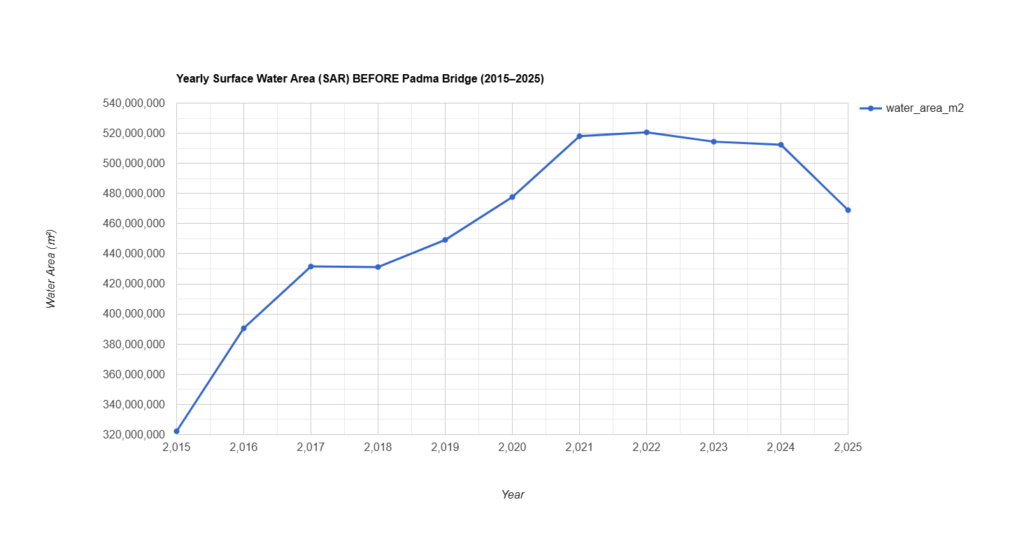
Recent bridge projects in Bangladesh offer important lessons. For writing this article, a satellite-based analysis (Sentinel-1 and Sentinel-2 using the Google Earth Engine platform) of the Padma Bridge and the Chin Moitree Bridge in Pirojpur was conducted, which reveals a comparable pattern. Before construction, both river systems exhibited substantial seasonal variability and greater surface water extent, reflecting natural hydrological dynamics.
The satellite data shown in the given graphs represent that the surface water area went down noticeably when the bridges started operating. This likely reflects some restriction in flow and a build-up of sediment around the structures. While this does not mean the river system has collapsed, it does show that bridges can change how the river behaves and that these changes can last.
This makes the proposed Bhola-Barishal bridge particularly sensitive. The Tentulia-Meghna distributary system supports hilsa migration routes, freshwater exchange with the estuary, fisheries-based livelihoods and natural land-building processes. Any disruption to these functions could carry long-term ecological and economic consequences, affecting biodiversity, fish stocks and river-dependent communities well beyond Bhola itself.
The debate, therefore, should not be framed as development versus environment. That is a false choice. The real demand should be for responsible, science-led infrastructure. If a bridge is to be constructed, its design needs to work with the river rather than against it, keeping obstructions within the channel to a minimum, using longer spans where possible, and being guided by solid hydrodynamic and sediment-transport studies rather than sheer engineering convenience.
Environmental and hydrological assessments should come before political decisions, not be treated as an afterthought.
The people of Bhola have every right to safe and dependable connectivity. At the same time, they deserve a future where the river system that supports their lives and livelihoods is not gradually undermined. Development that overlooks how rivers function is not real progress; it simply shifts the risk into the future.




