


From delayed implementation of a Madhupur forest ruling to fresh scrutiny of Chakaria mangroves, campaigners say meaningful conservation depends on enforcing laws and putting affected communities at the centre.
BELA highlights landmark Madhupur and Chakaria cases as environmental defenders from Bangladesh and Armenia call for stronger community rights, effective enforcement and gender-just conservation.
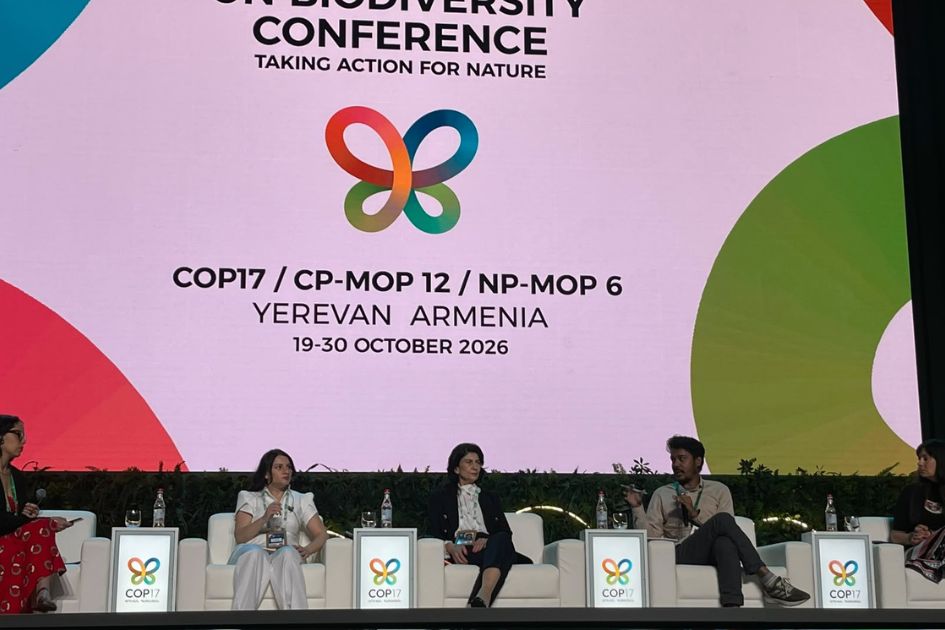
Bangladesh’s legal battles to protect endangered forests and Indigenous communities drew international attention at a civil society side event held alongside the UN Biodiversity Conference (COP17) on Monday morning, as environmental defenders from Bangladesh and Armenia called for stronger legal safeguards, community rights and accountability for ecological destruction.
The discussion highlighted a common challenge facing both countries: protecting biodiversity requires more than conservation pledges and court rulings. It demands effective enforcement, recognition of community rights and action against environmentally destructive activities.
The event, titled “From False Solutions to Transformative Change: Defending Territories, Protecting Forests, Advancing Justice,” took place on the Main Stage of the COP17 Green Zone in Yerevan. It was a civil society-led discussion held alongside the global biodiversity summit, separate from the formal intergovernmental negotiations.
Jointly organised by the Global Forest Coalition (GFC), Bangladesh Environmental Lawyers Association (BELA) and Armenian Forests NGO, the session brought together environmental advocates to examine how legal action and community-led conservation can address biodiversity loss while safeguarding human rights.
The discussion featured Rysul Hasan of BELA, Nazeli Vardanyan of Armenian Forests and Tehmine Yenokyan of Green Armenia. Valentina Figuera Martínez of the Global Forest Coalition moderated the session and presented preliminary findings from its Gender-Just Real Solutions Map.
Bangladesh’s legal battles to save forests
Representing Bangladesh, BELA’s Rysul Hasan highlighted how public interest litigation has helped defend threatened ecosystems and the rights of Indigenous Peoples and forest-dependent communities.
He presented two significant cases involving the Madhupur Sal Forest and the Chakaria Sundarbans, illustrating both the potential of environmental litigation and the difficulties of translating court decisions into effective conservation.
In 2010, BELA, alongside Indigenous organisations including Joyenshahi Adivashi Unnayan Parishad and Jatiya Adibashi Parishad, filed Writ Petition No. 1834/2010 seeking protection of the Madhupur Sal Forest and recognition of the rights of the Garo and Koch communities.
After nine years of legal proceedings, Bangladesh’s High Court delivered a landmark judgment on August 28, 2019, directing the formation of a high-powered committee to prepare a long-term conservation plan, demarcate forest boundaries and ensure community participation in forest protection.
The judgment recognised the Garo and Koch communities as Indigenous inhabitants of the forest and affirmed their lawful settlement and custodial rights.
However, implementation remained largely stalled for more than five years. The mandated conservation committee was established only in late 2024, with Indigenous representatives and BELA included.
According to a case study published by the Global Forest Coalition and authored by BELA representatives, surveys have since begun, alongside commitments to halt harmful plantations and initiate ecological restoration. Nevertheless, commercial cultivation, land disputes and continuing pressure on forest resources remain serious challenges. ([Global Forest Coalition][2])
The Madhupur case illustrates how even landmark judicial decisions can fail to deliver meaningful environmental protection when implementation is delayed and Indigenous communities remain exposed to land disputes and commercial exploitation.
Hasan also highlighted BELA’s recent legal intervention concerning the Chakaria Sundarbans, a severely degraded coastal mangrove ecosystem in Bangladesh’s Cox’s Bazar district.
In July 2026, BELA filed a writ petition challenging the authorities’ failure to protect and restore approximately 21,020 acres of reserved and protected forestland.
On July 19, the High Court issued a rule seeking explanations from the government over its failure to restore the forest and the legality of notifications removing protected status from parts of the area.
The petition also sought directions to cancel unlawful land allocations, remove unauthorised occupants and restore the degraded mangrove ecosystem.
The court’s intervention initiated further legal scrutiny rather than constituting a final restoration judgment. ([The Daily Star][3])
Together, the cases demonstrate that legal recognition alone cannot safeguard ecosystems without effective enforcement, ecological restoration and meaningful participation by affected communities.
The Bangladesh presentation also drew attention to community-led ecosystem restoration under the Blue Economy for Inclusive Development and Climate Justice (BID4CJ) project.
Supported by the Australian Government through the Australian NGO Cooperation Program, the initiative brings together Oxfam and local partners, including Breaking the Silence (BTS) and Community Development Centre (CODEC), to promote ecosystem restoration, sustainable livelihoods and inclusive natural resource governance.
The presentation highlighted the role of 30 community-based organisations (CBOs) in advancing locally driven restoration efforts, demonstrating how community participation can complement legal advocacy and environmental protection.
Armenian defenders challenge mining expansion
The discussion also connected Bangladesh’s environmental struggles with concerns surrounding extractive industries in Armenia, particularly the controversial Amulsar gold mining project.
Nazeli Vardanyan of Armenian Forests addressed biodiversity protection and human rights in mining-affected communities, while Tehmine Yenokyan of Green Armenia discussed local resistance to extractive activities and concerns about potential threats to ecosystems, water resources and livelihoods.
Their interventions came just nine days after Armenia officially launched operations at the Amulsar gold mine on October 10, following years of delays and environmental opposition.
Prime Minister Nikol Pashinyan attended the inauguration ceremony in the Vayots Dzor region, describing the project as an economic achievement expected to generate employment, investment and national revenue.
The Armenian government maintains that environmental concerns have been addressed and that the mining project will contribute to economic development under modern environmental and social safeguards.
Environmental organisations, however, have challenged those assurances, arguing that longstanding concerns about biodiversity, water resources and potential ecological damage remain unresolved.
In a statement issued on October 12, Armenian civil society organisations criticised the commencement of mining operations, questioning whether adequate environmental and social safeguards were in place.
The controversy has renewed debate over how governments balance economic development with environmental protection, particularly when major extractive projects affect ecologically sensitive areas and local communities.
Speakers also examined Target 3 of the Kunming-Montreal Global Biodiversity Framework, which calls for at least 30 percent of terrestrial and inland water areas, and marine and coastal areas, to be effectively conserved and managed by 2030.
The target also emphasises equitable governance and recognition of the rights of Indigenous Peoples and local communities.
The discussion highlighted the importance of ensuring that conservation policies protect both biodiversity and the people whose livelihoods depend on natural ecosystems.
Community-led conservation offers an alternative
Beyond litigation and resistance to environmentally destructive projects, the side event explored how grassroots initiatives can offer more equitable approaches to biodiversity conservation.
Moderating the discussion, Valentina Figuera Martínez of the Global Forest Coalition presented preliminary findings from the emerging Gender-Just Real Solutions Map.
Developed collaboratively with grassroots organisations across the Global South, the initiative documents community-led approaches to forest protection, traditional knowledge, territorial rights and women’s leadership.
BELA is among the organisations contributing to the initiative, which examines how access to land, control over natural resources, unpaid care responsibilities and participation in decision-making influence gender equality and environmental outcomes.
Expected to launch in November 2026, the map seeks to demonstrate how community governance and women’s leadership can contribute to lasting ecosystem protection while addressing the inequalities that often undermine conservation efforts.
Participants also raised concerns about approaches they described as “false solutions”, including biodiversity offsets, credits and other market-based conservation mechanisms.
The Global Forest Coalition argues that such approaches risk commodifying nature while failing to address the underlying drivers of biodiversity destruction, including unsustainable resource extraction and unequal control over land.
Instead, the discussion emphasised rights-based conservation, stronger environmental accountability and greater recognition of Indigenous Peoples, women and frontline communities as essential actors in protecting biodiversity.
The experiences shared by environmental defenders from Bangladesh and Armenia demonstrated how community-led conservation, environmental litigation and grassroots advocacy can reinforce one another.
Turning conservation commitments into action
The civil society side event took place as governments, Indigenous representatives, environmental organisations and other stakeholders gathered in Yerevan for the UN Biodiversity Conference, running from October 19 to 30.
While the Green Zone discussion did not form part of the formal negotiations, its themes reflected wider concerns about the implementation of international biodiversity commitments.
COP17 marks the first global review of collective progress under the Kunming-Montreal Global Biodiversity Framework, adopted in 2022 with 23 targets aimed at halting and reversing biodiversity loss by 2030.
With only four years remaining until the deadline, the experiences shared by campaigners from Bangladesh and Armenia offer a reminder that conservation commitments must translate into tangible protection for ecosystems and the communities that depend on them.
The challenges highlighted at the side event extend beyond the two countries, reflecting wider tensions between economic development, environmental governance and the rights of communities living closest to threatened ecosystems.
For environmental defenders, the central challenge is not simply securing stronger international promises, but ensuring that existing laws, judicial decisions and conservation targets deliver measurable results on the ground.