

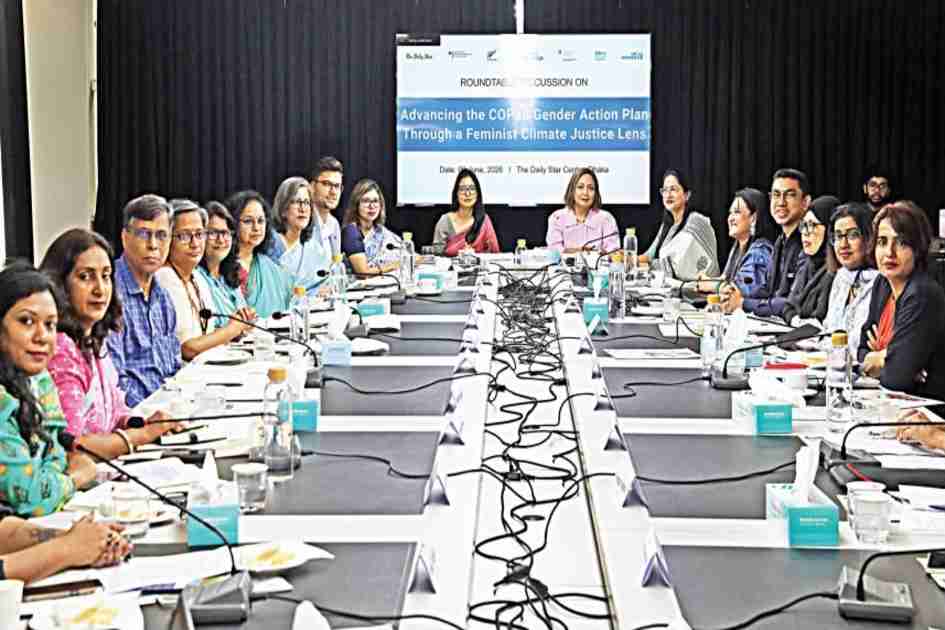

Experts say Bangladesh must close financing, data and accountability gaps to ensure women and marginalised communities shape climate decisions as countries prepare for COP31 negotiations in Antalya, Türkiye.
Bangladesh has made steady progress in integrating gender considerations into its climate policy frameworks. However, experts and development partners have warned that weak implementation, fragmented coordination, limited financing and inadequate data continue to exclude women and marginalised communities from climate decision-making processes that directly affect their lives.
The concerns were raised at a roundtable titled “Advancing the COP30 Gender Action Plan through a Feminist Climate Justice Lens”, jointly organised by UN Women Bangladesh and The Daily Star at The Daily Star Centre in Dhaka.
Speakers said that while Bangladesh’s Nationally Determined Contributions (NDCs), National Adaptation Plan (NAP) and Climate Change and Gender Action Plan (CCGAP) formally recognise gender equality and women’s vulnerabilities, these commitments have yet to translate into consistent and accountable action on the ground.
Delivering the keynote address, Kazi Rabeya Ame, Programme Analyst for Gender and Climate Change at UN Women Bangladesh, said climate change is inherently not gender-neutral as women and girls face disproportionate impacts because of unequal access to resources, land, technology and decision-making power.
She highlighted Bangladesh’s escalating climate vulnerability, citing floods, cyclones, river erosion, salinity intrusion and drought. Women in coastal and salinity-affected areas in the south, particularly those engaged in shrimp cultivation, face heightened health risks from prolonged exposure to saline water, reflecting deeper structural inequalities in access to livelihoods and resources.
Citing gender-related data, she noted that women’s labour force participation remains around 36 percent compared with 80.4 percent for men, while the lower secondary school completion rate for girls stands at 84.7 percent.
“This is a point of discussion which we should take forward,” she said.
She stressed that feminist climate justice must be grounded in recognition of inequality, redistribution of resources and climate finance, representation and accountability.
Navanita Sinha, Deputy Representative of UN Women Bangladesh, said Bangladesh’s climate frameworks recognise structural inequalities, including women’s unequal access to land and the links between climate shocks, gender-based violence, child marriage and trafficking. However, she stressed that implementation and accountability remain the critical gaps.
Participants said that despite strong policy frameworks, the main challenge lies in translating them into coordinated and measurable action across institutions, with fragmented governance slowing progress.
A major concern raised during the discussion was the persistent financing gap. Shamim Banu Shanti, Deputy Secretary at the Finance Division, said Bangladesh faces an estimated annual shortfall of $20.1 billion to implement its NAP and NDC commitments, while more than 70 percent of climate finance is currently mobilised domestically.
Experts said this financing gap lies at the heart of implementation failures, as underfunding disproportionately affects community-level adaptation programmes where women are most actively engaged.
Farah Kabir, Country Director of ActionAid Bangladesh, said gender justice remains marginal in global climate negotiations and financing systems. She stressed that loss and damage financing must be central to any feminist climate justice framework.
Representatives from Manusher Jonno Foundation, BRAC, FAO Bangladesh and UNFPA Bangladesh also said that despite strong policy instruments, structural, political and financial barriers continue to constrain transformative change.
Development partners from the Embassy of Switzerland in Bangladesh, the German Embassy Dhaka and the Embassy of Sweden in Bangladesh called for stronger localisation of climate finance, systemic reform of funding mechanisms and the integration of gender-transformative indicators into climate, infrastructure and energy investments.
Nayoka Martinez Bäckström, Deputy Head of Development Cooperation at the Embassy of Sweden in Bangladesh, said women’s climate initiatives are often difficult to finance because they are too small, too complex or do not fit traditional funding models. She added that Bangladesh should influence climate investment pipelines linked to the NAP and NDC so that gender-transformative indicators are embedded in project design.
Experts further stressed that despite comprehensive gender-responsive policies, the key challenge remains the lack of accountability mechanisms, coordinated implementation and sustained financing needed to deliver measurable impact.
The discussions come as countries continue to grapple with unfulfilled promises from COP30, while preparations are already underway for COP31 in Antalya, Türkiye, where climate finance, implementation gaps and gender justice are expected to remain central agenda items.
Closing the discussion, participants called for stronger collaboration among the government, development partners, civil society, academia and the private sector to ensure that feminist climate justice principles are embedded not only in policy design but also in budgeting, implementation and monitoring, moving from COP30 commitments toward COP31 negotiations and beyond.




