

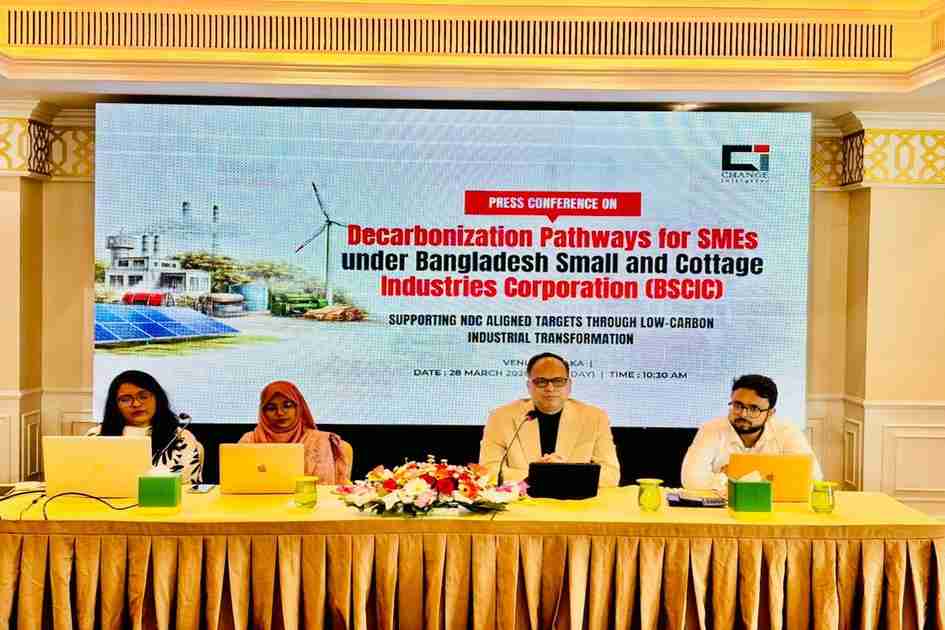

A new study finds renewable energy in BSCIC estates could cut emissions, lower SME costs by up to 50% and strengthen energy security through solar and innovative financing solutions.
A new study by Change Initiative says targeted renewable energy interventions in Bangladesh Small and Cottage Industries Corporation, or BSCIC, industrial estates could cut more than 14.09 million tonnes of carbon dioxide emissions a year, slash SME operating costs by 30% to 50% and open the way for annual carbon credit earnings of up to $0.40 million.
Presented at a press conference in Dhaka on Saturday, the study said Bangladesh’s small and medium enterprises, which account for more than 90% of industrial units, employ around 85% of the industrial workforce and generate 25% to 30% of gross domestic product, are central to the country’s climate and industrial future.
It said the sector remains heavily exposed to global energy shocks because about 95% of Bangladesh’s electricity is generated from fossil fuels, while the country’s updated climate target, or NDC 3.0, aims to cut 69.84 million tonnes of carbon dioxide equivalent from the energy sector by 2035.
The research examined four high-impact sectors in BSCIC industrial estates: tannery, plastic manufacturing, plastic packaging and light engineering. Together, the sectors are estimated to emit 46.99 million tonnes of carbon dioxide equivalent annually, with a technically feasible reduction potential of 14.097 million tonnes a year, the study said.
The sectoral analysis found emission reduction potential of 19% to 33% in tanneries, 19% to 31% in light engineering, 33% to 49% in plastic manufacturing and 15% to 28% in packaging.
One of the key findings was the potential of estate-scale solar systems. The study said allocating just 10% of BSCIC estate space for solar could install about 57 megawatts of capacity, generate 82,968.88 megawatt-hours of electricity annually and cut emissions by 51,440.71 tonnes of carbon dioxide a year.
If expanded to 20% of estate space, installed solar capacity could rise to 114 megawatts, annual power generation to 165,937.76 megawatt-hours and avoided emissions to 102,881.41 tonnes of carbon dioxide a year, it said.
The financial analysis said a typical 20-kilowatt rooftop solar system could generate about 79 units of electricity a day, recover its investment in around 4.2 years and deliver a 23% internal rate of return under a CAPEX model. Under an OPEX model, SMEs could adopt solar with no upfront investment and still save immediately on power bills.
M Zakir Hossain Khan, lead researcher, said the findings showed the need for a deeper structural shift in Bangladesh’s industrial energy system.
“While global conflicts threaten to turn out our lights and air pollution steals years from our lives, our factory rooftops sit idle. BNP’s renewable energy vision must move beyond targets to ensure energy sovereignty, by reducing import dependence and delivering reliable, affordable power to SMEs, which drive Bangladesh’s economy and employment,” he said.
“We don’t just want to survive the 2026 energy crisis. We want to lead the region. Renewable energy transitions in China, India and Vietnam show we can turn to a nature-smart, sovereign Bangladesh by securing energy independence or sovereignty, insulating CMSMEs from grid instability and the price volatility of imported fossil fuels without losing competitiveness or employments.”
The press conference was led by Khan, while co-researchers Sabrin Sultana and Najifa Alam Torsa delivered the keynote presentation and outlined the study’s main findings.
According to the study, the research combined machine-level energy assessments, production mapping and verified electricity data to build an emissions baseline.
Beyond the technical findings, it said several structural barriers are slowing adoption of clean energy in SME clusters, including limited access to concessional finance, high upfront investment costs, lack of technical expertise among relevant stakeholders and the absence of standardised energy auditing systems.
To address those constraints, the study proposed a cluster-based decarbonisation pathway built on three pillars: shared renewable energy systems at estate level, innovative financing models including OPEX and concessional renewable energy finance and stronger institutional coordination through BSCIC and related agencies.
Khan, who was identified at the event as an independent observer of the Climate Investment Fund and multilateral development bank trust funds, urged the government to act quickly.
“In the current crisis, meeting government’s target to achieve 20% share of renewable energy by 2030 and reducing energy inequity, renewable energy sovereignty for the SMEs is not just a climate issue, it is an economic survival strategy,” he said.
“We have 14 million tons of carbon at stake and a 50% cost-saving opportunity at hand. We must stop importing our energy and start generating our sovereignty. Tax breaks, incentives and innovative financing tools like progressive carbon tax and philanthropy grants can play vital role in reducing fiscal burdens and debt trap risks.”
The study said decarbonising SMEs should be treated not only as an energy transition plan but also as a high-impact economic priority because cutting fossil fuel use can lower production costs, raise profit margins and support industrial expansion through technological upgrading, creating conditions for employment growth while helping Bangladesh meet its climate commitments.
The launch event was attended by policymakers, financial institutions, development partners and industry stakeholders to discuss how low-cost, high-impact decarbonisation solutions could be scaled up across Bangladesh’s industrial sector.




