

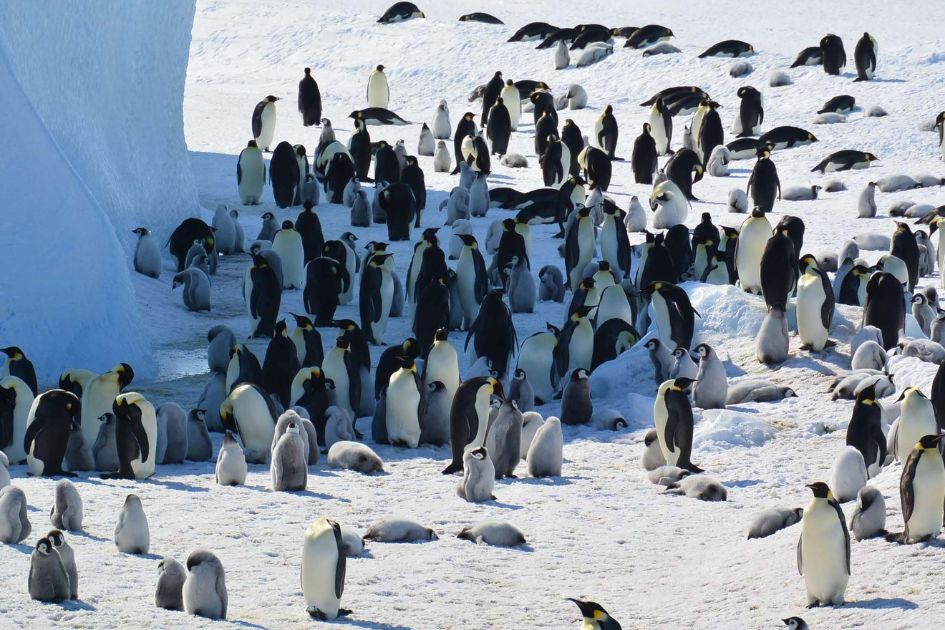



Climate change, sea-ice loss and disease are driving emperor penguins, Antarctic fur seals and southern elephant seals closer to extinction, according to new IUCN Red List assessments released ahead of Antarctic treaty talks.
The emperor penguin and Antarctic fur seal have been classified as Endangered as climate change rapidly reshapes Antarctica’s fragile ecosystem, the International Union for Conservation of Nature (IUCN) said Thursday.
According to the latest update of The IUCN Red List of Threatened Species, shrinking sea ice is projected to cut emperor penguin populations by half by the 2080s, while Antarctic fur seal numbers have already fallen by 50 percent since 2000 because of declining food availability.
The southern elephant seal has also moved closer to extinction risk after outbreaks of Highly Pathogenic Avian Influenza (HPAI) devastated colonies across the region.
“These important findings should spur us into action across all sectors and levels of society to decisively address climate change,” said IUCN Director General Dr Grethel Aguilar.
“The declines of the emperor penguin and Antarctic fur seal on the IUCN Red List are a wake-up call on the realities of climate change. As countries prepare to gather at the Antarctic Treaty Consultative Meeting in May, these assessments provide essential data to inform decisions regarding this majestic continent and its awe-inspiring wildlife.”
She described Antarctica as the planet’s “frozen guardian,” saying it stabilises the climate and shelters unique wildlife.
Scientists said the emperor penguin is under growing threat from the early break-up and disappearance of sea ice, which has hit record lows since 2016.
The species depends on fast ice, sea ice attached to coastlines, the ocean floor or grounded icebergs, to raise chicks and survive moulting periods when the birds are not waterproof.
If the ice melts too early, entire breeding colonies can collapse before chicks are able to swim.
Researchers said climate models examining multiple future warming scenarios show emperor penguin populations are likely to decline sharply this century unless greenhouse gas emissions are cut dramatically.
“Penguins are already among the most threatened birds on Earth,” said Martin Harper, chief executive of BirdLife International, which coordinated the emperor penguin assessment for the IUCN Red List.
“The emperor penguin’s move to Endangered is a stark warning: climate change is accelerating the extinction crisis before our eyes. Governments must act now to urgently decarbonise our economies.”
Dr Philip Trathan of the IUCN Species Survival Commission Penguin Specialist Group said researchers concluded that human-driven climate change posed the greatest threat to emperor penguins.
“Early sea-ice break-up in spring is already affecting colonies around the Antarctic, and further changes in sea-ice will continue to affect their breeding, feeding and moulting habitat,” he said.
“Emperor penguins are a sentinel species that tell us about our changing world and how well we are controlling greenhouse gas emissions that lead to climate change.”
The southern elephant seal, scientifically known as Mirounga leonina, was reclassified from Least Concern to Vulnerable after severe declines linked to avian flu outbreaks.
The disease has spread rapidly worldwide since 2020 and increasingly infected mammals, according to the IUCN.
Four of the species’ five major subpopulations have been affected, with more than 90 percent of newborn pups dying in some colonies. Adult females have also suffered major losses because they spend longer periods on beaches than males.
Scientists warned that warming temperatures could intensify disease outbreaks among marine mammals, especially in polar regions where animals have historically faced limited exposure to pathogens.
Species living in dense colonies such as southern elephant seals are particularly vulnerable to disease transmission.
“These assessments sound an alarm for all Antarctic seals, as we are concerned about how environmental changes are affecting all ice-dependent species,” said Dr Kit Kovacs, co-chair of the IUCN SSC Pinniped Specialist Group.
She called for urgent monitoring of climate change impacts across Antarctica despite the logistical and financial challenges of conducting research in the remote region.
The new assessments are currently available on the IUCN Red List pre-publication page and will later appear on the official species profiles as part of a broader Red List update later this year.
The emperor penguin assessment was prepared by the IUCN SSC Penguin Specialist Group in coordination with BirdLife International, while the seal assessments were produced by the IUCN SSC Pinniped Specialist Group.
Dr Kathleen Flower, vice president of biodiversity science at Conservation International, said the new listings reflected wider ecological collapse affecting wildlife globally.
“These listings are not only sobering for two iconic animals; they reflect what is happening to penguins and seals globally,” she said.
“Their decline underscores how quickly ecosystems are being degraded and how the compounding impacts of warming accelerate food scarcity, emerging disease, and habitat loss. The result is rapidly increasing extinction risk for many species.”
She added that the IUCN Red List remained an essential scientific tool that must be strengthened with climate-informed research to help prevent climate-driven extinctions.
Source: IUCN




