

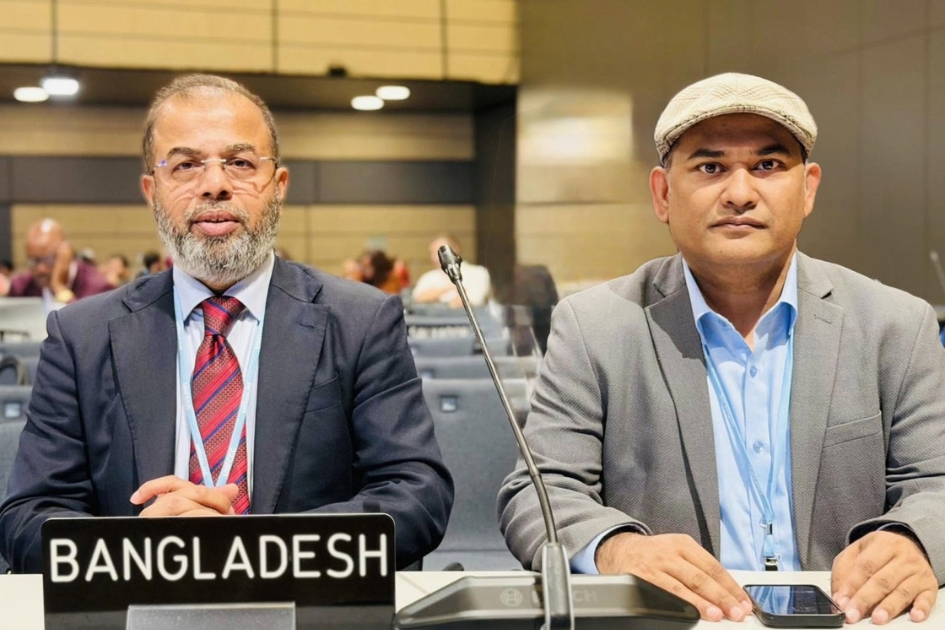

At SB64 in Bonn, Bangladesh is pressing for climate finance, faster loss and damage support, carbon market access, green jobs and a just transition for vulnerable nations facing escalating climate impacts.
At the ongoing SB64 climate talks in Bonn, Bangladesh is taking a more assertive position in global climate negotiations, calling for grant-based adaptation finance, faster operationalisation of the Loss and Damage Fund, expanded access to carbon markets, green jobs and a just transition pathway that ensures equity in the global shift away from fossil fuels.
Bangladesh’s delegation includes Dr Saimum Parvez, Special Assistant to the Prime Minister on Environment, Forestry and Climate Change, and Dr Sheikh Faridul Islam, State Minister for Environment, Forestry and Climate Change, along with other climate negotiators. Delegation members say the aim is to ensure that the realities of climate-vulnerable countries are better reflected in global decision-making, particularly where finance, adaptation, development and just transition intersect.
Bangladesh’s objective is to ensure that climate-vulnerable countries are not seen only through the lens of loss but as active participants shaping global climate solutions and pathways for climate-resilient development and just transition. Taken together, these priorities reflect Bangladesh’s dual message in Bonn: a demand for fair international finance to address climate impacts it did not cause and a push to position climate action as a pathway to jobs, investment and a just transition toward long-term economic transformation.
The Bonn meetings, often described as a technical stepping stone ahead of COP, are taking place amid mounting pressure to close the gap between climate pledges and delivery, alongside deepening tensions over finance, equity, just transition and the speed of the global energy transition.
Against this backdrop, Bangladesh is adopting a more visible and strategic negotiating stance at SB64, with officials saying the country is moving beyond participation toward active bargaining in climate diplomacy.
A key demand remains grant-based adaptation finance. Bangladesh argues that for a country repeatedly affected by cyclones, floods, river erosion and salinity intrusion, adaptation is not a future challenge but an ongoing cost of survival.
“These impacts have already happened. Building embankments, restoring infrastructure and protecting livelihoods are the most expensive forms of climate action,” said Dr Saimum Parvez. “Adaptation costs more.”
Bangladesh has also raised concerns that much of the existing climate finance is delivered as loans, even when concessional, adding to debt burdens rather than compensating vulnerable countries for climate damages.
Closely linked to this is Bangladesh’s push for the swift and effective operationalisation of the Loss and Damage Fund established under the UN climate process. Dhaka is calling for direct access, faster disbursement and the inclusion of slow-onset events such as sea-level rise, salinity intrusion and long-term livelihood loss.
Beyond finance, Bangladesh is seeking stronger integration of its priorities across global frameworks, including adaptation indicators under the Global Goal on Adaptation, follow-up to the Global Stocktake, updated NDC guidance, transparency arrangements, ocean-climate linkages and just transition policies that protect workers and communities while enabling structural economic change.
At the same time, officials are framing climate action not only as a cost but also as an economic opportunity embedded within a just transition approach.
Bangladesh is exploring participation in carbon markets under Article 6 of the Paris Agreement, which allows countries to trade verified emission reductions. Officials say establishing a robust measurement, reporting and verification (MRV) system could help attract investment and potentially generate significant revenue from climate-linked projects.
The government is also holding sideline discussions in Bonn with international partners, including Germany-based institutions, to expand climate cooperation and investment flows.
A major focus is the green jobs agenda, including a national initiative to plant 250 million trees linked to nursery development, community forestry and local entrepreneurship. Officials estimate the programme could generate several hundred thousand jobs, particularly in rural areas, through nurseries, plantation activities and ecosystem restoration work.
Experts, however, caution that ecological design will be critical, recommending diversified species selection and long-term planning to ensure resilience and biodiversity.
Bangladesh’s broader climate strategy at SB64 also includes scaling renewable energy to 30% of electricity generation by 2040, advancing climate-smart agriculture such as water-efficient rice cultivation, promoting a just transition in the garment and industrial sectors and strengthening circular economy practices including recycling, waste management and public awareness.
The 64th sessions of the Subsidiary Bodies (SB64) under the United Nations Framework Convention on Climate Change (UNFCCC) opened in Bonn on Monday, June 8, marking the start of two weeks of negotiations that will shape the agenda for COP31, scheduled for November in Antalya, Türkiye. More than 7,000 participants, including government negotiators, civil society representatives, business leaders and investors, are attending the talks, which are widely seen as a key test of whether the global climate regime can move from negotiation to implementation at the pace required by escalating climate impacts.




