




Bangladesh’s updated biodiversity plan expands focus on restoration, protected areas, sustainable resource management, financing and community participation to meet national targets through 2030.
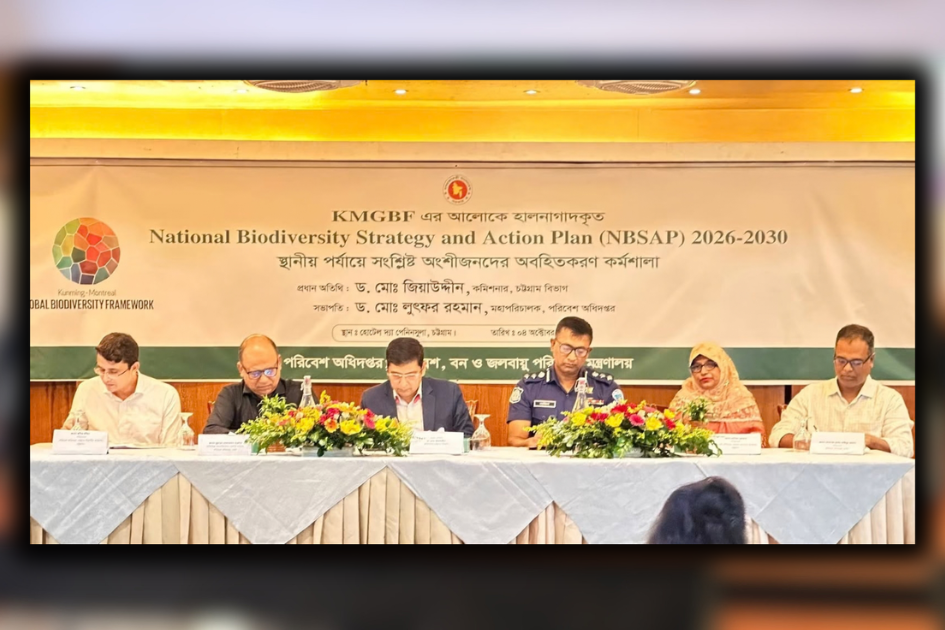
Local stakeholders must be actively involved in implementing Bangladesh’s updated National Biodiversity Strategy and Action Plan (NBSAP) for 2026–2030, the director general of the Department of Environment (DoE) said on Sunday.
Joining a workshop virtually as its chair, Dr Md Lutfur Rahman said biodiversity conservation goes beyond protecting species. “It is directly linked to ecosystems, the economy, local livelihoods and people’s participation,” he said.
The workshop, held at Hotel The Peninsula in Chattogram, informed local stakeholders about the updated plan, which is aligned with the Kunming–Montreal Global Biodiversity Framework (KMGBF). Adopted at the UN Convention on Biological Diversity’s COP15 in Montreal in December 2022, the framework sets global goals for 2050 and 23 targets for 2030.
Bangladesh’s updated NBSAP sets 23 national targets and 107 activities. The targets cover biodiversity conservation and restoration, protected areas, species recovery, invasive alien species, pollution reduction, climate resilience, sustainable agriculture, fisheries and forest management, ecosystem services and urban biodiversity. They also address equitable benefit-sharing, sustainable production and consumption, financing, data, capacity-building, public participation and gender equality.
The KMGBF’s global benchmarks include conserving at least 30 per cent of land, inland waters, coasts and seas, and restoring at least 30 per cent of degraded ecosystems by 2030. They also call for halting species extinction, reducing the introduction of invasive alien species by at least 50 per cent, and limiting pollution to levels that are not harmful to biodiversity.
Drawing on experience from the previous action plan, Rahman cited gaps in financing, monitoring, data, law enforcement and local community participation. He said the updated plan gives greater attention to implementation and monitoring, with regular reviews of progress and corrective action where needed.
Chattogram Divisional Commissioner Dr Md Ziauddin, the workshop’s chief guest, said government agencies, local administrations, elected representatives, researchers, educational institutions, private organisations and communities must work together. Coordinated local initiatives to protect Chattogram’s hills, rivers, sea and forests could help achieve national biodiversity targets, he said, urging stakeholders to contribute their views and experience.
Other attendees included DoE Additional Director General Muhammad Solaiman Haider; Director Mohammad Hasan Hasibur Rahman; Chattogram Regional Director Zamir Uddin; and Chattogram Metropolitan Director Sonia Sultana. Officials from government agencies, development organisations, educational institutions and other stakeholder groups also took part.




