

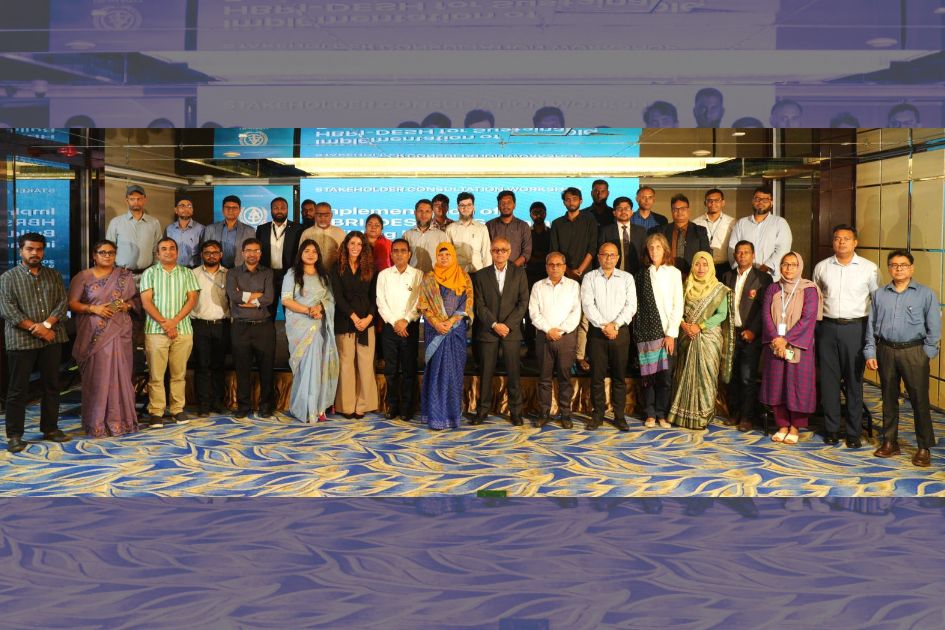

Officials and development partners outlined policy, financing and digital steps for HBRI-DESH, a national tool aimed at scaling affordable, climate-resilient and resource-efficient buildings.
Bangladesh took a step on today toward establishing a national Sustainable Building Labelling System, as government officials, UN agencies, financial institutions, academics, professional bodies and private sector representatives met in Dhaka to discuss the implementation of HBRI-DESH.
The Stakeholder Consultation Workshop focused on HBRI-DESH, or Design for Environment and Sustainable Habitats, and its digital platform, DESHboard, which are intended to serve as Bangladesh’s nationally developed labelling system for sustainable, affordable and climate-resilient buildings.
The workshop was led by the Housing and Building Research Institute under the Ministry of Housing and Public Works, in collaboration with the United Nations Human Settlements Programme, the United Nations Environment Programme and the United Nations Office for Project Services.
It was held under the project “Transforming the Built Environment through Sustainable Materials in Bangladesh”, funded by the German Federal Ministry for Economic Cooperation and Development.
The inaugural session included Most. Ferdousi Begum, Additional Secretary and Chairman of the National Housing Authority; Mr. Asifur Rahman Bhuiyan, Chief Architect of the Department of Architecture; and Dr. Giasuddin Haider, Director General of HBRI.
A high-level panel titled “Advancing Sustainable Buildings in Bangladesh: Policy, Institutional Pathways and Financing for HBRI-DESH Implementation” brought together senior representatives from the Ministry of Housing and Public Works, Rajdhani Unnayan Kartipakkha, the National Board of Revenue and Dhaka Power Distribution Company Limited.
The panel included Md. Abdul Awal, Deputy Secretary at the Ministry of Housing and Public Works, and Md. Ashraful Islam, Chief Town Planner at Rajdhani Unnayan Kartipakkha, Bangladesh’s capital development authority, to discuss the policy, coordination and financing needed to scale the system.
According to the UNEP/GlobalABC Global Status Report 2025–2026, buildings and construction account for nearly 37 percent of global energy-related CO₂ emissions and around half of global material extraction.
Bangladesh, among the world’s fastest-urbanising countries, has seen its urban population roughly double in two decades and is projected to become majority-urban by 2037, with housing demand expected to reach 10.5 million units by 2030, according to the International Finance Corporation.
Participants at the consultation represented government ministries and agencies, Bangladesh Bank and financial institutions, development partners, universities and research institutions, professional bodies such as the Institute of Architects Bangladesh and the Institution of Engineers, Bangladesh, architectural firms, real estate developers, construction industry representatives, environmental experts and civil society organisations.
“HBRI-DESH is more than a technical framework. It is a nationally owned instrument that will help translate Bangladesh’s commitment to sustainable urban development into practical action. Through strong collaboration among government, the private sector and development partners, we can establish a credible and transparent system that promotes sustainable, affordable and climate-resilient buildings across the country,” said Most. Ferdousi Begum, Additional Secretary and Chairman of the National Housing Authority.
The consultation generated recommendations on governance, institutional coordination, financing mechanisms, capacity development and digital systems, which will directly inform HBRI-DESH’s implementation guidelines and a phased national rollout, including pilot initiatives and partnerships to encourage wider adoption.
The initiative supports Bangladesh’s Nationally Determined Contributions and progress toward Sustainable Development Goals 11, 12 and 13, marking a milestone toward a low-carbon, resource-efficient and climate-resilient built environment.




