

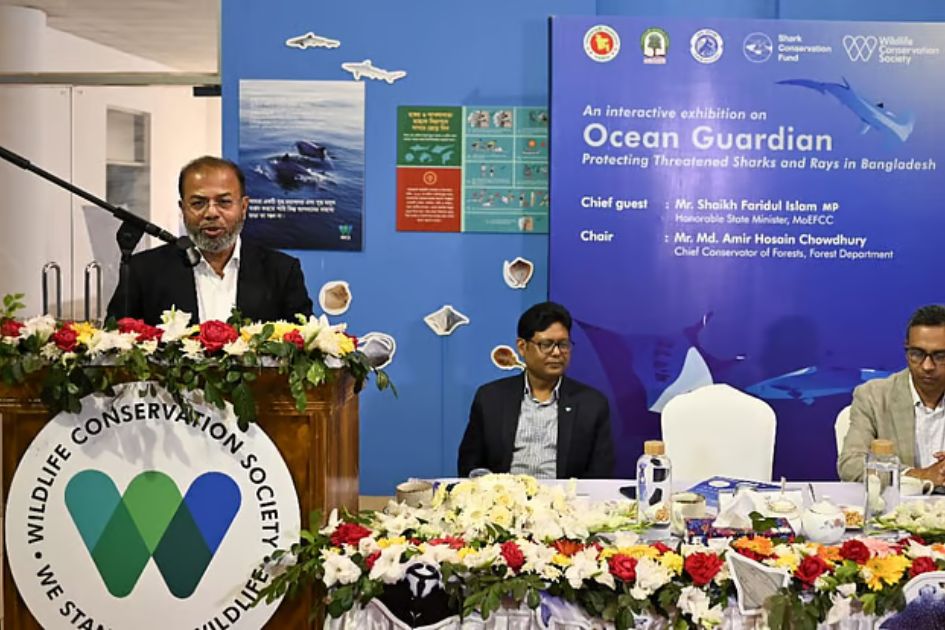



Bangladesh’s environment minister vows zero tolerance for poison fishing, warning of ecosystem destruction, species loss and long-term food security risks, urging stronger enforcement and public awareness across affected regions nationwide.
Bangladesh’s environment state minister has issued a strong warning against the use of poison in fishing, saying even close relatives would face action if found guilty of the practice that is harming aquatic ecosystems and threatening future food security.
“I have already made it clear that I will not spare anyone, even my own brother, if he uses poison to catch fish,” said Sheikh Faridul Islam, state minister for environment, forest and climate change, at an event in the capital on Monday.
He was speaking as the chief guest at an educational exhibition on endangered shark and ray species held at the Bangladesh Shilpakala Academy. The exhibition, organised by the Wildlife Conservation Society Bangladesh (WCSB), was inaugurated by the minister earlier in the day around 11:00 am.
Highlighting environmental concerns, Faridul Islam said many marine species are disappearing due to human activities. He pointed to incidents such as poison fishing in the Sundarbans and oil tanker accidents, noting that fish and other marine life are unable to adapt to such disruptions.
“Our aquatic species are becoming extinct for various reasons, mainly due to human actions. Natural causes play a role, but their impact is very limited,” he said.
He warned that the use of poison in water bodies destroys entire ecosystems, wiping out fish and other organisms in rivers and canals. Such practices, he added, would create long-term suffering for future generations and disrupt nutritional supply.
“As a result of poison use, everything in canals and rivers is being eliminated and many species are disappearing from the planet. In the long run, our children will face risks of malnutrition. We must act in a planned and responsible way,” he said.
The minister also stressed the need for grassroots awareness to protect sharks and rays, locally known as shaplapatā fish.
The event was chaired by Chief Conservator of Forests Amir Hossain Chowdhury, who warned that overexploitation is threatening marine food chains. “To protect the marine ecosystem, we must save sharks and rays,” he said.
WCSB Country Director Jahangir Alam was also present at the event.
The three-day exhibition is being held at Gallery 3 of the Bangladesh Shilpakala Academy and will run until April 8. It remains open to visitors daily from 10:00 am to 8:00 pm.
The exhibition showcases the importance of sharks, whales and rays, along with the threats to their habitats and the need for conservation. Awareness messages are presented through posters, stickers, marine specimens and visual displays.
Research indicates that Bangladesh is home to more than 100 species of sharks and rays, with two out of every three species currently facing the threat of extinction.




