

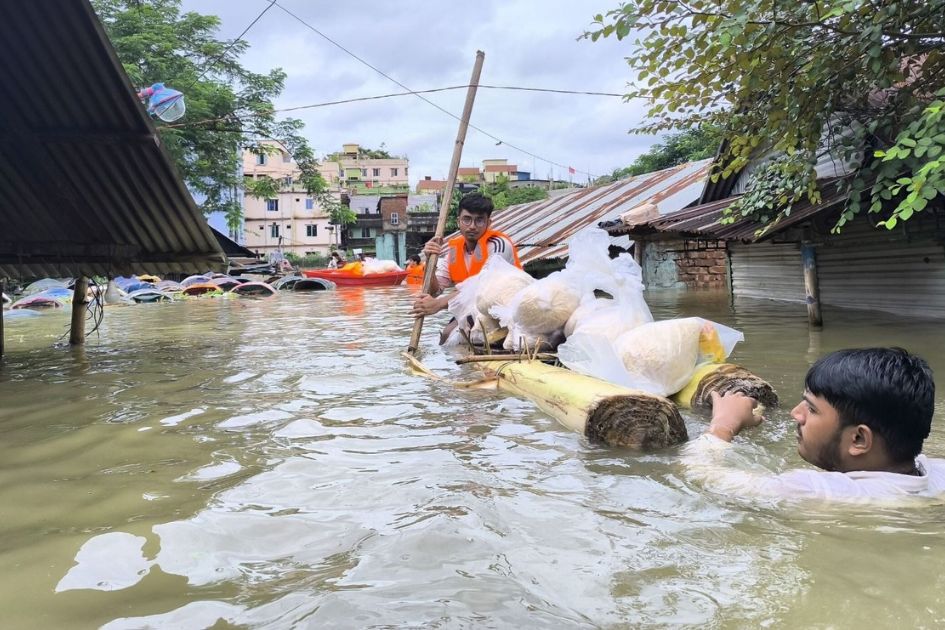



Developing nations are intensifying pressure on wealthy countries to deliver Loss and Damage Fund financing as growing delays expose widening gaps between climate pledges and real support.
The long-awaited Fund for Responding to Loss and Damage (FRLD) is under intense global pressure as developing countries accuse wealthy nations of failing to turn climate promises into real money on the ground, with Bangladesh’s political leadership and other Global South voices calling for urgent delivery rather than continued delays in climate finance.
At the World Economic Forum’s “Summer Davos” in China, Bangladesh’s Prime Minister Tarique Rahman reiterated that climate finance must move from “promise to delivery,” reflecting wider frustration among vulnerable nations that global climate talks are still producing negotiations faster than results even as climate impacts accelerate across the world.
He said, “The Loss and Damage Fund must move from promise to delivery, with accessible and predictable support for affected nations. Second, climate finance must become more accessible, concessional and responsive to the needs of vulnerable countries. It should also accelerate technology transfer and private-sector investment. In this regard, we need greater mobilisation and operationalisation of the Green Climate Fund.”
At London Climate Action Week, Nigeria’s Environment Minister Balarabe Abbas Lawal delivered one of the strongest criticisms yet of the fund, calling it a “mirage” and questioning whether UN climate summits have become little more than endless discussions without delivery.
“Whenever we go to UN climate summits, we talk about loss and damage funds, and all these years nothing has been translated into action,” he said, warning that repeated delays are eroding trust between rich and poor nations at a critical moment for climate action.
The fund, created in 2023 after years of pressure from vulnerable countries, was meant to provide urgent financial support to nations suffering irreversible climate impacts such as floods, storms, droughts and rising seas. But critics say the gap between promises and reality remains dangerously wide.
For many frontline countries across Africa, Asia and the Pacific, the frustration is no longer abstract. Communities are already living through repeated climate disasters while financial support remains slow, uncertain and far below the scale of need.
CEO Says Fund Is Moving but Delivery Gap Remains
FRLD Executive Director Ibrahima Cheikh Diong defended the institution’s progress, insisting systems are being built and the fund is “moving according to plan.”
He said the aim is to begin disbursing funds by the end of the year, stressing that delays carry human consequences.
“Every time wasted, when it comes to loss and damage, is lives not saved,” he said, acknowledging growing impatience among developing countries.
While officials point to operational progress, vulnerable nations argue that administrative timelines remain disconnected from climate realities on the ground, highlighting a widening gap between institutional readiness and urgent humanitarian need.
Money Gap Deepens Trust Deficit
Despite expectations that the fund would eventually mobilise tens of billions of dollars annually, actual contributions remain limited.
So far, wealthy countries have pledged around $822 million, but only about $449 million has been delivered. Several major economies, including Italy, France and Luxembourg, have reportedly not fully met their commitments.
An internal briefing note from the fund’s secretariat warns that without fresh inflows, the mechanism could run dry as early as 2027.
To prevent a funding collapse, the FRLD is preparing a replenishment drive next year while also exploring alternative financing approaches to broaden its resource base. Experts caution, however, that the deeper issue is not only funding volume but whether the system can deliver speed, predictability and accessibility to countries already facing repeated climate shocks.
Kenya became the first African nation to receive landmark climate disaster funding. It will be used to identify Kenyans who have suffered climate-related loss and damage over the past decade.
The Sh90 million ($700,000) in funding comes from the Santiago Network on Loss and Damage, a Switzerland-based United Nations mechanism funded by voluntary contributions from developed countries and the international community.
The Kenyan funding will be administered by the national government and used to identify communities that have suffered losses as a result of climate-induced droughts, floods, crop failures and other extreme weather events.
Festus Ng’eno, Principal Secretary for Kenya’s Environment, Climate Change and Forestry Ministry, announced the achievement at the recent UN June climate meeting in Bonn, Germany. He said the assistance is a milestone as Kenya is only the second country globally to benefit from the fund. Vanuatu, a low-lying archipelago, was the first.
From Crisis Fund to System-Wide Climate Finance Rethink
The frustrations surrounding the FRLD are increasingly feeding into a broader reassessment of the global climate finance architecture, where the debate is no longer only about how much money is needed but how it is structured and delivered.
At Devex Impact House, discussions featuring leaders from the Climate Investment Funds, HSBC and the FRLD highlighted a growing divide between traditional grant-based climate finance and emerging investment-driven approaches.
Experts warned that grants and pledges alone are increasingly seen as insufficient to meet the scale of the climate emergency. At the same time, there is no full consensus on the way forward. While some argue that blended finance, guarantees and private capital are essential, others caution that market-based solutions alone may fail to reach the most vulnerable countries without strong public support and risk-sharing mechanisms.
The debate reflects a shifting reality. Public development finance is tightening in many donor countries while renewable energy costs are falling sharply, making climate investment more economically viable but still unevenly distributed across regions and income groups.
Pakistan Highlights Frontline Financing Gap
Former Director General of the Pakistan Environmental Protection Agency (Pak-EPA), Asif Shuja, underscored the imbalance facing vulnerable countries such as Pakistan, which contributes less than 1 percent of global emissions but continues to suffer severe and repeated climate impacts.
He said adaptation finance must increase significantly alongside stronger institutional capacity to ensure countries can plan and implement resilience measures effectively.
Blended Finance Push Faces Delivery Question
Participants noted that the growing push toward blended finance, combining public funds, guarantees and private investment, is aimed at unlocking far larger pools of capital for climate action.
However, experts cautioned that private capital will not flow at scale into high-risk climate environments without strong public backing to reduce risk and ensure equitable outcomes.
The result is a system still in transition. Traditional grant-based aid is under pressure while new financial models are not yet fully capable of meeting the urgency and scale of climate impacts.
A Shared Crisis, Not Separate Debates
Although the Loss and Damage Fund crisis and the broader climate finance shift are often discussed separately, both reflect the same underlying structural challenge of whether global financial systems can deliver fast, fair and sufficient support to countries already experiencing irreversible climate harm.
As climate disasters intensify, the gap between negotiation rooms and real-world impacts is becoming harder to ignore.
Waiting for Delivery, Not Design
As the world heads toward another round of climate negotiations, vulnerable nations are increasingly clear in their message. They are no longer interested in new frameworks or technical refinements alone.
They want delivery.
For now, the central question remains whether global climate finance will move quickly enough from design to disbursement or remain trapped between promises, pilots and postponed action.
Sohanur Rahman, Executive Coordinator of YouthNet Global, said the urgency can no longer be ignored.
“Climate-vulnerable communities are not asking for new promises. They are asking for timely, predictable and fair finance that reaches those who are already living the climate crisis every day.”




