




Environmentalists have urged stronger enforcement of pollution laws, tighter controls on vehicles and industries, and wider use of sustainable alternatives to curb Bangladesh’s worsening pollution.
Bangladesh environmental activists on Tuesday called for a 10-point action plan to tackle air, noise, visual, polythene and plastic pollution, including stricter enforcement of existing laws and measures targeting polluting vehicles, brick kilns, industries and construction activities.
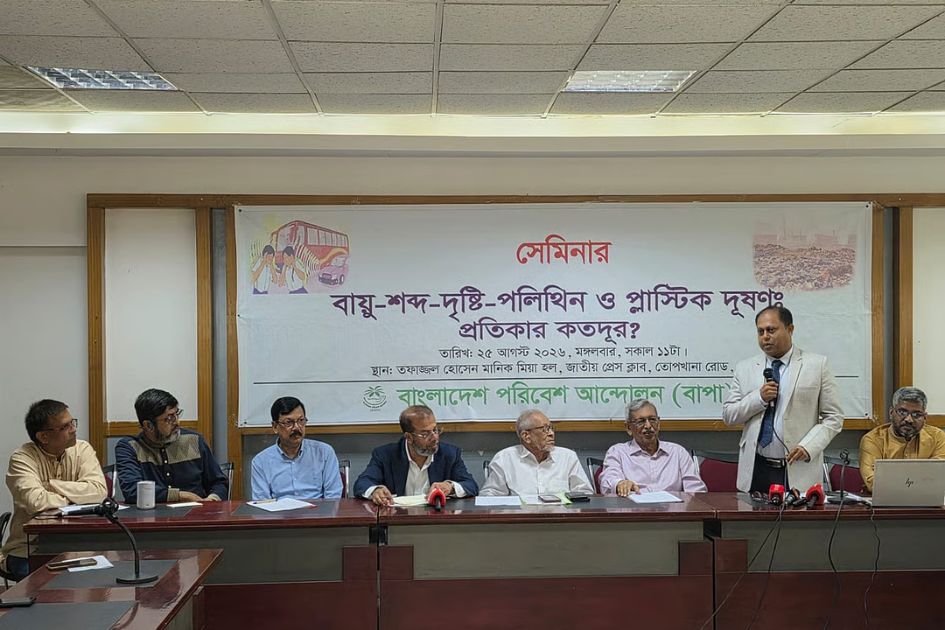
The recommendations were made at a seminar titled “Air, noise, visual, polythene and plastic pollution: How far have we come in addressing it?” organised by the Bangladesh Poribesh Andolon (BAPA), a national environmental advocacy organisation, at the Tafazzal Hossain Manik Mia Hall of the National Press Club in Dhaka.
The seminar was chaired by BAPA President Professor Dr Nur Mohammad Talukdar and moderated by its General Secretary Md Alamgir Kabir. BAPA Vice-President Professor M. Firoz Ahmed and executive member Ahsan Rony presented the main paper on polythene and plastic pollution, while joint secretary Professor Dr Ahmed Kamruzzaman Majumder presented the main paper on air and noise pollution.
State Minister for Environment, Forest and Climate Change Sheikh Faridul Islam was the chief guest. Dhaka University Pro-Vice-Chancellor Professor Dr Abdus Salam, Environment and Social Development Organization (ESDO) Secretary General Dr Shahriar Hossain and BAPA executive member and urban planner-architect Iqbal Habib also spoke at the seminar.
In his speech, Faridul Islam said the prime minister this year inaugurated the Environment Fair without displaying her own photograph.
He said shutting down all billboards in the country after midnight would reduce visual pollution while also preventing substantial electricity wastage.
“We all have to become aware from our respective positions,” he said.
The state minister announced that brick kilns that burn wood to produce bricks would be shut down after the current monsoon. He also said officials who had authorised such brick kilns would be brought under punishment.
Bangladesh now needs to move towards environmentally friendly block bricks, he said. He also called for involving young people in environmental protection and said there were plans to stop unfit vehicles and gradually increase the use of electric vehicles.
BAPA President Nur Mohammad Talukdar said public awareness needed to be increased to prevent polythene and plastic pollution. At the same time, he said the government should develop, market and make readily available environmentally friendly alternatives.
In his paper, Professor M. Firoz Ahmed described waste and plastic pollution as a long-term threat to the environment and river ecosystems.
Bangladesh produces about 25,000 tonnes of solid waste every day, including about 7,500 tonnes in Dhaka, he said. Per-capita plastic use in urban areas has risen from 3 kilograms in 2005 to about 9 kilograms, while the figure in Dhaka has reached 22.25 kilograms. The country generates about 800,000 tonnes of plastic waste annually, he said.
About 55 percent of total waste is disposed of in an unplanned manner in open areas, while industrial waste, electronic waste, leachate and plastic are creating long-term pressure on rivers, water bodies, groundwater and ecosystems.
He said polythene and plastic account for 80 percent of blockages in water drainage.
Nanoplastics block cells in the human body, he said, and called for the rapid implementation of 14 laws to prevent plastic and polythene pollution.
Given the continuing increase in plastic waste, he said implementation of laws, regulations and action plans designed to prevent plastic pollution was essential.
The use of suitable alternatives to single-use plastics could provide a partial solution and represent a major step towards a comprehensive response, he said. Bio-based plastic bags could be considered as alternatives, but their biodegradability should be verified through third-party assessment.
Plastic contains a very high amount of thermal energy, about 14,000 British thermal units per pound, he said. Through pyrolysis, plastic can be converted back into petroleum, he added.
Professor Ahmed Kamruzzaman Majumder described air pollution as an invisible, infectious and life-threatening crisis and a major obstacle to Bangladesh’s environmental and economic progress.
Dhaka ranked 171st among 173 cities in the Economist Intelligence Unit’s 2025 Livability Index, he said. According to the Energy Policy Institute at the University of Chicago’s Air Quality Life Index data cited in the presentation, air pollution reduces the average life expectancy of Bangladeshis by about 5.5 years.
According to the Centre for Research on Energy and Clean Air, 102,456 people die every year from diseases caused by air pollution, while the World Bank estimates that environmental pollution costs Bangladesh 17.6 percent of its gross domestic product, he said.
Dhaka’s Air Quality Index often exceeds 200 to 300 during winter, he added.
According to research by the Center for Atmospheric Pollution Studies, construction work and road excavation account for 30 percent of air pollution sources, followed by brick kilns and industrial facilities at 29 percent, vehicles at 15 percent, transboundary pollution at 9.5 percent, household cooking smoke at 8.5 percent and waste burning at 8 percent.
The World Health Organization’s 2021 guideline sets an annual limit of 5 micrograms per cubic metre for PM2.5, while Bangladesh’s national standard under the Environment Conservation Rules is 35 micrograms per cubic metre.
Such pollution increases risks to respiratory and cardiovascular health and reduces productivity, he said.
On noise pollution, Majumder described an acute hearing and public health crisis in urban life. Noise levels exceed 60 decibels in 82 percent of locations in Dhaka, while levels reach 80 to 110 decibels at hotspots such as Farmgate, Shahbagh and Gabtoli.
Such exposure increases the risks of hearing loss, sleep disruption, psychological stress, high blood pressure and reduced work capacity, he said.
On visual pollution, he said unplanned urban landscapes were creating an aesthetic crisis. Visual pollution was damaging the aesthetics of cities, mental comfort and an orderly environment.
According to ESDO research, the number of billboards in Dhaka increased by 51 percent between 2019 and 2022, reaching 13,997. This has contributed to eye strain, headaches, deterioration of urban aesthetics and declining liveability, he said.
Dhaka University Pro-Vice-Chancellor Abdus Salam said many people had been working on environmental issues for a long time but “nothing is really happening.”
He said 75 percent of deaths in the country were caused by environmental disasters, while lead levels had increased because of the rise in electronic batteries.
Bangladesh should follow the models used by Japan and the United States to reduce pollution, he said. People were constructing homes according to their own preferences without considering environmental issues, he said, adding that the government needed to oversee such activities.
Existing laws must be properly enforced against polluters, he said.
ESDO Secretary General Shahriar Hossain said people absorb 70 percent of particles through the air. As a result, he said, almost everyone suffers from recurring coughs that sometimes do not go away even with antibiotics.
He said visual pollution was turning many people into patients with mental illness. Research shows that no cause can be identified for 70 percent of patients with mental illness, he said.
Hossain strongly called for implementation of the polluter-pays principle and for regional cooperation to enforce transboundary laws.
Urban planner and architect Iqbal Habib called for punishment of environmental polluters and incentives where necessary for institutions working to protect the environment.
He also called for comprehensive support and incentives for young people developing alternatives to polythene, as well as public participation, incentives and action plans to prevent encroachment and pollution.
BAPA executive member Ahsan Rony said Bangladesh is among the world’s top 20 countries contributing to plastic and polythene pollution.
A family in Dhaka uses an average of five polythene bags a day, while more than 25 million bags are discarded every day, he said. Polythene waste blocking drains was responsible for 80 percent of waterlogging in the city after the 1998 flood, he said.
BAPA General Secretary Alamgir Kabir questioned how an item banned in 2000 had returned and reached ninth place within a few years.
“Is this the responsibility only of the people, or also of the government and those involved in this business?” he said.
The seminar’s 10 recommendations included introducing regular mobile courts against vehicles without fitness certificates or emitting black smoke, incorporating air quality into the curriculum, shutting down illegal brick kilns and making the use of blocks mandatory in government projects.
The recommendations also called for signal automation and the introduction of Mini Asphalt Plant technology, the introduction of online air-quality monitoring systems in industrial facilities, increased publicity for 999 and hotlines for reporting noise pollution, strict enforcement of the Noise Pollution (Control) Rules 2025 and regular noise testing of vehicles.
The recommendations further called for controlling LED lights after 10 p.m. and organising hanging wires.
Among other BAPA central leaders attending the seminar were Vice-President Mahidul Haque Khan, Treasurer Md Aminur Rasul, Organising Secretary Mihir Biswas, Joint Secretaries Dr Halim Dad Khan and Humayun Kabir Sumon, and executive members Md Ashraf Amirullah, Monsefa Tripti and Mahmidah Naznin.




