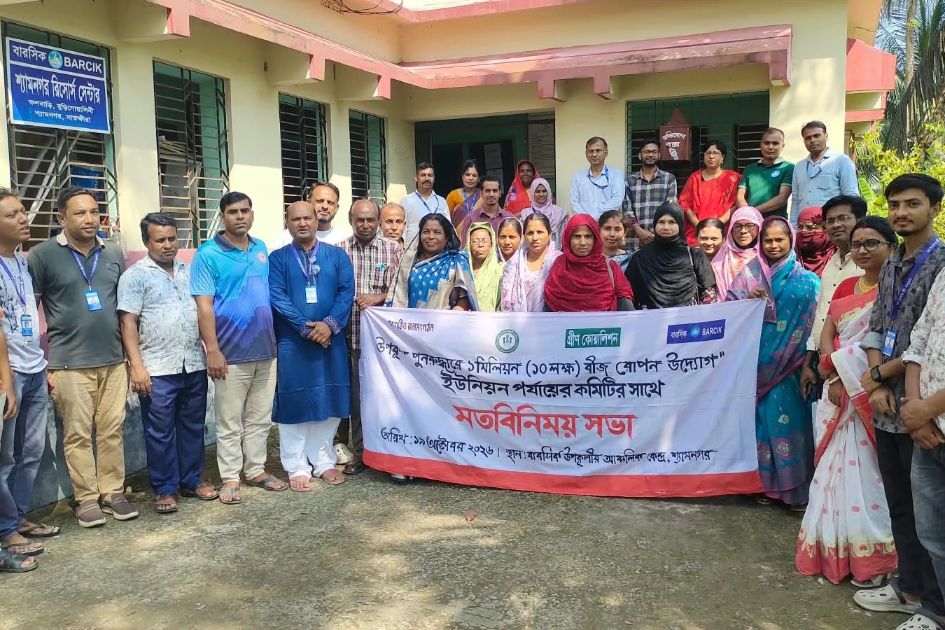



Community monitoring committees in Satkhira will coordinate sapling care, local fundraising and protection measures to improve survival rates and strengthen coastal biodiversity.
Local community groups and environmental activists in southwestern Bangladesh have pledged to work together to protect seeds and saplings planted under an initiative to restore coastal ecosystems threatened by climate change, salinity and natural disasters.
The commitment followed a meeting of members of union-level monitoring committees held on Monday (October 19) at the coastal regional centre of Bangladesh-based NGO BARCIK in Shyamnagar, Satkhira district. Participants agreed on measures including protecting saplings grown from the planted seeds, carrying out additional tree planting, building fences and enclosures, arranging tree guards and raising funds through community participation.
The meeting was organised by Organised People’s Organisation, the Shyamnagar Upazila Volunteer Association and the Green Coalition. It was chaired by Kamala Rani, a reserved-seat union council member representing wards 1, 2 and 3 of Ishwaripur Union.
In a welcome address, Shahin Islam, BARCIK’s regional coordinator, said the joint efforts by local communities and people’s organisations were important to coastal restoration.
He said the initiative was not limited to planting trees but was closely linked to protecting the coastal environment, biodiversity and people’s livelihoods. He also said the initiative had been translated into several languages and published in news media outside Bangladesh, bringing the local environmental effort to a wider audience.
“We do not finish our responsibility simply by planting a seed. Care and protection are needed at every stage, from germination to the growth of a sapling. Just like nurturing a child in one’s own womb. The sapling that has been born today could in the future become shelter for birds, a habitat for biodiversity and part of maintaining the ecological balance of the coast. Therefore, the planted seeds and saplings must not be allowed to be destroyed in any way. If local communities and people’s organisations come forward, BARCIK will also provide support from its respective position,” he said.
Other speakers included Md Zillur Rahman, president of the Green Coalition in Ishwaripur Union; Md Habibur Rahman, president of the Green Coalition in Kaikhali Union; Md Ashraf Hossain, president of the Green Coalition in Padmapukur Union; Lata Rani, the largest seed donor; and Kishor Kumar, a lecturer at Atulia A. Kader School and College.
Speakers said tree planting in coastal areas was not merely a greening programme but an important social initiative to address the impacts of climate change, conserve biodiversity and create a liveable environment for future generations.
They said the success of tree planting depended on seed germination, sapling survival and proper care. Ensuring a sense of ownership among local people, regular monitoring and community participation was therefore essential, they said.
The meeting was also attended by Farida Parvin, a member and panel chairman of Gabura Union Parishad; Shahana Mostofa, a member of Bhurulia Union Parishad; Shukkari Rani, a member of Padmapukur Union Parishad; Palashi Rani, a member of Munshiganj Union Parishad; as well as members of monitoring committees from different unions, Green Coalition leaders and environmental activists.
During the meeting, S. M. Jannatul Naim, a community facilitator at BARCIK, gave a PowerPoint presentation on the planning, implementation, public participation and progress of the initiative to plant 1 million seeds. The presentation covered various aspects of the initiative from its launch through implementation.
Following an open discussion, participants decided that each union would take necessary measures based on local conditions to protect planted seeds and saplings. These measures include building enclosures and fences around saplings, arranging regular care and organising protection and monitoring.
The monitoring committees in each union also pledged to return to their respective areas and hold further discussions with individuals, organisations and well-wishers who had expressed solidarity with the initiative from the beginning. They agreed to advance the protection and care of the planted seeds and saplings through crowdfunding or collective fundraising with their participation.
Participants said active involvement by local people was crucial alongside government and non-government initiatives to restore coastal nature. They said sustained collective efforts and care by local communities could ensure long-term environmental benefits from the seed-planting initiative while also creating opportunities to foster a love of nature, environmental responsibility and social leadership among the younger generation.
The initiative to plant 1 million seeds was launched on July 28, 2026, at an area adjacent to the Akashlina Eco-Tourism Centre in Shyamnagar. Shamsuzzahan Kanak, the upazila executive officer of Shyamnagar, inaugurated the programme.
The initiative aims to restore the coastal environment, involve local communities and facilitate the development of a green and biodiversity-rich coast through collective efforts.