

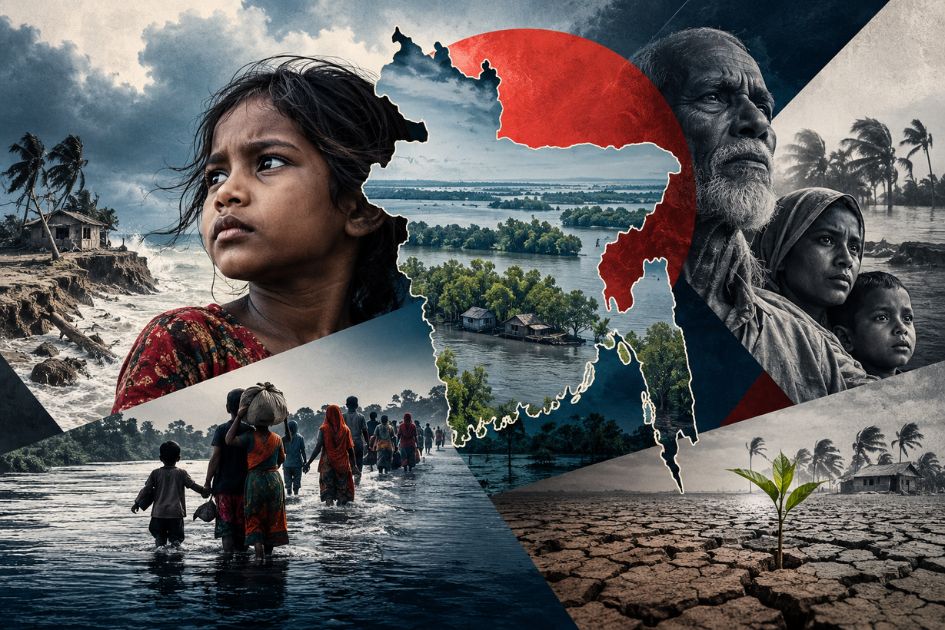



Bangladesh’s UPR-4 climate commitments enter an implementation phase as civil society urges stronger monitoring, accountability and participation of communities affected by climate risks.
Bangladesh has accepted 12 recommendations on climate change and human rights following its fourth Universal Periodic Review (UPR-4), after civil society organisations proposed 18 actions across seven thematic areas to address climate-induced human rights violations, according to two new publications by the Center for Participatory Research and Development (CPRD).
The publications, titled “Joint Civil Society Submissions for Safeguarding against Climate-induced Human Rights Violation: The Fourth Universal Periodic Review (UPR 4) of Bangladesh” and “Implementation of UPR-4 Recommendations for Safeguarding Against Climate-induced Human Rights Violations in Bangladesh: Engagement and Advocacy Guideline”, were launched during a National Stocktake Exercise on the Implementation of UPR-4 Recommendations.
The first publication is a reprint of the joint civil society submission prepared for Bangladesh’s UPR-4 review, while the second outlines civil society recommendations made during the review process, identifies those accepted by the Government of Bangladesh and provides a guideline for civil society organisations to engage in advocacy and track implementation before the UPR-5 process begins in early 2028.
Ahead of the UPR-4 cycle in May 2023, civil society organisations in Bangladesh conducted evidence generation, national consultations, compiled recommendations and engaged with the UPR-4 pre-session at the United Nations Permanent Mission in Geneva. Through the process, they proposed 18 actions across seven thematic areas.
Bangladesh subsequently supported 12 recommendations directly related to climate change and human rights, including measures concerning resilience to salinity and flash floods, climate-related displacement, a human-rights-based displacement policy, protection of older persons, attention to persons with disabilities, cyclone warning systems and data on climate-sensitive diseases.
The CPRD guideline said the main challenge now is to translate the UPR-4 commitments into measurable national action during the implementation period until early 2028. It highlighted the need for clearer institutional responsibilities, systematic monitoring, rights-based assessment of climate policies and investments, improved data and accountability mechanisms and meaningful participation of climate-affected communities and civil society.
The guideline noted that the UPR-4 cycle represents an accountability milestone to ensure Bangladesh’s climate policies and programmes create tangible improvements in the everyday security, dignity and rights of people living on the frontlines of climate change.
During Bangladesh’s third UPR cycle in May 2018, the Government of Bangladesh had accepted two climate-related recommendations: continuing efforts to address the negative impacts of climate change and developing strategies to mitigate those impacts. The joint civil society submission said that although the government had taken measures to implement those commitments, climate change impacts remained the root cause of many ongoing human rights violations in Bangladesh.
The submission highlighted climate-related impacts on rights to life, water and sanitation, housing, education and culture, with particular focus on loss and damage as well as women’s and children’s rights.
Among its recommendations, civil society groups called for countrywide mapping of climate displacement and development of a national database, ensuring housing, land and property rights for victims of climate displacement, creating sustainable alternative employment opportunities and initiating skill-development and employment generation programmes in climate-vulnerable areas.
The submission also recommended ensuring safe drinking water and irrigation access for water-stressed communities in climate-vulnerable areas and protecting child education in climate-vulnerable and displaced communities.
The National Stocktake Exercise highlighted the role of the National Human Rights Commission of Bangladesh and called for coordinated efforts among key ministries, including the Ministry of Environment, Forest and Climate Change, Ministry of Foreign Affairs, Ministry of Health and Family Welfare, Ministry of Women and Children Affairs and Ministry of Disaster Management and Relief, to implement the UPR-4 recommendations.
The CPRD published the engagement and advocacy guideline in August 2026. The report was developed based on the Joint Civil Society Submission to Bangladesh’s fourth UPR review cycle on Climate Change and Human Rights in 2023. The joint civil society submission was originally published in May 2023 and reprinted in August 2026.




