

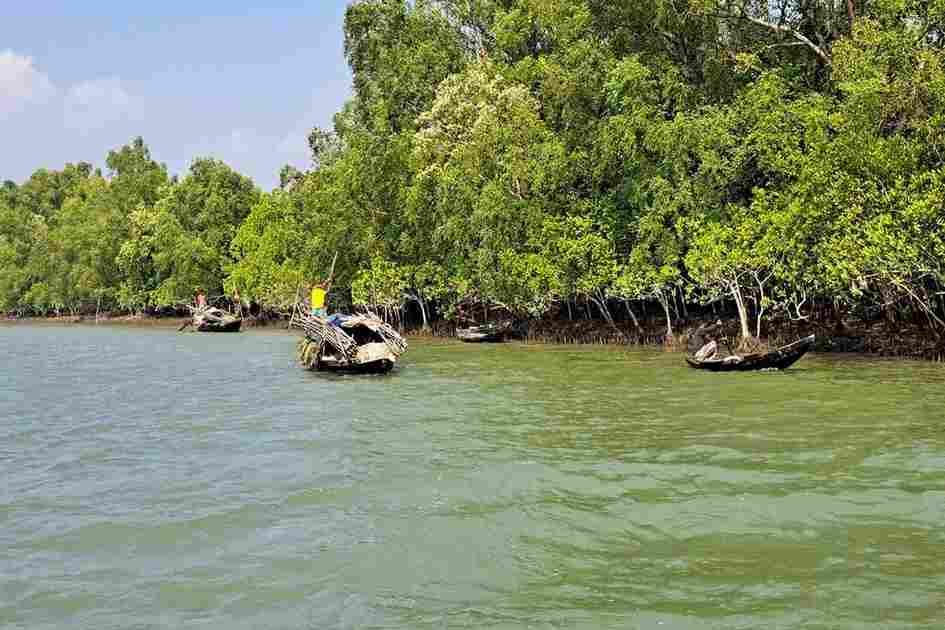



Armed gangs have resurfaced in the Sundarbans, abducting fishermen and alarming tourists, undermining local livelihoods, conservation efforts and security in the world’s largest mangrove forest.
The Sundarbans, the world’s largest mangrove forest and a UNESCO World Heritage Site spanning Bangladesh and India, is experiencing a resurgence of armed banditry. The rise in attacks is sending waves of fear through local communities and severely impacting tourism. Fishermen, honey collectors, forest workers and even tourists have been targeted in recent months, disrupting traditional livelihoods and the economic stability of coastal districts.
On the night of February 14, the notorious Karim Sharif gang launched a sudden attack on Shelarchar, a fishing settlement in the eastern Sundarbans. Six fishermen, Khairul 35, Faruk 28, Samsul Islam 25, Safarul 32, Maruf 28 and Milon 30, were abducted at gunpoint from homes near the forest edge. The victims, from villages in Khulna’s Koyra sub-district and Bagerhat’s Rampal and Morelganj areas, were taken deep into the forest despite the proximity of a Forest Department patrol post.
“This is unprecedented. We are no longer safe even near official patrol areas,” said Ariful Haque Mithu, a fish dealer in Shelarchar. “Earlier, bandits sometimes abducted fishermen for ransom while they were deep in the forest. Now they attack entire villages. People are terrified to venture out for work or collect resources.”
A day earlier, another incident was reported in the Dublar Loitrokhali area where bandits seized a fishing trawler, highlighting the growing audacity of these groups.
Threat to Livelihoods
Local livelihoods have been severely disrupted. Many fishermen now avoid entering the forest while honey collectors and woodcutters report paying large sums, sometimes up to 100,000 taka or around 1,000 US dollars, in ransom. “We have been working here for generations. Now our families live in constant fear. Even if released, the trauma lingers,” said a local fisherman who requested anonymity. Families are frequently forced into debt to pay ransoms, compounding the socioeconomic impact.
“The safety of fishermen is a top priority,” said Mohammad Shariful Islam, Officer in Charge of the Eastern Sundarbans Forest Range. “We have instructed the Shelarchar Forest Patrol to intensify monitoring and patrolling operations.” Md Rezaul Karim Chowdhury, Divisional Forest Officer of the Bagerhat Sundarbans East Division, added, “We are trying to identify the locations of the bandits and maintain round the clock communication with law enforcement.”
Impact on Tourism
Tourism, another vital source of income, has also suffered. The Sundarbans attracts thousands of domestic and international visitors annually, drawn to the Royal Bengal tiger, estuarine crocodiles and migratory birds. In the 2023-24 fiscal year, 41,000 tourists visited the Satkhira Range. That number fell slightly to 39,000 in 2024-25 and dropped to just 13,000 in the first six months of the current fiscal year. Local resort managers and boat operators report sharp revenue declines.
The risk to tourists was evident on January 2, 2025, when two foreign visitors and a resort owner were abducted from a wooden boat near Kanurkhal. They were rescued in a coordinated 48 hour operation led by the Bangladesh Coast Guard and Forest Department. “Incidents like this endanger lives and jeopardize the Sundarbans’ reputation as a safe ecotourism destination,” said a Dhaka based travel industry expert.
Law Enforcement Response
Authorities have intensified operations, deploying the Bangladesh Police, Coast Guard, Rapid Action Battalion, Forest Department and Navy. “Since August 5, 2024, bandit activity has increased in the Sundarbans. We are coordinating efforts across Bangladesh Police, Coast Guard, RAB and the Navy to bring these criminals to justice,” said Satkhira Superintendent of Police Arefin Jewel. “Joint operations are ongoing. New gangs that are increasing criminal activity will be brought under the law.”
A senior officer of the Mongla Coast Guard West Zone added, “From August 2024, we have observed renewed bandit activities. Regular and special operations have been conducted to apprehend criminals and ensure safety in the Sundarbans.” Since the resurgence began, more than 50 bandits and their associates have been arrested. Weapons, ammunition and narcotics have been seized and dozens of hostages freed.
Despite these efforts, dense mangroves, winding rivers and isolated char islands make detecting and tracking bandits challenging. Forest officials and law enforcement continue to coordinate with local communities to maintain rapid reporting and response.
Conservation and Community Impact
The Sundarbans is home to endangered species including the Royal Bengal tiger, estuarine crocodiles and a wide variety of migratory birds. Experts warn that ongoing insecurity could reduce community engagement in conservation. “When local people fear for their lives every time they enter the forest, they are less likely to participate in conservation or sustainable resource management,” said Sohanur Rahman, Executive Coordinator of YouthNet Global.
Persistent banditry also threatens the broader ecological and economic significance of the Sundarbans. The forest’s protection is crucial not only for human livelihoods but also for global biodiversity and climate resilience.
Looking Ahead
While authorities recorded notable successes including a government declaration in November 2018 that the Sundarbans was bandit free, the resurgence highlights the fragility of security. Coordinated operations dismantled criminal networks yet new gangs continue to exploit the complex terrain.
Experts and local leaders emphasize that long term solutions require more than law enforcement. Holistic measures including community led patrols, alternative livelihoods, technology enabled surveillance and strong conservation programs are essential to restoring safety and stability.
The resurgence of banditry in the Sundarbans is both a national and international concern affecting biodiversity, economic stability and Bangladesh’s reputation as a steward of a globally significant ecosystem. Residents and tourists alike hope that with sustained law enforcement, community engagement and long term planning, the Sundarbans can once again become a safe and thriving haven for both people and wildlife.




