


Electrified wire traps stretched across Sherpur paddy fields injured a wild elephant, raising alarm over escalating human-elephant conflict and weak enforcement of Bangladesh’s wildlife protection laws.
Villagers in northern Bangladesh have laid nearly a kilometre of electrified wire traps along paddy fields at the foot of the Garo Hills to stop wild elephants, leaving at least one elephant seriously injured and alarming wildlife officials and conservationists.
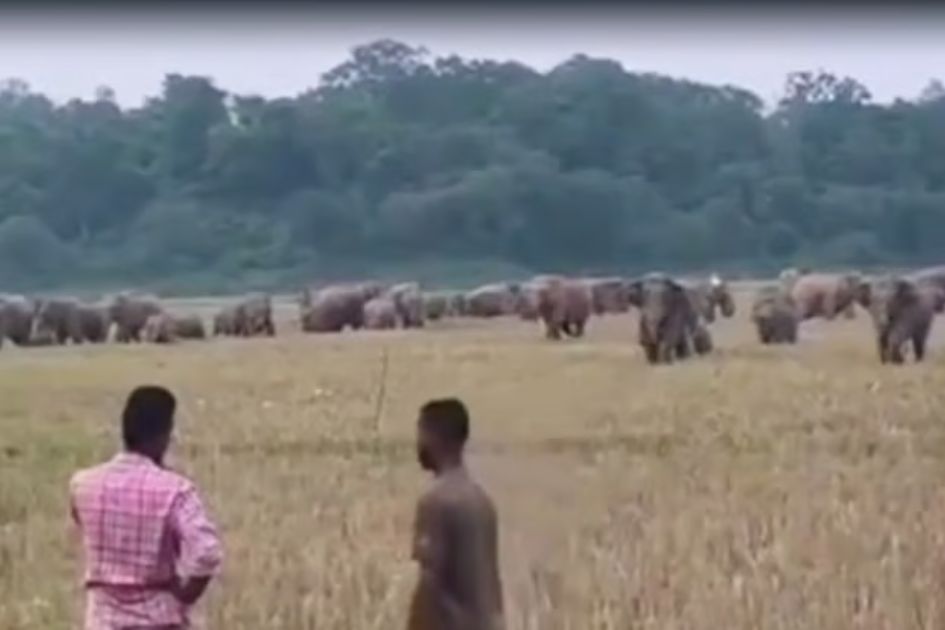
Video footage obtained by this reporter shows a herd of elephants emerging from the forest near Nakugaon land port in Sherpur district’s Nalitabari upazila last Thursday and entering rice fields at dusk. As more than a hundred villagers watched from a distance, one elephant moved ahead of the herd before becoming entangled in electrified wires hidden inside the fields. The animal collapsed and writhed in pain while onlookers were seen cheering.
Local residents sensitive to wildlife protection said copper GI wires connected to generators had been spread across about one kilometre of farmland bordering the Garo Hills to prevent elephants from entering cropland. More videos of the traps later spread on several Facebook pages.
Forest officials said they faced resistance from villagers when trying to remove the illegal traps. They accused Noabil Union Parishad chairman Mizanur Rahman and local union council member Md Mannan of inciting attacks on forestry workers.
Both Mizanur Rahman and Md Mannan were present at the scene during Thursday’s attempted elephant killing, according to members of the Elephant Response Team (ERT). ERT members said they were unable to safely drive the elephants back to the forest because of obstruction from local residents.
Forest Department data show that 32 elephants were killed in Netrokona, Sherpur, Mymensingh and Jamalpur districts between 2016 and 2025.
Speaking to reporters, Mizanur Rahman said rice was cultivated on 300 to 400 acres west of Nakugaon port and local people used generators to light lamps in the fields to deter elephants. He admitted that farmers occasionally connected those generators to electric fencing.
However, he denied personally assisting in setting up electrified wires and also rejected allegations that forestry officials had been attacked.
Nalitabari Range Officer Dewan Ali said villagers jointly drove elephants away while most of the paddy remained unharvested. But after half the crop had been cut, some farmers were left alone to protect their fields and resorted to electrified GI wire fencing.
He said forestry staff were surrounded and blocked by villagers when they tried to dismantle the electric traps on Thursday.
Dewan Ali added that the government provides compensation for crop damage caused by wild animals but many villagers are reluctant to follow the formal process because it takes one to one-and-a-half months for payments to arrive. He said the Forest Department distributed 859,000 taka in crop compensation only last week.
According to Forest Department records, only seven general diaries and one police case were filed over the 32 elephant killings recorded in the Garo Hills region over the past decade. Another case was filed in a forest court.
Attempts to contact union council member Md Mannan by phone regarding allegations of attacks on forestry workers were unsuccessful.
Bangladesh’s newly passed Wildlife (Conservation and Security) Act 2026 classifies elephants as a protected flagship species under Schedule 1(a). Elephant killing is considered a cognisable and non-bailable offence.
Under the law, anyone convicted of killing an elephant or tiger without a licence faces a minimum of two years and up to seven years in prison, along with fines ranging from 100,000 taka to 1 million taka for a first offence. Repeat offenders can face up to 12 years in prison and fines of up to 1.5 million taka.
Section 37 of the law also empowers forest officials and law enforcement agencies to arrest suspected wildlife offenders without a court warrant in cognisable cases.
The International Union for Conservation of Nature (IUCN) listed elephants as critically endangered in Bangladesh in 2016. An IUCN survey conducted that year estimated the country’s elephant population at 268.
Forest Department figures show that 146 elephants died in Bangladesh between 2016 and 2025. Of those, 26 were killed using electric traps. Authorities say the use of electrified fencing to kill elephants has been increasing not only in Sherpur but also in Jamalpur, Mymensingh, Rangamati, Cox’s Bazar and Chattogram.
M A Aziz, a zoology professor at Jahangirnagar University and elephant expert, said both farmers’ livelihoods and elephant conservation needed equal attention.
“There are more elephants in Sherpur than the surrounding forest areas can support, yet wildlife management remains inadequate,” he said. “Authorities tend to react only after incidents occur. The Forest Department must work year-round to raise awareness among local people and strengthen the capacity of Elephant Response Team members to guide elephants safely back to forests.”
This post is republished from Prothom Alo.




