

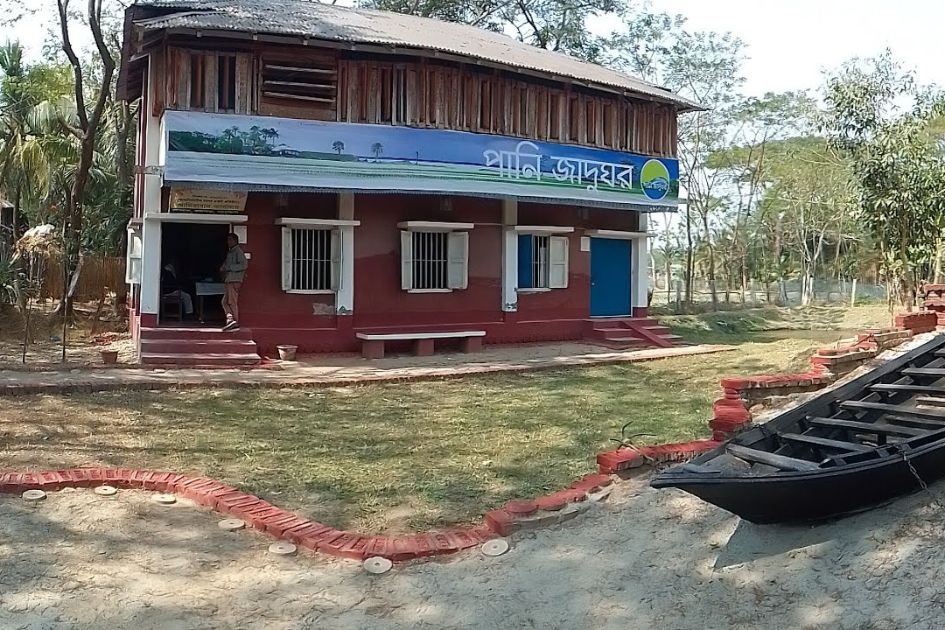

Asia’s first water museum in Patuakhali, preserving water from 87 rivers and river heritage, faces declining visitors and funding shortages despite its importance for climate awareness and environmental education.
Asia’s first water museum, home to preserved water collected from 87 rivers and a unique archive of river heritage, is struggling to survive as visitor numbers sharply decline and financial support remains limited in southern Bangladesh.
The museum, located in Kalapara of Patuakhali district near the tourist destination of Kuakata, was established on December 29, 2014 under the “AVAS” project funded by ActionAid Bangladesh. It is recognised as Asia’s first and the world’s seventh water museum.
Built on 15 decimals of land beside the Pakhimara market area by the coastal social welfare organisation Upokuliya Janakalyan Sangha, the museum was created by 485 men and women from five villages to raise awareness about climate change, environmental degradation and the growing threats facing rivers and water resources.
“Natural disasters, barriers to the normal flow of rivers, pollution and climate change are causing rivers to lose their identity day by day,” said Mohammad Zainal Abedin, president of the organisation and member secretary of the museum management committee.
“The artificial scarcity of water and environmental risks are negatively affecting agriculture, culture and the social structure. The museum was established to create public awareness about these issues,” he said.
Inside the two-storey tin-roofed building, visitors can see rows of white glass bottles containing water collected from 87 rivers. The collection includes water from 58 transboundary rivers flowing into Bangladesh from Nepal, India, Bhutan and Myanmar along with water from 30 domestic rivers.
The museum also displays fading rural traditions and river-based lifestyles through fishing boats, fish traps, cast nets, crab-catching tools, weaving machines, bamboo containers, clay cooking pots and brass utensils.
Photographs on the walls depict rivers, canals and the lives of fishermen, potters, weavers and other communities dependent on waterways.
At the entrance, a boat anchored with chains on sand symbolises rivers drying up because of human-made obstructions.
Despite its rare collection and environmental significance, the museum is now facing a severe crisis.
“Initially there was a large number of local and foreign tourists, but now visitors have decreased drastically,” Abedin said.
“The lack of government patronage, the distance from Kuakata and insufficient publicity have made it difficult to keep the museum running.”
Entry fees are 10 taka for students and 20 taka for other visitors.
Museum director Lipimitra said daily attendance has fallen to an alarming level.
“Previously both local and foreign tourists visited regularly. Now on average only three to five visitors come each day,” she said.
“As a result, maintaining regular operations and preserving the exhibits has become a major challenge.”
She added that years of limited income and insufficient support have made infrastructure renovation, exhibit preservation and promotional activities increasingly difficult.
Visitor Shamim Reza described the museum as a rare educational experience.
“Seeing water from 87 rivers together is truly unique,” he said. “This is an important place for learning. With proper renovation and initiatives, it could become a valuable national asset.”
Uttam Sarkar, organisational secretary of the museum management committee, said the museum symbolises the sacrifices and heritage of coastal communities.
“It is an effective initiative to raise awareness among younger generations about rivers and water resources,” he said.
Sarkar said the museum received significant attention in its early years when ActionAid actively supervised operations. Although some renovation work is currently underway, he said a more coordinated plan is needed to attract tourists again.
K.M. Bacchu, convener of the coastal environmental movement group UPORA in Kuakata, described the museum as a matter of pride.
“People become familiar with water from 87 rivers here. The museum should be renovated and enriched,” he said.
He added that tourists visiting Kuakata must set aside extra time to travel to the museum, discouraging many from going there.
“If it were located closer to Kuakata, it would receive much greater recognition,” he said.
Mezbha Uddin Mannan, Kalapara coordinator of the environmental group DHARA and former general secretary of Kalapara Press Club, called the initiative highly commendable.
“This museum is one of the clearest examples of disappearing rivers, canals and environmental degradation,” he said. “It is extremely important for the younger generation.”
Mannan said ActionAid continues to oversee and renovate the museum annually, but visitor numbers are still declining.
“We believe preserving this museum is essential. It should be relocated closer to Kuakata to ensure its survival,” he added.
Environmental activists and museum organisers say that with proper support, promotion and government patronage, the museum could once again become an important centre for tourism and environmental education in Bangladesh’s coastal region.
This post is republished from Jago News.




