

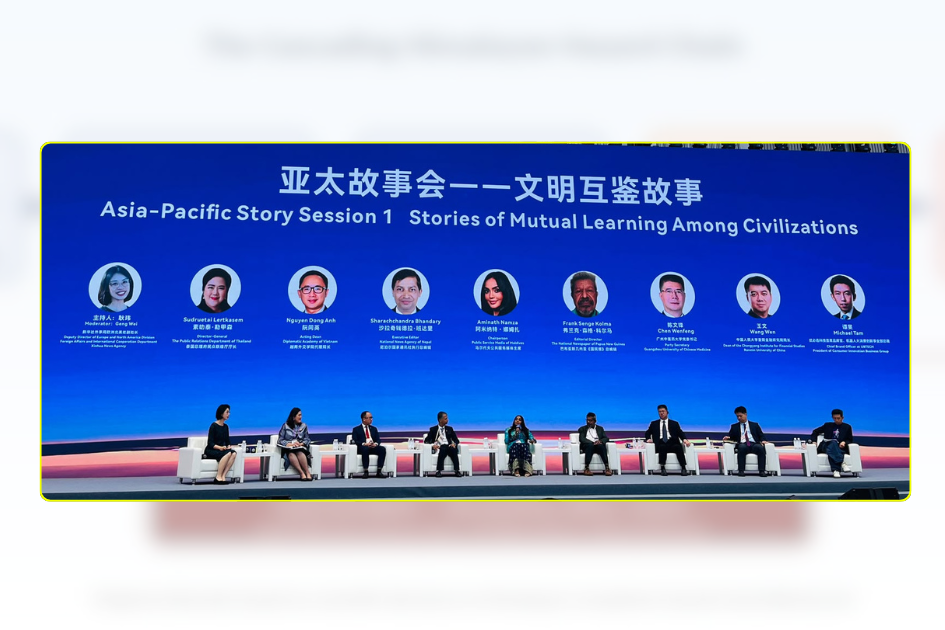



Speakers at the Asia-Pacific Media Forum in Shenzhen call for stronger media cooperation, mutual trust and regional integration amid rapid digital transformation and growing challenges to communication.
The Asia-Pacific Media Forum opened in Shenzhen on Saturday (5 September) with a focus on strengthening mutual trust, regional cooperation and communication as media organisations across the Asia-Pacific region face profound changes from digital transformation.
The forum, themed “Building a Path to Shared Prosperity for the Asia-Pacific Community: Media Consensus and Action”, is being held at the Qianhai International Convention Center. Li Shulei, head of the Publicity Department of the Central Committee of the Chinese Communist Party and a member of the Politburo of the Chinese Communist Party, delivered the welcome speech.
The opening ceremony also featured speeches by Melissa Fleming, Under-Secretary-General for Global Communications at the United Nations; Lyu Yansong, editor-in-chief of Xinhua News Agency; Shezra Mansab Ali Khan Kharal, Minister of State, Ministry of Climate Change and Environmental Coordination, Pakistan; Dmitri Gornostaev, Deputy Director General of Rossiya Segodnya, Russia; Zhu Min, former deputy governor of the People’s Bank of China and former deputy managing director of the International Monetary Fund; Konstantinos Oikonomou, senior vice president of CNN; Felix Paz Quiroz, director of Agencia Peruana de Noticias Andina, Peru; and Qian Chaoyang, chairman of the board of China Southern Power Grid Co., Ltd.
The forum documents say media should reduce misunderstandings, enhance mutual trust through interaction and establish closer regional cooperation mechanisms to collectively shape a more authentic, multi-dimensional and comprehensive picture of people-to-people and cultural exchanges in the Asia-Pacific region.
The Asia-Pacific Communication Index says the communication model of APEC has been continuously evolving from “event-driven coverage of annual meetings” to “value-oriented discussions on a regular basis”, with growing regional influence. It identifies openness, innovation and cooperation as the core themes of APEC communication, saying openness has received the most in-depth analysis, innovation has led in communication growth rate and cooperation has covered the widest range and generated the highest level of consensus.
The forum is also set to release the Shenzhen Consensus of the Asia-Pacific Media Forum, adopted by participating delegates. The document reflects broad agreement on advancing open cooperation, driving digital, intelligent and green development and strengthening media collaboration. It also underscores a shared commitment to upholding multilateral trade, expanding AI-driven solutions, fostering intercultural dialogue and jointly advancing prosperity across the Asia-Pacific region.
Eight Chinese member organisations of the Organizing Committee of the Asia-Pacific Media Partnership Program are also scheduled to exchange cooperation documents with foreign counterparts.
The agreements include a memorandum of understanding on mutual cooperation between People’s Daily of the People’s Republic of China and Editora Perú of Republic of Peru; a memorandum of understanding on the Global South Media and Think Tank Forum Mechanism between Xinhua News Agency of the People’s Republic of China and News and Periodicals Enterprise Ministry of Information of the Republic of the Union of Myanmar; and an agreement on deepening cooperation between China Media Group and Rossiya Segodnya International Media Group.
Other agreements involve China Daily and Sin Chew Daily; China International Communications Group and the autonomous non-profit organization “TV-Novosti” (Russia Today TV, RT); China News Service and Asia Times; Nanfang Media Group and Antara News Agency; and Shenzhen News Group and the Global Alliance of Business Newspapers.
The forum is also launching the “Gather in Shenzhen, Create a Better Asia-Pacific” Media Cooperation Initiative, consisting of three major projects.
The first focuses on technology sharing through the Asia-Pacific Digital and Smart Media Shenzhen Center. The initiative says Shenzhen is developing technological infrastructure for the media industry, an OpenHarmony ecosystem, digital and intelligent laboratories and diversified application scenarios. It aims to share technologies and application achievements with media partners across the Asia-Pacific region.
The second project focuses on content co-creation through the “Witness Miracles, Seek Solutions” Co-Creation and Simulcast Program. It invites media partners across the Asia-Pacific and the world to take Shenzhen as a typical case and development model to jointly plan and produce objective, authentic and multi-dimensional content products.
The third element is the Training Project of Asia-Pacific Media Partnership Program (APMP 100). Organised by Xinhua News Agency, the programme will provide training opportunities for 100 media professionals from across the Asia-Pacific in 2026. Its curriculum covers converged media development in China, platform-based communication ecosystems, practical applications of artificial intelligence, innovation in communication and technology-enabled content production.
The first APMP 100 session was held in Beijing from July 22 to 24, with 32 journalists participating. The second session is scheduled to be held in Shenzhen from September 6 to 8.
The forum programme also includes a Science and Technology Innovation Achievement Exhibition featuring technological achievements from Guangdong Province, particularly Guangdong-made products and smart manufacturing in Shenzhen. Its four thematic zones focus on intelligent media applications, embodied intelligence, quality living and smart cities.
The forum began with arrival and registration on September 2, followed by field visits and panel discussions on September 3 and 4. The opening ceremony and plenary session are being held on September 5.
A plenary session scheduled for the afternoon includes speeches by Xi Yanchun, vice president of Xinhua News Agency; Prak Thaveak Amida, under secretary of state at Cambodia’s Ministry of Information; Huang Hanquan, president of the Chinese Academy of Macroeconomic Research; Ye Tint, deputy minister at Myanmar’s Ministry of Information; Huang Can, vice president and editor-in-chief of Nanfang Media Group; Kaewkamol Pitakdumrongkit, executive director of the Pacific Economic Cooperation Council International Secretariat; Virgandhi Prayudantoro, director of news at the Indonesian National News Agency; Yu Meng, vice president and vice president of imaging at vivo; and Nur-ul Afida Binti Kamaludin, chief executive officer of the Malaysian National News Agency (BERNAMA).
The forum also includes experience sharing under the Joint Interview Program for Asia-Pacific Journalists and the release of the Asia-Pacific Communication Index.
A think-tank report titled “Openness, Innovation and Cooperation: Building a More Prosperous Asia-Pacific Community”, released by the Xinhua Institute at the forum, says APEC has grown into the premier economic cooperation mechanism in the Asia-Pacific, with the highest institutional level, the broadest scope of cooperation and the greatest regional influence.
According to the report, APEC member economies are home to approximately 40 percent of the world’s population, account for more than 60 percent of global GDP and nearly half of global trade. It says the region has become a hub for global economic growth, an anchor of stability for global development and a powerhouse for cooperation.
The report also highlights multilateral frameworks including the Belt and Road Initiative and the Regional Comprehensive Economic Partnership, saying they have helped advance trade and investment liberalisation and facilitation, deepen economic and technical cooperation and boost the flow of goods and personnel.
The forum is being hosted by the Publicity Department of the CPC Central Committee, Xinhua News Agency and the People’s Government of Guangdong Province, and organised by the Shenzhen Municipal People’s Government.




