

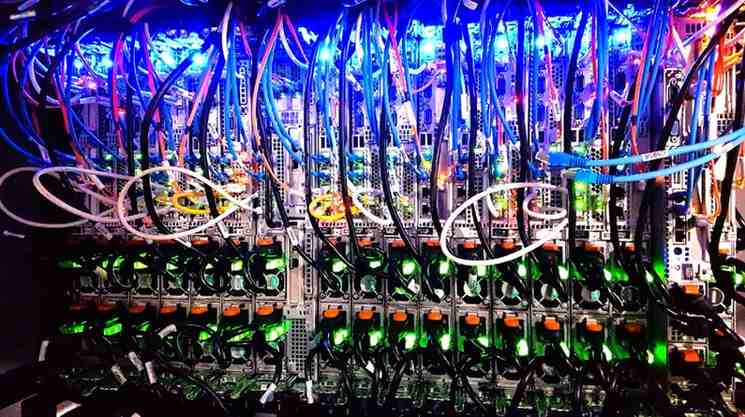



Tech giant Amazon has twice as many data centers worldwide, including in India, as previously reported.
mazon uses far more data centres across the globe—and has a bigger impact on the environment—than previously reported, leaked data reveals.
The Seattle-based company has bet billions of dollars on an expansion into cloud computing and AI-assisted services, from automated coding to translation, and is building hundreds of data centers worldwide as it vies with Microsoft and Google for leadership of the booming AI market.
Amazon has never said publicly how many data centers it operates, or how much energy and water they use. Industry estimates put the number between 100 and 475. But leaked figures seen by SourceMaterial show the true figure is much higher.
In 2023 Amazon used 924 data centers in more than 50 countries, with many more in development, the data shows.
Along with its competitors, Amazon has come under increasing scrutiny for its energy use, amid concerns that data centers are driving a spike in electricity demand that will delay a transition away from fossil fuels.
“New data centers are directly causing utilities to build new gas plants and delay coal plants’ retirements, and that locks us into using dirty energy for decades at a minimum,” said Eliza Pan, a former worker in Amazon’s cloud computing arm and spokeswoman for Amazon Employees for Climate Justice.
Water consumption is also a worry. In April a SourceMaterial investigation revealed that Amazon, Microsoft and Google are building data centers, which use vast volumes of water for cooling, in some of the world’s driest areas.
Kylee Yonas, an Amazon spokeswoman, defended the company’s green record:
“Not only are we the leading data center operator in efficiency, we’re the world’s largest corporate purchaser of renewable energy for five consecutive years with over 600 projects globally,” she said.
Amazon’s claims on green energy are controversial: the company has been criticized for using “creative accounting” by buying renewable energy certificates alongside direct purchases of green energy.

In Germany, the online marketplace DataCentres.com lists four Amazon data centers. The leaked data records 50. According to the leak, these data centers used at least 1.3 million megawatt hours of electricity in 2023, more than enough to power every household in Frankfurt, the city where all but a few of Amazon’s smallest German data centers are located.
In the Indian business capital, Mumbai, Amazon has three ‘availability zones’, each with one or more data centers, according to the company’s website. The leaked records seen by SourceMaterial from inside Amazon reveal that last year Amazon used 16 data centers in the city.
Leased servers
Amazon’s presence is also much larger than previously realised in many other countries, including Japan, Singapore and the United Kingdom. Like Germany and India, these countries have all seen plans to move away from fossil fuels challenged by the AI boom.
In the UK, developers are exploring linking data centres to the country’s main gas pipelines amid a rush for energy access, according to a recent report.
Data centres currently account for 1.5 per cent of global energy demand. That could rise to 4.4 per cent by 2035 as AI boom drives construction, nearly twice as much as the aviation sector consumes today, according to the International Energy Agency.
The reason that the number of Amazon data centres has been underestimated is likely to be the company’s use of servers that it leases rather than owns, according to a letter sent by a former Amazon employee to the US Federal Trade Commission last year and seen by SourceMaterial.
Amazon has leasing arrangements with 180 partners, the leaked data shows.
‘They are everywhere’
In the letter to the FTC, the employee raised concerns that these undisclosed data centers could potentially conceal an Amazon monopoly over the cloud computing market. (The Trade Commission did not open an anti-monopoly investigation.)
Amazon has concentrated the centers it owns outright in Virginia and Ohio, where gas and coal provide a large share of electricity. Outside the US, Amazon usually rents either entire facilities or server racks in centers shared with other companies.
“New data centers are directly causing utilities to build new gas plants.”
It is the shared “colocation” units that account for the largest increase in data center energy use globally, said Shaolei Ren, a computing specialist at the University of California, Riverside.
“Most of the energy in the data center industry is going into colocations,” he said. “They are everywhere.”
In 2023, Amazon’s colocation data centers used over 7.8 million megawatt hours of electricity, according to the data, more than enough to power every home in Seattle and San Francisco combined. These centers account for about a fifth of Amazon’s total processing power, the figures show.
Colocation facilities are often smaller, and more likely to be built in urban areas rather than remote locations favored for hyperscale data centers like Amazon’s sprawling Project Rainier complex in rural Indiana, Ren said.
Revelations of the extent of Amazon’s data center expansion come amid warnings of an investment bubble in the AI industry. Earlier this month, Sundar Pichai, the head of Google’s parent company, Alphabet, said that there was some “irrationality” in the wave of investment that has swept the market.
XXX
Each day, Kiran Kasbe drives a rickshaw taxi through his home neighborhood of Mahul on Mumbai’s eastern seafront, down streets lined with stalls selling tomatoes, bottle gourds and aubergines–and, frequently, through thick smog.
Earlier this year, doctors found three tumors in his 54-year-old mother’s brain. It’s not clear exactly what caused her cancer. But people who live near coal plants are much more likely to develop the illness, studies show, and the residents of Mahul live a few hundred meters down the road from one.
Mahul’s air is famously dirty. Even behind closed car windows, there is a heavy stench of oil and smoke.
“We are not the only ones facing health challenges in the area,” said Kasbe, who is 36. “It’s all covered with filth.”
Two coal plants plant run by the Indian multinationals Tata Group and Adani were due to close last year in a government push to cut emissions. But late in 2023, those decisions were reversed after Tata argued that electricity demand was rising too fast for Mumbai to go without coal.
Neither company responded to requests for comment.

Economic growth and the need for air conditioning in climate change-linked extreme heat have seen India’s electricity demand soar in recent years. But an investigation by SourceMaterial and the Guardian reveals the biggest single factor in the city’s failure to end its dependence on fossil fuels: energy-hungry data centers.
Leaked records also reveal the scale of the presence of the world’s biggest datacentre operator, Amazon, in Mumbai.
In the city’s metropolitan area, Amazon, on its website, records three “availability zones”, which it defines as one or more data centers. Leaked records from last year seen by SourceMaterial from inside Amazon reveal the company used 16 in the city.
As India transforms its economy into a hub for artificial intelligence, the data center boom is creating a conflict between energy demand and climate pledges, said Bhaskar Chakravorti, who researches technology’s impact on society at Tufts University.
“I’m not surprised they’re falling behind their green transition commitments, especially with the demand growing exponentially,” he said of the Indian government.
Kylee Yonas, a spokeswoman for Amazon, said Mumbai’s “emission challenges” were not caused by Amazon.
“On the contrary – Amazon is one of the largest corporate investors in renewable energy in India, and we’ve supported 53 solar and wind projects in the country capable of generating over 4m megawatt hours of clean energy annually,” she said. “These investments, which include our 99 megawatt wind project in Maharashtra, are enough to power over 1.3m Indian homes annually once operational.”
Amazon is building hundreds of data centers around the world as it vies with Microsoft, Google and others for leadership of the booming AI market.

The company is failing to take responsibility for its role in prolonging the use of the most polluting energy sources, said Eliza Pan, a spokeswoman for Amazon Employees for Climate Justice.
“Amazon is using the shiny thing of AI to distract from the fact that it’s building a dirty energy empire,” she said.
Yonas denied this, saying: “Not only are we the leading data center operator in efficiency, we’re the world’s largest corporate purchaser of renewable energy for five consecutive years with over 600 projects globally.”
Amazon’s claims on green energy are controversial: the company has been criticized for using “creative accounting” by buying renewable energy certificates alongside direct purchases of green energy, as described by a member of Amazon Employees for Climate Justice.
‘Everything is contaminated’
Mahul, where Kasbe drives his rickshaw, is a former fishing village now home to tens of thousands of people who moved there after slum clearances elsewhere in the city.

Kasbe and his mother arrived there in 2018 after their home in the suburb of Vidyavihar was bulldozed. She had been healthy before the move but deteriorated rapidly until eventually she was diagnosed with brain cancer, he said.
Gajanan Tandle, who lives nearby, said pollution-linked illnesses were common. “There are so many cases of skin and eye irritation, cancer, asthma, TB and more, and no assistance from the government,” he said.
Another local, Santosh Jadhav, has lobbied the government to move people away from Mahul.
“Everything is contaminated. We are tired of fighting for a decent means of living,” he said. “It’s hell for us here.”
Hidden data centers
Amazon, an online marketplace that processes 13 million customer purchases each day, according to research by CapitalOne, has bet billions of dollars on an expansion of its lucrative cloud computing business and expansion of AI-assisted services, from automated coding to translation.
The reason so many of its Mumbai centers have slipped under the radar is that they are leased rather than owned by the company. Whereas in the US Amazon tends to own its facilities outright, elsewhere it often rents either entire data farms or server racks in centers shared with other companies.
Shared “colocation” units account for a larger increase in data center energy use worldwide than owned or wholly leased, according to Shaolei Ren, a computing specialist at the University of California, Riverside.
“Most of the energy in the data center industry is going into colocations,” he said. “They are everywhere.”

Amazon’s Mumbai colocation data centers used 624,518 megawatt hours of electricity in 2023, enough to power over 400,000 Indian households for a year, the leaked data shows.
India is poised to overtake Japan and Australia to become the second-largest user of data center electricity in the Asia-Pacific region, S&P has forecast. By 2030, data centers will consume a third of Mumbai’s energy, according to Ankit Saraiya, chief executive of Techno & Electric Engineering, an Indian power infrastructure supplier.
‘Toxic hell’
As it scrambles to keep ahead of demand for power, the state government of Maharashtra has extended the life of Tata’s coal plant in Mahul by at least five years. At the same time, it also postponed the shutdown of a 500-megawatt station operated by Tata’s rival, Adani Group, north of the city.
When Tata argued for the extension in a petition to the state energy board, the biggest single factor the company cited was increased energy demand from data centers. Adani said most anticipated new demand in the five years after the date by which its station was due to close would be from data centers.
The power stations are just two of many polluters in Mumbai’s Mahul district. The area is also home to three refineries and 16 chemical factories, according to a 2019 report published by India’s Centre for Policy Studies which called the neighborhood a “toxic hell”.
But the Tata station, opened in 1984 and like other older power stations subject to laxer emissions rules, is “one of the key sources of air pollution in Mumbai”, according to Raj Lal, chief air quality scientist at the World Emission Network.
It contributes nearly a third of local PM2.5 pollution, according to the Centre for Research on Energy and Clean Air. PM2.5 refers to airborne particles 2.5 micrometers or less in diameter that can cause significant health problems when inhaled.

Toxic heavy metals in coal ash from the plant are likely to cause “respiratory diseases, kidney issues, skin problems, cardiac issues”, said Shripad Dharmadhikary, founder of the environmental organization Manthan Adhyayan Kendra.
Even with the Tata plant kept running, Mumbai’s power grid is creaking under the strain of surging demand. To guard against blackouts, Amazon’s colocation data centers in the city have bought 41 diesel generators as backup and are asking for approval to install more, documents show.
In August a report by the Center for Study of Science, Technology and Policy (CSTEP) identified diesel generators as a major source of air pollution in the region.
The presence of data centers that require constant power and diesel generators for backup “will naturally exacerbate emissions”, said Swagata Dey, air quality specialist at (CSTEP), asserting that data center operators should be required by law to power them with pollution-free solar electricity.
One Amazon site in particular, just across the Thane Creek from Mahul, hosts 14 generators. One of the company’s partners received permission earlier this year to install 12 further generators at the site.
“Public health impacts must be a central consideration when siting data centers and choosing energy sources,” said Ren of the University of California, Riverside, who co-wrote a recent paper assessing public health risk from diesel generators at US data centers.
The report was produced with support from Internews’ Earth Journalism Network as part of the “Dark Side of the Boom” collaborative reporting project on resource-intensive digital technology in Asia. It was first published in the Bloomberg on November 24, 2025. It has been lightly edited for length and clarity.




