

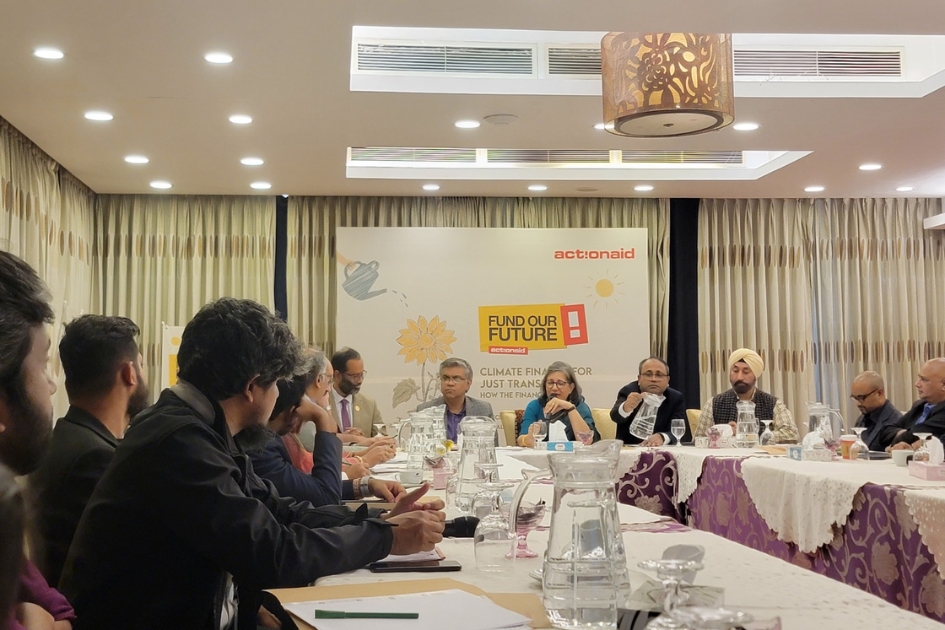



Experts, policymakers and activists met at an ActionAid Bangladesh roundtable to assess COP30 outcomes, expose climate finance gaps and call for grants-led just transition protecting workers, women and vulnerable communities.
ActionAid Bangladesh brought together experts, policymakers, and activists to discuss the harsh realities of climate finance and the latest decisions from COP30. The roundtable, titled Climate Justice Campaign: Fund Our Future, focused on sharing findings from ActionAid’s latest global report, Climate Finance for Just Transition: How the Finance Flows, and exploring how Bangladesh can push for a fairer shift toward a green future. With climate change hitting farmers, women, and coastal communities hardest, the event highlighted the urgent need for more grants, less debt, and real action on the ground.
The event drew participants from civil society organizations, women’s groups, youth networks, unions, researchers and government officials. It was part of ActionAid’s ongoing Fund Our Future campaign, launched globally in 2023 to address financial systems that fuel climate injustice. The campaign has been tracking where climate finance goes and where it falls short. This year’s report, released in November 2025, is the third in the series and presents a worrying picture. Despite repeated promises, funds for a just transition that protects workers’ jobs, women’s rights and community livelihoods during the shift away from fossil fuels are shrinking.
Farah Kabir, Country Director of ActionAid Bangladesh, set the tone by emphasizing the campaign’s focus. “This year, ActionAid is prioritizing its work on just transition to ensure climate action is fair, inclusive and people-centered,” she said. She pointed to a stark imbalance, noting that while trillions of dollars continue to flow into fossil fuels, climate finance for local communities, youth and women remains minimal or largely invisible. Farah stressed that a just transition is impossible unless climate finance is redirected toward empowering local people, especially youth and women who are on the frontlines of climate impacts.
The discussion also reflected on key outcomes from COP30, which recently concluded in Belem, Brazil. The conference introduced initiatives such as the Belém Action Mechanism, aimed at making global climate efforts more inclusive. However, speakers cautioned that these steps may not be sufficient. Harjeet Singh, a prominent climate activist, offered a sobering assessment. “COP may have saved multilateralism, but it has not saved the climate,” he said. He added that the Paris Agreement now carries a major question mark, as the promise to limit global warming to 1.5°C remains uncertain.
Bangladesh’s unique vulnerability to climate impacts, from rising sea levels to recurring floods, was a central theme of the discussion. Golam Rabbani, a climate adaptation expert, highlighted the growing debt burden faced by developing countries. “With global climate funds being limited, Bangladesh must safeguard its national priorities, yet in doing so we are increasingly falling into a debt trap,” he said. He also drew attention to the lack of funding for locally led adaptation, noting that it receives less than 10 percent of total climate finance, despite its importance.
Rajibul Islam, Joint Secretary at the Economic Relations Division, reinforced these concerns with data. He noted that only 10 percent of Bangladesh’s total climate finance comes in the form of grants, while the remaining 90 percent is provided as loans. He described this as an alarming reality for a highly climate-vulnerable country and urged development partners to shift their focus from mitigation toward urgently needed adaptation finance.
Several speakers focused on practical pathways forward. Asaduzzaman from UNDP stressed the importance of collaboration, stating that climate projects require financing from both the government and the private sector, alongside a comprehensive climate finance strategy. He warned that without a clear strategy, tracking climate finance sources and their effective use becomes extremely difficult.
Dr. Anil Kumar Saha from FAO echoed the call for joint action, emphasizing that climate funds are extremely limited for countries like Bangladesh, making cooperation between the government and the private sector essential.
From the financial sector, Morshed Millat of Bangladesh Bank discussed evolving regulatory frameworks. He said Bangladesh Bank’s climate risk management guidelines align well with national priorities, including the National Adaptation Plan and the Sustainable Development Goals. However, he acknowledged that private sector and banking engagement remains limited, with most interest focused on mitigation rather than adaptation. To address this gap, he suggested promoting public-private partnership projects centered on adaptation and called for a dedicated climate finance taxonomy similar to the green finance taxonomy.
The roundtable also highlighted key findings from ActionAid’s global report. Globally, only 2.8 percent of multilateral climate mitigation finance supports just transition efforts, equivalent to just one dollar in every 35 spent over the past decade. In Bangladesh, the pattern is similar, with fossil fuels and large-scale industrial agriculture receiving the majority of funding, while workers, women, farmers and marginalized communities are largely overlooked. The report calls for trillions of dollars in grants from the Global North, a rapid phase-out of fossil fuels and the integration of just transition principles into national policies.
Reflecting on ActionAid’s activities in 2025, a flyer shared at the event highlighted several milestones. These included the Renewable Energy FEST in April, where youth showcased green technologies; a nationwide strike on April 11 that mobilized more than 2,100 activists in support of renewable energy; and the Global Climate Strike on November 14, which involved 3,195 participants demanding “Just Transition Now!”
By the end of the discussion, participants agreed on several outcomes, including a stronger shared understanding of global climate finance gaps, consensus on policy priorities for Bangladesh and stronger coalitions among civil society and advocacy groups. As outlined in the concept note, the event aimed to strengthen national commitment toward systemic change, ensuring that climate finance supports inclusive, gender-responsive and community-driven pathways.
In a country where climate disasters are part of daily life, the roundtable served as a reminder that change begins with dialogue. Yet speakers emphasized that words must translate into action through more grants, stronger strategies and a clear focus on those most affected. ActionAid’s message was clear and urgent: fund our future fairly.




