

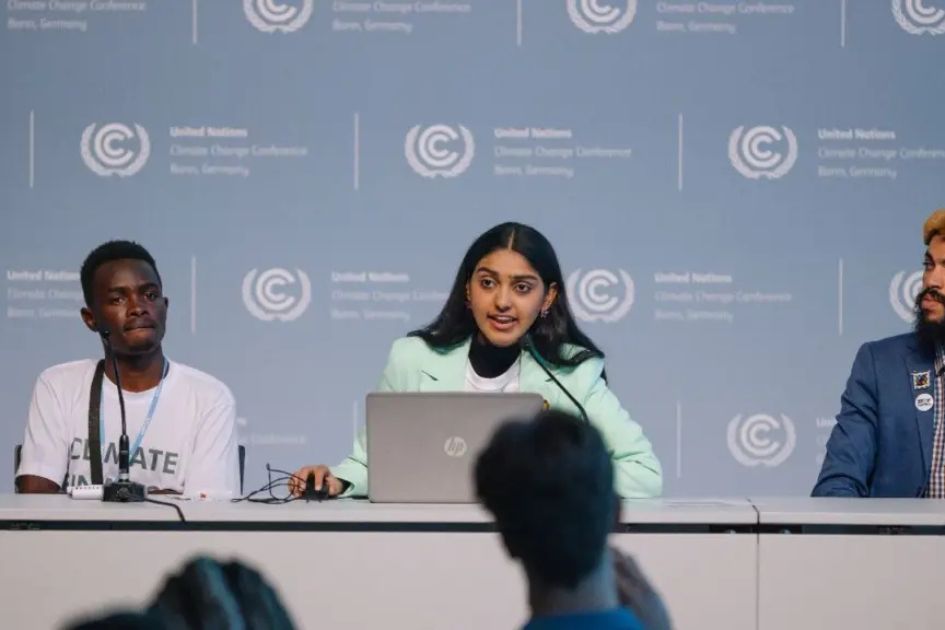



Indian climate justice advocate Zainab Bie is amplifying Global South voices in UN climate negotiations, pushing for equitable climate finance, inclusive policymaking and greater representation of vulnerable communities worldwide.
In the complex world of global climate negotiations, where financing formulas and policy frameworks often dominate discussions, young Indian climate justice advocate Zainab Bie is working to ensure that the voices of the most affected communities are not left behind.
Based in Delhi, Bie has emerged as a prominent advocate for equitable climate finance and stronger representation of developing nations in international climate policymaking. Working with Equal Right, an organisation focused on climate justice and redistribution, she has become a vocal supporter of mechanisms aimed at mobilising climate finance and distributing resources more fairly among countries most vulnerable to climate change.
Still in her early twenties, Bie has represented youth and Global South perspectives at major international climate forums including COP27 in Egypt, the UN Bonn Climate Conference, COP28 in Dubai, COP29 in Baku and COP30 in Brazil. She also curates the Impactship Newsletter, a platform designed to improve access to climate fellowships, grants and advocacy opportunities for young people across India and the Global South.
Her journey into climate advocacy began while studying economics at Miranda House, Delhi University. During her studies, she repeatedly encountered a question that would ultimately shape her career: why do the countries suffering most from climate change receive the least financial support to address its consequences?
Growing up in Delhi, Bie witnessed the city’s changing climate firsthand. Heat waves became more intense and prolonged, monsoon patterns grew increasingly unpredictable and poor air quality became a persistent concern.
“India has over 1.4 billion people. The needs, for health, education and poverty eradication, are enormous. And the cost of energy transition falls hardest on workers in mines and factories, on families who depend on those livelihoods. That’s a real human cost,” she said.
As her understanding deepened, she concluded that climate change was not solely an environmental issue but also an economic and social justice challenge.
“The question isn’t just what the temperature will be in 2050. It’s who pays for the damage already happening, and who gets to decide,” she said.
Bie identifies two major inequalities that continue to shape the global climate crisis.
The first concerns the imbalance between those responsible for emissions and those suffering the consequences. Industrialised nations account for the majority of historical cumulative greenhouse gas emissions, yet developing countries often face the most severe impacts, including droughts, floods, cyclones and growing food insecurity.
She points to the New Collective Quantified Goal (NCQG), agreed at COP29 following years of advocacy by developing countries, youth groups and civil society organisations, as an example of this ongoing challenge.
“The headline numbers rarely match the scale of actual needs. And much of what gets counted as climate finance is not new and additional, with significant portions still provided as loans rather than grants, meaning vulnerable countries continue taking on debt to address a crisis they didn’t primarily create,” she said.
The second inequality, she argues, exists within the climate negotiation process itself. International climate conferences remain expensive, highly technical and often inaccessible to many young advocates from developing nations.
“If you’re a young advocate from the global south, even getting accreditation to attend a climate negotiation, where our futures are discussed without us, is a logistical and financial challenge most people never overcome,” she said.
According to Bie, this creates a cycle in which those most affected by climate change remain among the least represented in policymaking spaces.
At COP28, she worked with the International Renewable Energy Agency (IRENA) on renewable energy communications. At COP29 in Azerbaijan’s capital Baku, she concentrated on climate finance negotiations surrounding the NCQG and the Cap and Share model through her work with Equal Right.
Across these forums, she observed what she described as a recurring disconnect.
“The frameworks being debated were written in a language and logic that originated in a very specific part of the world. The Global South perspective, understanding how climate impacts interact with poverty, land rights, food security and informal economies, often had to fight for space,” she said.
She cites examples ranging from farmers in rain-dependent regions facing shifting crop cycles to daily wage workers enduring 48-degree Celsius temperatures without air conditioning and coastal fishing communities whose livelihoods are being altered by changing ocean patterns.
“The disconnect is about whose mental model of the problem gets to shape the solutions,” she said.
For Bie, meaningful inclusion in climate policymaking is not merely symbolic but essential for effective outcomes.
“When people who understand ground realities of climate impacts are in the room, the policies that emerge are different. They include local knowledge. They account for context. They’re more likely to actually work,” she said.
She noted that visible representation alone is insufficient if policy discussions continue to be driven exclusively by priorities developed elsewhere.
“Real inclusion is when someone from a flood-affected community isn’t just invited to speak about their experience, they’re part of the team designing the policy response,” she said.
Bie also advocates unrestricted grants for grassroots organisations and participatory grantmaking processes that give local communities a direct role in determining how resources are distributed.
Equal Right’s approach reflects these principles through support for unconditional cash transfers, allowing communities to decide independently how best to respond to climate-related challenges. This may include strengthening homes against extreme heat, diversifying crops after failed monsoons or maintaining food security following disasters.
As one of the youngest participants in many policy discussions, Bie said she frequently encountered subtle forms of dismissal.
“There’s a very particular kind of dismissal in those settings. It doesn’t always announce itself. Sometimes it looks like being talked over. Sometimes it’s someone assuming you’re there to observe, not contribute. Sometimes it’s a question directed to the person next to you instead of you, even when you raise the topic,” she said.
Preparation and confidence, she said, helped her navigate such situations.
“I also learned you don’t always need permission to take space. Sometimes you simply take it,” she said, adding that knowing her views reflected those of thousands of young people globally gave her the confidence to persist.
Bie often describes her role as “bridge work”, connecting complex climate negotiations with communities that may never encounter the technical language used in international policy forums.
She said she can discuss the architecture of the NCQG with negotiators at a United Nations climate conference and then explain the significance of climate finance to a young person in a small town using examples grounded in everyday life.
“That translation work, carrying ideas and urgency between different worlds, is what feels most alive to me,” she said.
The same philosophy informs the Impactship Newsletter, which curates climate fellowships, grants, jobs and advocacy opportunities for young people, particularly those in smaller cities and towns across India and the Global South.
Looking ahead, Bie hopes Equal Right will become a leading voice on climate finance flows in the Global South and on reforms needed to make those flows more equitable.
Among the ideas she supports is a global carbon budget model under which countries receive proportionate per-capita rights and those exceeding their carbon allocation contribute financially to a redistribution fund benefiting countries with lower emissions.
“It’s a mechanism that turns climate justice from a moral argument into a policy architecture,” she said.
She hopes such proposals eventually move beyond advocacy campaigns and into formal negotiating texts.
Bie also believes the Asia-Pacific region should play a much stronger role in global climate finance discussions.
The decisions taken over the next five to ten years on energy transition, adaptation finance and climate reparations will affect hundreds of millions of people across the region, she said, making stronger representation essential.
Reflecting on her work, Bie’s story highlights the growing influence of young advocates seeking to bridge the gap between global policymaking and local realities.
In a country of more than 1.4 billion people, where the consequences of climate decisions are increasingly visible, her efforts underscore the importance of ensuring that those most affected by climate change have a seat at the table where solutions are shaped.
This post is republished from The Logical Indian.




