

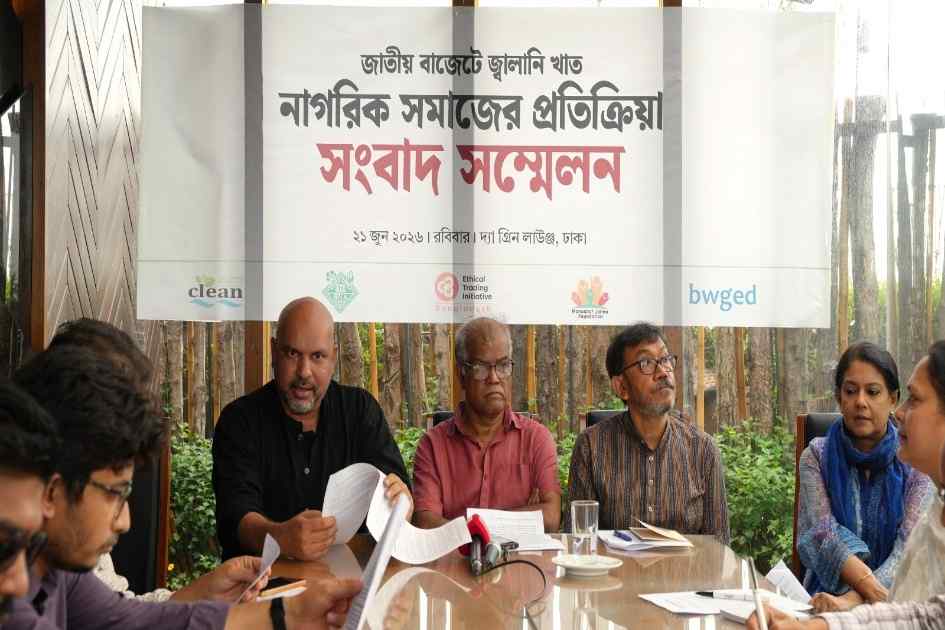

Civil society groups welcomed solar and electric vehicle tax breaks in Bangladesh’s budget, but warned contradictory tax orders, fossil fuel incentives and limited public funding could slow renewable energy growth.
In a joint reaction to the 2026-27 budget, Coastal Livelihood and Environmental Action Network (CLEAN), the Bangladesh Environmental Lawyers Association (BELA), Ethical Trading Initiative (ETI) Bangladesh, Manusher Jonno Foundation (MJF) and the Bangladesh Working Group on Ecology and Development (BWGED) thanked Prime Minister and Finance Minister for what they called landmark decisions to promote solar power and reduce fossil fuel demand in transport.
The groups said that after years of advocacy by civil society, the budget speech on June 11 announced the withdrawal of all import duties, value-added tax and advance income tax on renewable energy equipment, especially solar power equipment. They also noted the decision to waive the 5 percent tax on bills of solar power producers and to significantly reduce customs duties, taxes and registration fees for electric vehicles.
They said the measures could cut the cost of installing rooftop solar systems and producing solar electricity by 30 to 37 percent, helping reduce pressure on the economy from energy imports and supporting the government’s target of installing 10,000 megawatts of solar power by 2030. Lower taxes on electric vehicles could also reduce fossil fuel demand in the transport sector.
But the organisations said the budget’s clean energy promise had already been undercut by a National Board of Revenue order issued on June 8, three days before the finance minister’s budget speech.
They questioned how the order, issued through a statutory regulatory order or SRO, could be published before the finance minister formally proposed the gazette notification on June 11.
Under the SRO, duty and tax waivers for solar panels, inverters and batteries would continue until June 2031, but exemptions for other equipment such as mounting structures, controllers, DC cables and battery energy storage systems would expire in June 2028. The groups said that with only two years left after the new fiscal year, such a short window would make it extremely difficult to expand local production and the market, ultimately slowing solar power growth.
They said the SRO also imposed conditions that would not help the government achieve its targets and would instead obstruct renewable energy expansion.
The first condition restricts the benefit to VAT-registered institutions only. The second says the facility will apply only to Renewable Energy Service Companies, or RESCOs, that generate solar power through their own financing and management and supply electricity to a party under a Power Purchase Agreement, or PPA.
According to the groups, that means only large solar firms installing systems for big companies under PPAs will benefit, while ordinary residential consumers with systems of 1 kilowatt to 5 kilowatts will effectively be left out because millions of households and small entrepreneurs will neither secure financing in that way nor sign PPAs to install rooftop solar.
They said the SRO had therefore created a barrier for millions of residential consumers, from the prime minister’s office to village farmers, and introduced a new inequality between large and small solar businesses. They added that the order also ignored solar irrigation, solar street lighting, solar-powered water supply and agrivoltaics.
The groups accused the NBR bureaucracy of working against the expansion of renewable energy and in favour of fossil fuel imports while disregarding the government’s own policy direction, warning that such an approach could ultimately damage the national economy.
They also criticised what they described as continued incentives for fossil fuels in the budget.
Although the finance minister identified LNG imports as a major challenge in his budget speech, he also kept in place the waiver of 15 percent VAT and 2 percent advance income tax on LNG imports, which the groups said made LNG appear artificially cheap.
The budget also proposed expansion initiatives for the second phase of the Barapukuria coal mine and the Dighipara coal mine. The groups said coal extraction in Bangladesh is no longer economically viable, noting that domestic coal costs around $170 per tonne to extract while imported coal fluctuates between $90 and $120 per tonne.
They said the existing Barapukuria mine should instead be preserved as a strategic reserve and that plans to expand other coal mines should be halted.
The groups also criticised plans in the budget to build a new refinery and strategic fuel storage, saying that if the same amount of money were invested in renewable energy, there would be no need for additional refinery capacity or petroleum storage. They warned that spending on fossil fuels would crowd out adequate financing for renewable energy and said this was already happening.
They pointed out that the budget proposed extending duty and tax concessions on imported coal until June 2030. It also reduced tax at source on fuel supplied from refineries from 1.5 percent to 1 percent and cut tax at source on power supply companies from 4 percent to 3 percent. Both steps, they said, would hinder renewable energy expansion.
The groups noted that the finance minister referred several times in his budget speech to the burden of capacity payments and to corruption under the previous government, which they said was a positive example of acknowledging the problem. They also welcomed his reference to reviewing capacity charges and PPAs.
However, they said he made no commitment to negotiate with independent power producers, or IPPs, or to take legal action to reduce the burden of capacity payments. They said now was the right time for political commitment and effective action, warning that the proposed 40,000 crore taka subsidy in the budget would not be enough to protect the Bangladesh Power Development Board, or BPDB, because its losses in 2024-25 had already exceeded 56,000 crore taka.
They also noted that under renewed PPAs signed between 2021 and 2024, the last rental power plant, the 55-megawatt Ashuganj unit, is due to shut down by November this year, but the finance minister gave no commitment in his speech not to renew rental power plant contracts.
On public spending, the groups said the allocation for the energy and power sector in the 2026-27 development budget totals 17,193 crore taka, including 2,254 crore taka for the Energy and Mineral Resources Division and 14,939 crore taka for the Power Division.
Of that total, only 379.24 crore taka has been allocated for renewable energy, equal to just 2.2 percent of overall energy and power spending.
They said Bangladesh would need at least 21,750 crore taka per year to meet its 2030 renewable energy target, including a minimum of 6,750 crore taka, or $563 million, in public funding.
The groups also said Bangladesh Bank had capped loans from the Green Transition Fund at 30 crore taka, which they described as wholly inadequate for renewable energy. Given that energy and power are among the most sensitive sectors of the economy and that renewable energy offers huge domestic business potential, they said they had demanded the creation of a 25,000 crore taka financing fund, or prefinancing fund, but found no reflection of that in the budget.
They said every kilowatt of solar power installed in Bangladesh reduces fuel oil imports by an average of 30,000 taka per year and saves about 550,000 taka over 20 years. On that basis, they had demanded a subsidy of 25,000 taka per kilowatt for household and agricultural solar systems up to 3 kilowatts, along with an additional 10 percent incentive for women, Indigenous communities and retrenched workers. No such provision was included in the budget, they said.
The groups added that although the finance minister pledged to create 532,000 new and sustainable jobs in various sectors in 2026-27, he ignored renewable energy’s potential to generate at least 1 million new jobs in the country. They said large-scale employment could be created through training led by the Department of Youth Development, the Department of Women Affairs, the Department of Cooperatives and labour and manpower authorities.
In their statement, the organisations placed seven strategic demands before the government.
First, they called for the cancellation of the June 8, 2026 NBR SRO and for all duties and taxes on solar equipment to be removed for the next 10 years for all users.
Second, they demanded the creation of a 25,000 crore taka renewable energy fund in the budget, to be channelled by Bangladesh Bank to commercial banks on an interest-free basis so that banks could lend to renewable energy entrepreneurs at no more than 5 percent interest. They said the mechanism must be based on prefinancing rather than refinancing.
Third, they called for direct subsidies of at least 25,000 taka, or $200, per kilowatt for residential rooftop solar systems in order to encourage citizen participation. To reduce inequality and support marginalised groups, they said projects led by women and Indigenous communities should receive an additional 10 percent subsidy.
Fourth, they urged the immediate activation of guidelines for corporate power purchase agreements and the launch of competitive wheeling charges for industrial and private investors so that merchant power plants can deliver clean electricity through the national grid.
Fifth, they demanded that all newly approved utility-scale solar projects be required to include at least 20 percent battery energy storage capacity to protect grid stability.
Sixth, they called for renewable energy training programmes under the Department of Youth Development, the Department of Women Affairs, the Department of Cooperatives and the manpower authorities to build local skills and create 1 million green jobs every year, reducing dependence on foreign workers for high-skilled tasks.
Finally, they called for a progressive emissions tax on fossil fuel-based power generation and polluting industries to discourage polluters and incentivise green businesses.




