

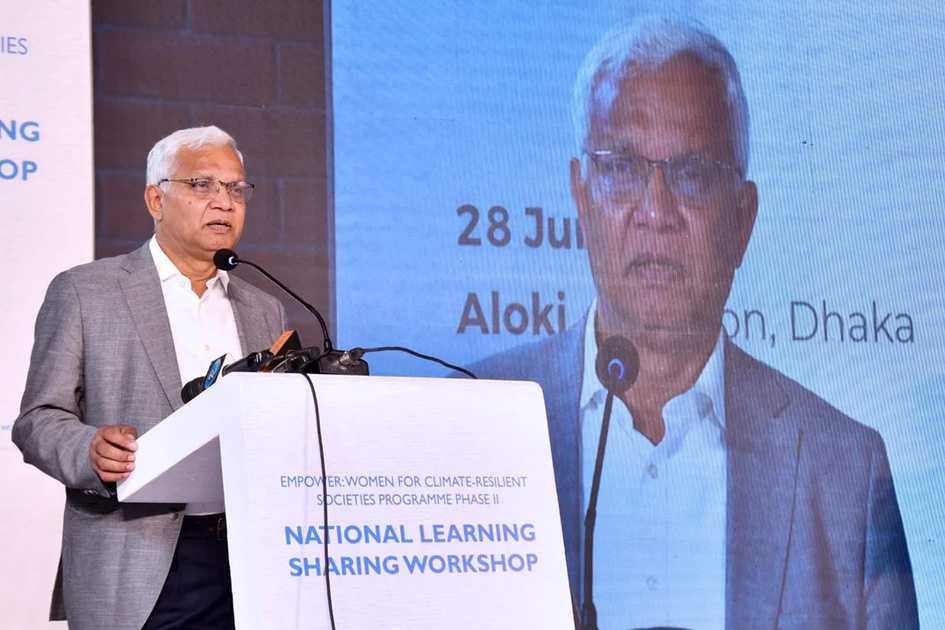



Social Welfare and Women and Children Affairs Adviser Zahid Hossain says women’s leadership must be central to climate adaptation as Bangladesh seeks to scale up grassroots resilience models.
Women’s empowerment in the face of climate change is no longer just a development priority but a matter of national survival in Bangladesh, Social Welfare and Women and Children Affairs Adviser Professor Dr A Z M Zahid Hossain said on Sunday.
Speaking as chief guest at a national workshop in the capital’s Tejgaon area, he said women were among the hardest hit in climate-vulnerable countries like Bangladesh and that sustainable adaptation would not be possible without ensuring their active participation and leadership.
He made the remarks at the “National Experience Sharing and Scaling-Up Workshop” organised by the Empower Women for Climate Resilient Societies project, Phase Two, at Aloki Auditorium.
The adviser said the current government remained firmly committed to women’s empowerment and was giving priority to women in social protection programmes, skills development training and climate adaptation activities. He said the successful experiences generated through the Empower project should now be expanded across the country.
He said rural women suffered the most from disasters driven by climate change, including floods, cyclones, rising salinity and drought. Efforts by the government and international organisations to improve their living standards and strengthen their ability to cope with disasters were commendable, he added.
Expressing gratitude for the Empower project, Zahid Hossain said women trained under the initiative had already improved their lives and were taking leadership roles at the local level in climate-resilient agriculture and livelihood activities. He said the time had come to take that success to a much wider scale.
He stressed that women’s voices must be ensured at every level, from national policymaking to grassroots implementation. A gender-sensitive approach in climate planning was no longer optional but mandatory, he said.
He added that the Ministry of Social Welfare and the Ministry of Women and Children Affairs were ready to work more closely with such projects in the future. The government wanted every woman in the country to be capable of confronting the challenges of climate change and to play a leading role in protecting families and communities, he said.
During the event, project achievements and lessons from activities implemented in several districts were presented. Participants recommended that the successful models highlighted in the discussion should be expanded to other parts of the country.
Among those attending the workshop were UN Women Bangladesh Representative Gitanjali Singh, government officials, development partners, representatives of United Nations agencies, NGO representatives, researchers and around 100 grassroots women entrepreneurs from Kurigram, Jamalpur, Khulna, Satkhira and Cox’s Bazar.




