

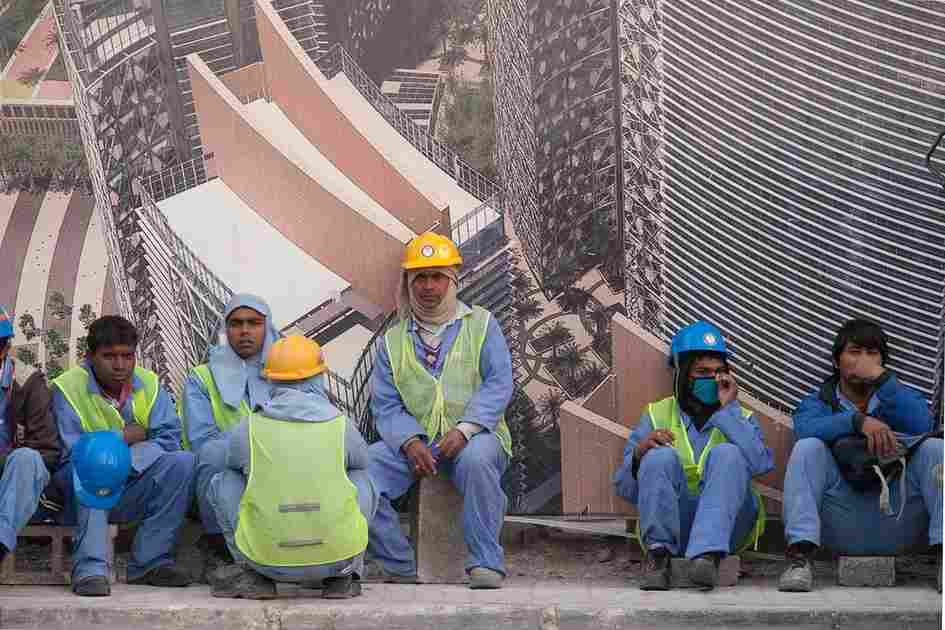



Human Rights Watch says Gulf migrant workers face rising heat-related health risks as climate change intensifies extreme temperatures and governments rely on inadequate workplace protections.
Migrant workers across Gulf countries are facing growing health dangers as climate change drives temperatures to increasingly deadly levels while governments continue to rely on inadequate workplace heat protections, Human Rights Watch (HRW) said this week.
The rights group interviewed 20 migrant workers from Bangladesh, Nepal and Pakistan employed in construction and app-based bike delivery services in Kuwait, Qatar, Saudi Arabia and the United Arab Emirates between February and May. Workers described worsening heat exposure and insufficient occupational health and safety measures as another dangerous summer begins.
Several Gulf Cooperation Council (GCC) countries enforce midday work bans that prohibit outdoor work between late morning and mid-afternoon from June until August or September. However, HRW said these seasonal restrictions remain the only heat protection available to many migrant workers despite growing scientific evidence that fixed calendar and time-based bans do not adequately reduce heat-related health risks.
“Despite a wealth of evidence on both global temperature increases and the severe health risks extreme heat exposure poses, Gulf states are dragging their feet on adopting adequate protections,” said Michael Page, deputy Middle East director at Human Rights Watch.
“Gulf states have the means and capacity to adopt these protections, including restricting working hours based on actual temperature thresholds rather than fixed schedules,” he added.
Outdoor workers said they are often forced to balance physically demanding work in extreme temperatures with pressure from employers to continue working.
A road construction worker in the UAE described working in temperatures reaching 48 degrees Celsius.
“During summer, it becomes difficult to work by 7:30 or 8AM, but we have to work until 11:30AM no matter what. That is the most difficult time. How will we get through this year?” the worker said.
Exposure to extreme heat can trigger fatal heatstroke, worsen existing medical conditions, reduce cognitive function and increase the risk of workplace accidents. HRW noted that many Nepali migrant workers have returned home from Gulf countries suffering long-term health problems including kidney failure.
Another worker based in the UAE said reports of heat-related deaths among workers heightened fears for their own safety.
“Sometimes we hear news that someone in another company collapsed from the heat and died. When we hear that, we get goosebumps. We think, ‘Maybe tomorrow it will be our turn. We are also working in the same heat.'”
According to the Intergovernmental Panel on Climate Change’s Sixth Assessment Report, heat extremes across the Arabian Peninsula have increased largely because of human-induced climate change. A 2024 study by World Weather Attribution also found that climate change has made heatwaves five times more likely and approximately 1.7 degrees Celsius more intense across West Asia.
App-based bike delivery workers interviewed by HRW said the lack of shaded rest areas, intense sunlight that reduced visibility and overheating of the electronic devices required for work caused sunburn, dizziness and fainting.
Despite those conditions, workers said digital platform companies continued to push them to complete time-sensitive deliveries while fear of losing their jobs made it difficult to reject assignments.
Some pickup locations offered rest shelters, cool drinking water or air-conditioned buses while some companies adjusted work schedules to cooler evening hours.
Countries including Kuwait and Qatar have banned bike deliveries during summer midday restriction periods while the UAE has required rest and cooling stations for delivery riders and announced plans to expand those facilities.
“During the very hot three months, in some places, every 15-20 kilometers, there were buses with AC arranged for rest for bike delivery riders,” one worker said.
“Water was also available there. If the heat was too much, we could rest there … but those were only in limited places.”
Experts cited by HRW said Gulf countries should introduce heat protection measures based on the Wet Bulb Globe Temperature (WBGT) index and establish work-rest schedules using real-time heat conditions rather than fixed hours.
Only Qatar has adopted the WBGT system after introducing it in 2021 with an upper threshold of 32.1 degrees Celsius that requires outdoor work to stop. HRW said the threshold remains too high and enforcement continues to be inconsistent.
“When we sweat a lot, the body becomes extremely weak,” one worker said.
“But because of company pressure, we continue working. The mind says, ‘I can do it,’ but the body does not support us … Every season, someone collapses.”
Workers also described major differences in workplace protections depending on their employer.
“On large sites, doctors are stationed. Good companies provide all facilities. In smaller companies, however, such facilities do not exist,” one migrant worker said.
Another worker said access to basic necessities also varied.
“Some sites provide cool water, others don’t. To stay hydrated, you need to use the toilets frequently. But many construction sites did not have proper toilet provisions.”
HRW said the absence of strong evidence-based policies and weak government oversight have left migrant workers dependent on individual employers and supervisors for protection from dangerous heat.
A masonry helper working in Qatar recalled supervisors forcing employees back to work after only brief breaks.
“We would feel dizzy when working in the heat. We would rest for 5 to 10 minutes after which the foreman would again call us to work,” the worker said.
“If we laid down, he would immediately shout telling us to get up and work.”
The International Labour Organisation adopted a new treaty on June 12 establishing labour standards for gig work and requiring governments to take preventive measures against occupational accidents, diseases and other health risks.
Human Rights Watch urged Gulf governments to quickly ratify the convention and incorporate its provisions into domestic legislation, including stronger measures to address the growing threat of extreme heat.
“Rising global temperatures are making existing extreme summer heat in the Gulf more dangerous, especially for the millions of migrant workers who work outdoors without adequate rest and hydration,” Page said.
“Gulf states should guarantee safety and health protections to all workers.”




