

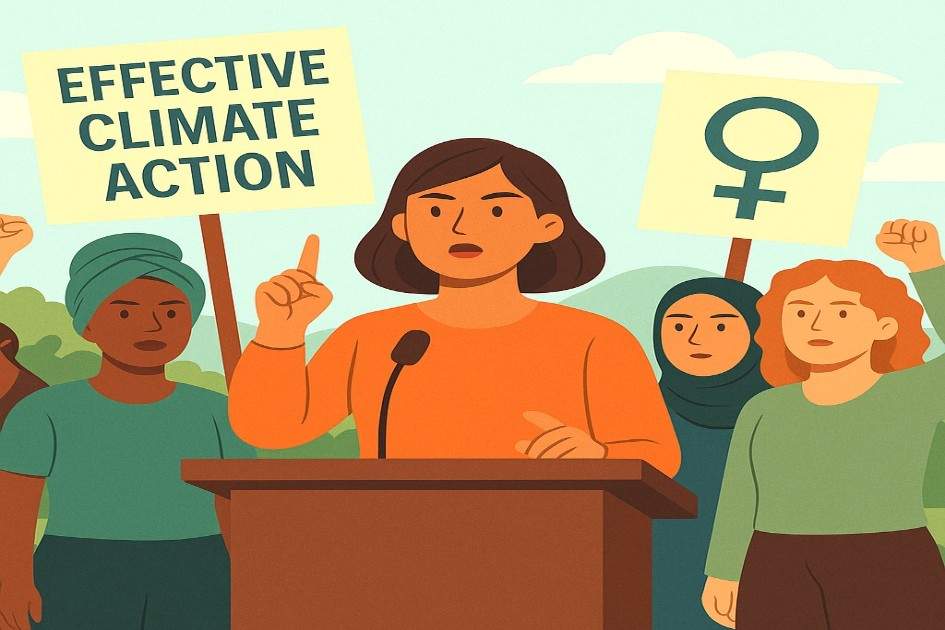



Over 125 women leaders from 50 countries gathered for the 7th Global Women’s Assembly for Climate Justice, urging bold action ahead of COP30. Speakers called for ending fossil fuels, deforestation, and greenwashing, while championing gender equity and women-led climate solutions.
Women leaders from around the world convened online this week for the 7th Global Women’s Assembly for Climate Justice, calling for urgent and transformative climate action ahead of COP30 and beyond. The Assembly, hosted by the Women’s Earth and Climate Action Network (WECAN), brought together over 125 women policymakers, government officials, and grassroots activists from 50 countries to amplify women-led climate justice solutions.
In her opening remarks, WECAN Founder and Executive Director Osprey Orielle Lake underscored the Assembly’s core message: “Women are not just fighting for climate justice, we are innovating it.” Citing research linking women’s political participation to stronger environmental outcomes, she stressed the need to dismantle systemic barriers that exclude women from decision-making. “We must amplify women’s voices not just as participants but as architects of a thriving future,” she said.
Lake also framed this year’s negotiations within the broader context of rising authoritarianism and rollbacks on environmental and human rights, particularly in the United States. She warned that these political trends are undermining global climate ambitions and called for deeper intersectional organizing.
Day one of the virtual event featured speakers from South Africa, Norway, Fiji, Ecuador, and others, all reinforcing the urgent need for bold action at COP30 in Brazil. WECAN, along with over 160 signatories—including Amazon Watch, Rainforest Action Network, and elected officials from Canada and New Zealand—launched a “Call to Action” urging governments, financial institutions, and corporations to adopt climate policies that reflect the scale of the crisis.
South African social justice consultant Zukiswa White, speaking from the UN climate negotiations in Bonn, offered a sobering assessment of the current political climate. “Delaying progress on the Paris Agreement is a political choice,” she said. “The UNFCCC system is no longer fit for purpose. Our task is to make climate justice outcomes a political inevitability.”
The Assembly’s Call to Action outlines several priorities, including halting fossil fuel expansion, ending greenwashing and deforestation, and centering gender equity in climate policies. Speakers also called for strengthening grassroots, democratic, and community-based solutions.
Nigerian climate activist Adenike Titilope Oladosu, founder of the I Lead Climate Action Initiative, shared the disproportionate burdens women face, particularly in accessing water amid worsening droughts. “Across Sub-Saharan Africa, women walk 40 billion hours annually just to fetch water,” she said. Her organization has supported 100,000 women in gaining access to tools and resources that counter the dual pressures of climate change and patriarchal systems.
“When women have platforms,” Oladosu added, “they become the true custodians of the environment and changemakers in society.”
As the road to COP30 continues, the Assembly made it clear: empowering women is not just a matter of equity—it is a pathway to meaningful, effective climate action.




