


As countries assess progress towards 2030 biodiversity targets, the CBD Women’s Caucus calls for accessible long-term funding, recognition of traditional knowledge and stronger accountability.
The CBD Women’s Caucus urges governments to remove funding barriers, recognise women’s leadership and embed gender equality and human rights in the Yerevan Pathway.
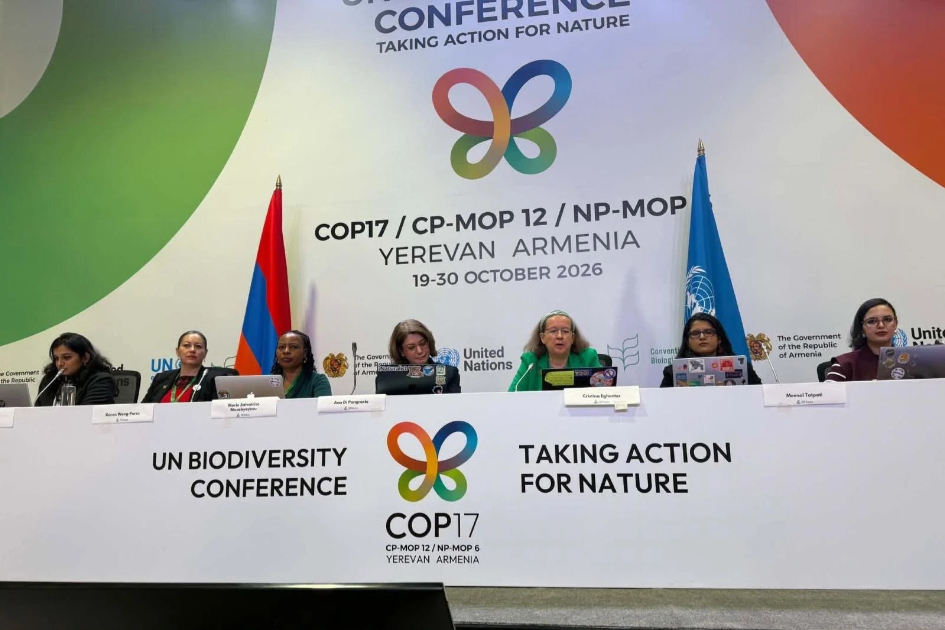
Women protecting biodiversity must have direct access to international conservation funding and a meaningful say in how that money is spent, the Convention on Biological Diversity (CBD) Women’s Caucus urged at COP17 in Yerevan, calling on governments to turn gender equality commitments into practical action.
At a press conference in the Blue Zone of the Meridian Expo and Event Centre on Tuesday morning, Caucus representatives called for predictable, long-term financing, stronger recognition of women’s contributions and greater participation by Indigenous Peoples and local communities in biodiversity governance.
The demands come as governments attending the October 19-30 UN Biodiversity Conference undertake their first collective review of progress towards the 2030 global biodiversity targets, with financing and implementation gaps dominating discussions.
Funding must reach women and communities
Ana Di Pangracio, Deputy Director and Biodiversity Director of Fundación Ambiente y Recursos Naturales (FARN), said biodiversity finance must be judged not only by how much money is mobilised but also by who can access it, who controls its allocation and who ultimately benefits.
“Without adequate financial resources, the commitments made by governments remain promises written on paper,” she said.
Di Pangracio called for adequate, predictable and sustainable public financing, stressing that developed countries must honour their international commitments. She also warned against financing arrangements that increase the debt burden of developing countries, women and vulnerable communities.
Her intervention comes amid growing pressure on governments to fulfil the Kunming-Montreal Global Biodiversity Framework’s financing commitments.
Under Target 19, countries agreed to mobilise at least $200 billion annually from public, private, domestic and international sources by 2030. This includes increasing international biodiversity-related financial flows to developing countries to at least $30 billion annually by the same year.
However, the Women’s Caucus argued that raising more money would achieve little for grassroots conservation unless existing barriers to accessing resources were removed.
Women-led organisations, Indigenous Peoples and local communities frequently struggle to secure funding despite their contributions to protecting ecosystems, restoring degraded landscapes and managing natural resources sustainably.
Complicated application procedures, restrictive funding arrangements and short project cycles often disadvantage smaller community organisations.
The Caucus therefore demanded simplified, flexible and long-term financing that women-led and community-based organisations can access directly.
It also called for women to have meaningful representation in the governance of financial mechanisms and decisions about resource allocation.
The representatives stressed that financial accountability must extend beyond reporting how much money has been committed or disbursed.
They urged stronger environmental and social safeguards and greater scrutiny of whether funding reaches intended beneficiaries and delivers measurable improvements for communities and biodiversity.
Recognition of rights and traditional knowledge
The Caucus also highlighted the importance of recognising the distinct contributions and rights of women, Indigenous Peoples and local communities in conservation.
Their concerns reflect commitments already included in the Kunming-Montreal Global Biodiversity Framework.
Target 22 calls for inclusive and gender-responsive participation in biodiversity decision-making, access to justice and information and respect for the rights of Indigenous Peoples and local communities over their lands, territories, resources and traditional knowledge.
Target 23 specifically requires gender equality in implementing the framework, including women’s equal access to land and natural resources and their meaningful participation and leadership in biodiversity-related policies and decisions.
Traditional ecological knowledge, passed down through generations, plays an important role in conserving forests, wetlands and other ecosystems. The framework recognises the need to respect the rights of knowledge holders while ensuring their meaningful participation in decisions affecting their territories and livelihoods.
The Caucus’s demands underscore the difference between recognising those contributions in international agreements and ensuring that women and communities have the resources and authority to put conservation commitments into practice.
Beyond government-centred decision-making
Cristina Eghenter, Senior Expert in Global Governance Policy at WWF International in Italy and a member of the Women’s Caucus Board, called for a broader approach to biodiversity governance that recognises the responsibilities, rights and contributions of different stakeholders.
She emphasised the importance of a whole-of-society approach throughout the development, implementation, monitoring and accountability of biodiversity policies.
According to Eghenter, the frequently used expression “actors other than national governments” does not adequately acknowledge the distinct status and contributions of different constituencies.
The Women’s Caucus, together with representatives of Indigenous Peoples, local communities and youth, has therefore jointly proposed using the term “major groups and other stakeholders”.
The proposed change goes beyond terminology. It seeks clearer recognition of groups whose rights, knowledge and participation are essential to implementing biodiversity agreements.
Such recognition could help strengthen their involvement in monitoring progress, shaping policies and holding institutions accountable.
The terminology remains a proposal advanced by these constituencies rather than an agreed COP17 outcome.
Gender equality in the Yerevan Pathway
Eghenter also urged governments to accelerate inclusive and effective biodiversity action following the first global review of the Kunming-Montreal framework.
She said the proposed Yerevan Pathway offers an opportunity to strengthen the whole-of-society approach while advancing gender equality and human rights-based biodiversity governance.
The pathway is being developed through the COP17 process to translate findings from the global review into stronger implementation, international cooperation and accountability.
For the Women’s Caucus, the challenge is to ensure that gender equality and meaningful participation become integral to those efforts rather than remaining broad policy commitments.
The global review comes four years after countries adopted the Kunming-Montreal framework in 2022, setting 23 targets to halt and reverse biodiversity loss by 2030.
With implementation falling short in several areas, governments face increasing pressure to accelerate conservation measures, strengthen financing arrangements and close gaps between international commitments and action on the ground.
The Women’s Caucus is pressing for gender equality to become a measurable part of biodiversity implementation, backed by accessible funding, representation in decision-making and stronger accountability.
Its demands place a fundamental question before negotiators in Yerevan: whether the resources and decisions shaping the future of biodiversity will genuinely reach and include the women, Indigenous Peoples and local communities helping to protect it.