



At COP30, scientists and leaders warn that holding the 1.5°C goal is not symbolic but essential to prevent irreversible damage to the planet’s ice systems, rising seas, and global security. Rapid glacier melt, accelerating sea-level rise, and weakening ocean circulation reveal a world already nearing dangerous tipping points. For climate-vulnerable nations like Bangladesh, exceeding 1.5°C would mean catastrophic floods, salinity intrusion, and escalating storms, making decisive global action and stronger NDCs more urgent than ever.
Rising Concerns at UN Climate Conference of the Parties (COP30)
At the UN Climate Conference of the Parties (COP30), concerns have intensified over global efforts to limit warming to 1.5°C, as outlined in Article 2 of the Paris Agreement. In his opening address, Brazil’s President Lula issued a stark warning, stating that “climate change is not a threat to the future, it is a tragedy of the present.” He stressed that denial and delay are no longer viable, noting: “We are moving in the right direction, but at the wrong speed. Crossing 1.5°C is a risk we cannot take.” President Lula also called for a decisive end to climate denialism, emphasizing the growing challenges posed by misinformation. “In the age of disinformation, obscurantists reject not only scientific evidence but also the progress of multilateralism.” He further underscored the importance of global action by noting that, without the Paris Agreement, the world would be on course for catastrophic warming of nearly 5°C by the end of the century.
What has been observed in the ocean and the cryosphere
The cryosphere is sending unmistakable warning signals. Across every component ice sheets, glaciers, sea ice, permafrost, and polar oceans, we are now witnessing rates of change without precedent in the observational record. Mass loss from the Greenland and Antarctic ice sheets has quadrupled since the 1990s, pushing both regions closer to irreversible tipping points that could lock in sea-level rise for centuries. The global rate of sea-level rise has doubled in just 30 years, and if current acceleration continues, we could face 1 centimeter per year by 2100, far beyond the limits of feasible adaptation for many coastal nations. This year, the fastest glacier retreat ever observed: Hektoria Glacier in Antarctica retreated 25 kilometers in a single year. This is a stark reminder that rapid, abrupt losses are possible in larger glaciers like Thwaites, with global consequences.
Mountain glaciers tell a similar story. The world is losing an average of 273 billion tonnes of ice each year. Forty percent of all glacier loss over the past 50 years occurred in the last decade alone. At today’s warming level of 1.2°C, nearly 40% of global glacier mass loss is already committed. Polar oceans are also changing rapidly. Both the Atlantic and Antarctic overturning circulations are weakening, while polar ocean acidification has surpassed planetary boundaries, threatening ecosystems and fisheries that millions depend on. Arctic permafrost has now become a net source of carbon emissions, further amplifying warming. These changes are not distant or abstract. They threaten water, food, and energy security for billions; they jeopardize critical fisheries; they endanger infrastructure; and they sharply increase risks for coastal populations worldwide.
Why the 1.5 °C crossing is dangerous
Even the current global warming level of 1.2°C is already too high to prevent coastal loss and damage linked to polar ice sheet melt. Minimizing the risk of crossing critical ice-sheet tipping points likely requires bringing temperatures back below 1°C. Significant glacier loss is already occurring at present temperatures, with cascading downstream impacts for billions of people. Yet limiting warming to 1.5°C would preserve twice as much global ice compared to our current 2.6°C trajectory and up to 25 times more ice in some regions. New assessments also indicate that the risk of an AMOC shutdown this century, driven by meltwater from Greenland and declining sea ice, is higher than previously thought: roughly 70% on our current pathway, and still 25% even if warming is held to 1.5°C. Arctic permafrost regions have already shifted from being a carbon sink to a net carbon source. Meanwhile, ocean acidification has surpassed survivable thresholds for many shelled organisms across extensive areas of the Arctic and Southern Oceans.
How vulnerable are Bangladesh and low-lying coastal deltas
Bangladesh is highly vulnerable to the accelerating impacts of climate change, particularly cryosphere changes, sea-level rise, salinity intrusions, and the increasing frequency and intensity of storms. Bangladesh is increasingly affected by the rapid melting of the Himalayan cryosphere, which feeds the major rivers that sustain the country. As glaciers retreat and snowpacks diminish, river flow patterns are becoming more erratic, causing higher risks of extreme floods during the monsoon and reduced water availability in the dry season.
With large portions of the country lying just a few meters above sea level, even modest rises threaten to inundate coastal areas, displace communities, and damage critical infrastructure. Salinity is steadily moving inland, degrading soil and freshwater resources, harming agriculture, and undermining food and water security. At the same time, intensified cyclones and storm surges are placing millions at risk, destroying livelihoods, and compounding long-term socioeconomic stresses. Together, these hazards make Bangladesh one of the world’s most climate-exposed countries, urgently requiring enhanced adaptation, resilience-building, and sustained international support. Accelerated glacial melt contributes to rising river levels, sedimentation, and the threat of outburst floods upstream, all of which ultimately heighten flood severity downstream in Bangladesh. Bangladesh strongly urged the urgency to keep the 1.5 °C goal alive with limited overshoot without resorting to dangerous so-called geoengineering,
Emission Gaps and NDCs Progress in 2025
The sixteenth annual UNEP Emissions Gap Report, released in November 2025, provides a science-based assessment of the gap between pledged greenhouse gas reductions and the emission levels required to meet the Paris Agreement goals. If fully implemented, current Nationally Determined Contributions (NDCs) would put the world on track for 2.3°C–2.5°C of warming by the end of the century, an improvement from last year’s estimate of 2.6°C–2.8°C, yet still far from meeting the 1.5°C or “well below 2°C” targets. Under existing policies, global warming is projected to reach 2.8°C, underscoring a significant implementation gap. To align with a 1.5°C-consistent pathway, global emissions in 2035 would need to fall by 55% compared to 2019 levels, while current NDCs deliver only about a 15% reduction.
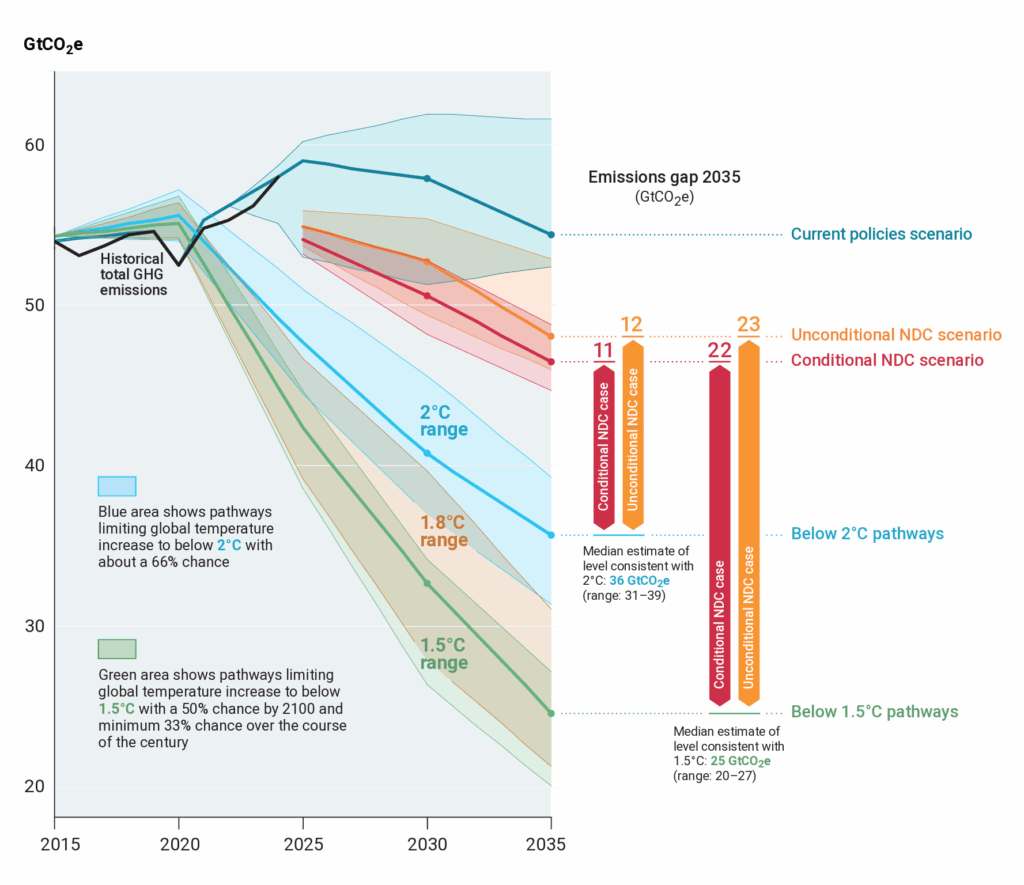
Global greenhouse gas (GHG) emissions could fall by about 12 percent below 2019 levels by 2035, according to a new analysis by the United Nations Framework Convention on Climate Change (UNFCCC). The assessment draws on 86 nationally determined contributions (NDCs) submitted by 113 Parties under the Paris Agreement. This marks a significant shift from pre-Paris projections, which anticipated a 20–48 percent increase in global emissions by 2035. The latest NDCs demonstrate rising ambition, with a growing number of countries aligning national plans with long-term net-zero goals.
Since the publication of the 2025 NDC Synthesis Report, 49 Parties have submitted 22 new or updated NDCs, representing approximately 69 percent of global emissions in 2019. These updated commitments offer a clearer picture of global progress toward limiting warming to 1.5°C. The synthesis indicates that full implementation of existing NDCs could reduce global emissions to around 12.3 gigatonnes (Gt) of CO₂ equivalent by 2035, equivalent to a 19-24 percent decline from 2019 levels. The analysis also finds that emissions from these Parties are expected to peak before 2030 and decline sharply through 2035.

Figure 2: Global emissions could fall 12% by 2035 with new NDC commitments (Source: UNFCC, 2025).
Concluding Remarks
The science is clear: limiting warming to 1.5°C remains essential for keeping cryosphere-related risks within manageable bounds. Every fraction of a degree matters. But science also tells us something else: our ability to detect, anticipate, and respond to these accelerating risks depends on strong, sustained cryosphere observation systems. Yet global budgets for these systems are declining. We urge Parties to strengthen long-term funding for cryosphere monitoring, early warning systems, and adaptation planning, and to significantly scale up support for vulnerable countries, including Least Developed Countries (LDCs) and Small Island Developing States (SIDS), facing escalating sea-level and water security risks.
Dr. A.K.M. Saiful Islam, Professor, Institute of Water and Flood Management (IWFM), Bangladesh University of Engineering and Technology (BUET), Dhaka, Bangladesh (Email: [email protected])




