

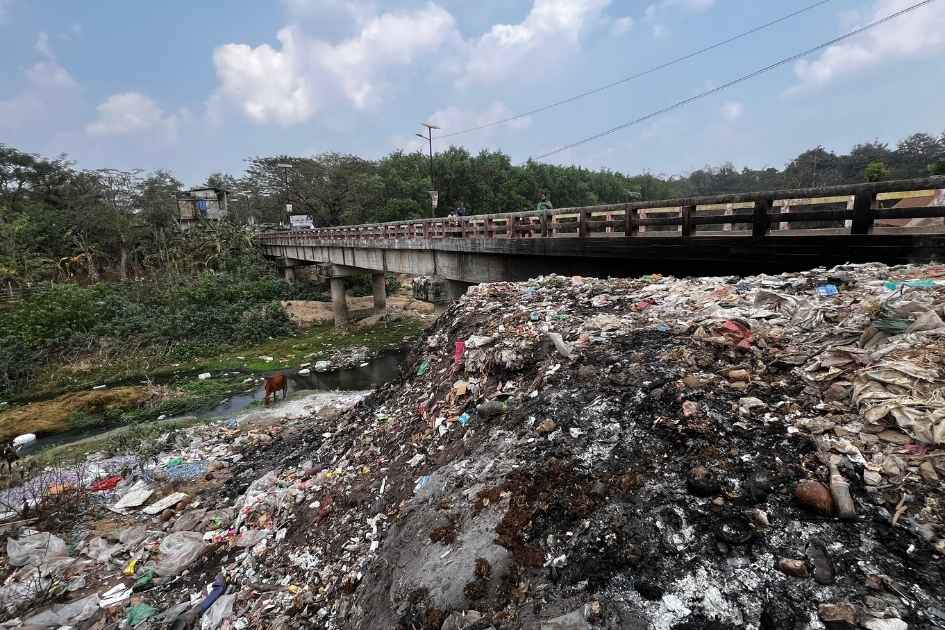



Uncontrolled dumping of market and livestock waste in Manikchhari is polluting a Halda River branch, threatening South Asia’s unique carp breeding ground and raising environmental and public health concerns locally.
Uncontrolled dumping of household, market and livestock waste into a branch of the Halda River in Manikchhari of Khagrachhari district is causing growing pollution, raising serious concerns for South Asia’s only natural spawning ground for major carp and for the health of nearby communities.
The Halda River is Bangladesh’s main natural breeding ground where major carp species such as rohu, catla, mrigal and kalibaus release fertilized eggs every year. The river plays a crucial role in the country’s freshwater fish production as collected eggs are transported to hatcheries where they are raised into fingerlings.
The spawning season in the Halda usually runs from April to June. During this period brood fish release large quantities of fertilized eggs, though the amount collected varies depending on environmental conditions and the health of the spawning ground. In 2024, fishermen collected only 1,840 kilograms of fish eggs from the river, significantly lower than the previous year.
A recent on-site visit found that waste from Rajbazar, Amtal and Mahamuni markets in Manikchhari is being dumped beneath the Mahamuni Bridge. The waste includes livestock and poultry refuse, polythene and plastic materials that do not decompose, creating piles of garbage that spread foul odors and pollute the surrounding environment.
Local residents said the situation has led to an increase in bad smells, flies and the risk of disease. Students and pedestrians also face difficulties traveling through the area because of the polluted conditions.
Rubel Hossain, a student from the area, said most of the waste from nearby markets ends up under the Mahamuni Bridge.
“Almost all the waste is dumped beneath the Mahamuni Bridge. It is not only spreading foul smells but also damaging the environment for fishing,” he said.
Local journalist and writer Abdul Mannan warned that the continued disposal of waste in open areas poses a serious threat to both the environment and public health.
“Waste from crowded markets in the upazila is being dumped in open spaces. Establishing a designated dumping station is urgently necessary. Otherwise the Halda River’s natural spawning ground will be damaged and fish breeding will decline,” he said.
Residents say simple restrictions on dumping are not enough. They argue that only a planned waste management system and a modern dumping station can reduce pollution in the river. Properly managed dumping facilities would not only help collect waste but also protect the river’s water quality and ecosystem.
The Halda River is not only important for fish reproduction. It also serves as a habitat for many aquatic plants and animals. Pollution in the river could therefore harm biodiversity, the local economy and public health.
Without immediate measures such as planned waste management, the construction of a dumping station and increased public awareness, the Halda River and Manikchhari upazila could face growing pollution and health risks, potentially leading to broader social and environmental problems in the future.
Upazila Nirbahi Officer Tahmina Afroze Bhuiyan said authorities have so far been unable to establish a dumping station because there is no available government land.
However, she added that traders have already been warned not to dispose of waste into nearby canals.
“A dumping station will be set up quickly once a suitable place is found,” she said.




