




A CPD–Samakal survey finds widespread failures in Bangladesh’s solar home systems, driven by weak maintenance, costly repairs and poor governance, leaving rural families reliant on the grid or diesel generators.
Nearly half of Bangladesh’s household solar home systems have stopped functioning, leaving millions of rural residents dependent on unstable grid electricity or expensive alternatives such as diesel generators. A joint survey by the think tank Centre for Policy Dialogue (CPD) and the Bengali daily Samakal shows that technical failures, financial constraints and governance issues are undermining the country’s renewable energy programs.
The survey also highlights that battery and inverter failures, coupled with limited after-sales support, remain the largest obstacles. Repairs are often costly and infrequent, and trained local technicians are scarce. Many households have stopped using solar systems and returned to grid electricity, undermining the original goal of off-grid electrification.
Bangladesh’s experience shows that while off-grid solar can expand electricity access and support clean energy goals, technical reliability, maintenance, financial access and governance are crucial to long-term success.
Experts recommend local repair centers, the availability of spare parts, user training and regulated service costs to restore trust and sustain usage.
Energy Adviser Faozul Kabir Khan said, “We are learning from the failures of earlier solar home systems. Now we are focusing on quality standards, specifying what type of panels and batteries must be used. This is essential to restore public confidence in solar energy.”
Solar home systems were first introduced in the 1990s to provide electricity to rural and off-grid areas. Supported by the government, international donors and microfinance institutions, over 4.1 million systems were installed by 2018, benefiting more than 20 million people. These systems allowed families to light their homes, run small businesses, charge mobile phones and support children’s education. Adoption peaked in 2019 but has slowed in recent years as access to the national grid expanded.
The survey found that 98.5 percent of households now have grid electricity. Only 1.5 percent of households remain fully off-grid, mostly in districts such as Chandpur, Chattogram, Gaibandha and Noakhali. Many households said grid electricity is more reliable and affordable, which has reduced the use of solar home systems and slowed the expansion of government-supported programs.
Battery failures were the most commonly reported problem, cited by 77 percent of respondents. Inverter malfunctions, lightning strikes, loose connections and low-quality components were other major challenges. Repair costs added to household burdens, with battery maintenance averaging 152 taka, fault repair 270 taka and connection fixes 220 taka. Most households said they need maintenance at least twice a year, and one-third need repairs annually, discouraging continued use.
Government-backed programs such as IDCOL, Test Relief (TR) and Cash for Work named Kabita have particularly high failure rates due to substandard equipment, weak monitoring and limited user training. Financial limitations also hinder households from maintaining their systems. The average cost of a government-supported system is around 9,000 taka, while private rooftop installations can exceed 23,000 taka. Some households relied on loans to install solar systems, with 13 percent still paying monthly installments averaging 600 taka.
Bribery incidents, though rare, were also reported. Two percent of respondents said they were asked for bribes, and one percent admitted paying an average of 2,100 taka. Mismanagement and low-quality equipment further reduced public confidence in solar energy.
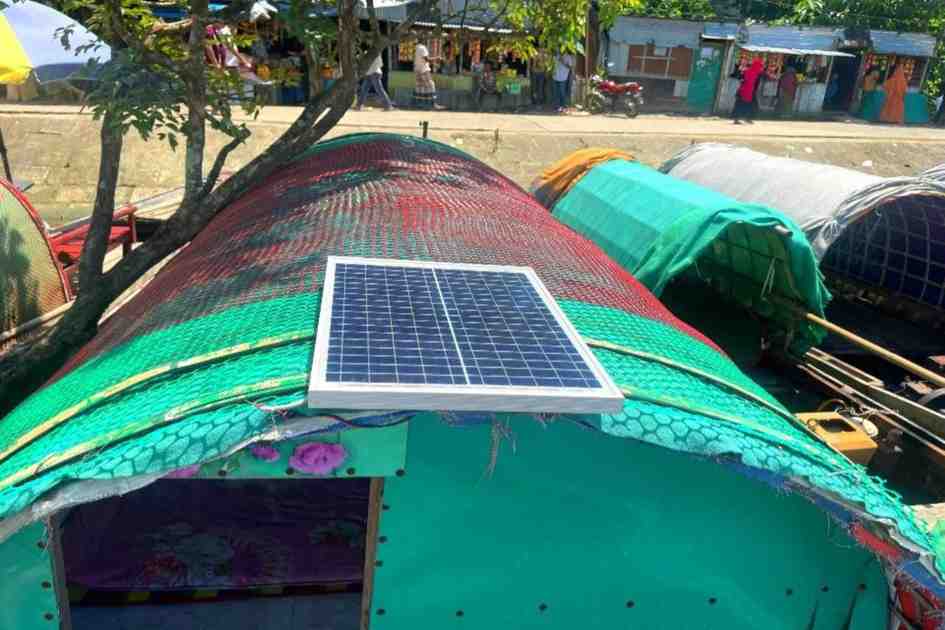
Field visits across several districts confirmed these findings. In Kurigram, batteries failed within months, and local repair services were scarce. In Chattogram, inverter malfunctions made repairs difficult to obtain. In Sunamganj’s haor region, tourist houseboats initially relied on solar panels, but most systems were removed due to maintenance challenges and higher electricity demand. Owners now rely on noisy and costly generators. One rooftop panel in Sunamganj, however, continues to function despite storms and heavy rain, showing that properly maintained systems can endure.
The effectiveness of solar systems varies by type. IDCOL systems were reported at 49 percent effectiveness, TR and Kabita panels 44 percent, other private rooftop systems 56 percent and individual rooftop systems 77 percent. This shows the importance of quality equipment, correct installation and ongoing maintenance.
Rapid expansion of the national grid has also reduced the perceived necessity of solar systems. Many households now see solar energy as complementary rather than essential. Combined with financial and technical barriers, this has slowed adoption and reduced public confidence in government-supported solar programs.
Government reports support these findings. IDCOL’s 2023 annual report notes that battery and inverter issues and lack of post-installation service are major challenges. Organizations such as the Society for Social Development and Rural Advancement have observed that solar systems deteriorate quickly without regular maintenance and training. In some areas, systems fail within two years of installation.
Sohanur Rahman, Executive Coordinator of YouthNet Global, emphasized the social dimension, saying, “A just transition to renewable energy must prioritize both climate goals and the communities affected. We need to ensure that rural households, small businesses and off-grid users have access to reliable solar solutions while creating local jobs for maintenance and technical support.”
SREDA is a Bangladesh government agency under the Ministry of Power, Energy and Mineral Resources and is responsible for increasing renewable energy production in Bangladesh. Chairman Mozzaffar Ahmed said, “The government has set a national solar policy and is promoting solar panels on all government offices, schools and healthcare facilities. But private companies and distribution agencies must supply quality products. If we ensure high standards and maintain proper support, solar energy can reliably complement grid electricity and reduce costs for users.”
The country’s solar journey offers lessons for other emerging economies. It demonstrates that scaling off-grid renewable energy requires more than installation. Quality control, oversight, community engagement and social equity measures are just as important. Without these, ambitious renewable energy programs risk failing to meet both climate and social objectives.




