

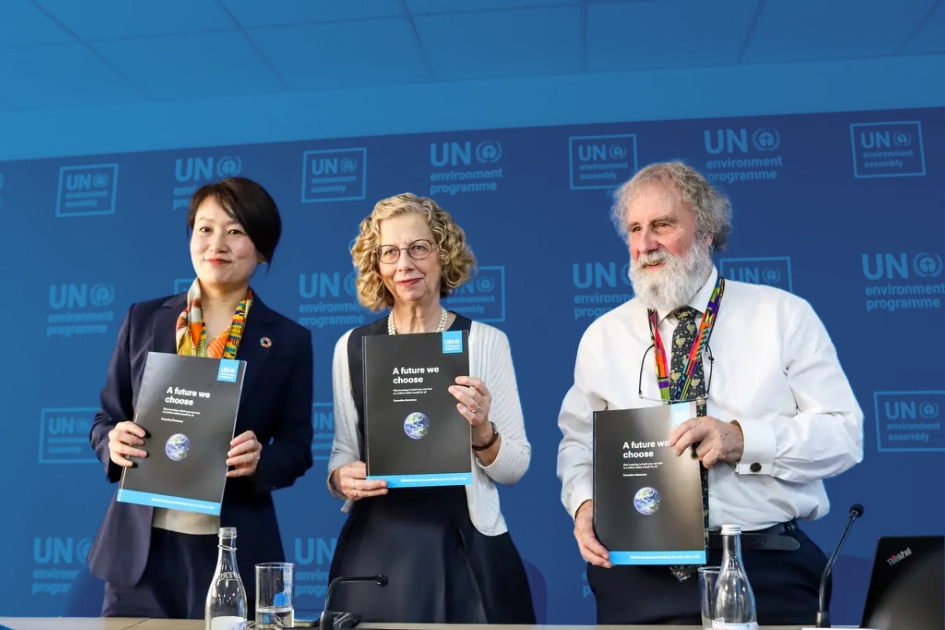



UN Report Warns Earth Is Entering an Uncharted Crisis but Says Trillion-Dollar Benefits Are Possible If the World Acts Now
In a stark new assessment, the United Nations has warned that the planet has entered “uncharted territory”, facing four accelerating environmental crises that threaten global health, safety, and economic stability.
The report, the Global Environment Outlook-7 (GEO-7), was launched on 9 December 2025 in Nairobi, Kenya. The report says that climate change, biodiversity loss, land degradation, and pollution are now so severe and so interconnected that they can no longer be treated as separate issues.
Every year, 100 million hectares of healthy land are lost due to erosion, overuse, or deforestation. This loss threatens global food production, especially for low-income regions that rely on farming, which is an area similar to Colombia or Ethiopia. The Global Environment Outlook Report has emphasized that it is a matter of great concern.
Nearly 60 percent of the world’s land surface is under moderate or heavy human pressure. According to the report, between 20 and 40 percent of the world’s land is now degraded. As land becomes less productive, farmers struggle, food becomes more expensive, and communities become more vulnerable to climate disasters. Although many governments have promised to restore degraded land by 2030, progress is far too slow.
“The Global Environment Outlook lays out a simple choice for humanity: continue down the road to a future devastated by climate change, dwindling nature, degraded land and polluted air, or change direction to secure a healthy planet, healthy people and healthy economies. This is no choice at all”, said Inger Andersen, UNEP Executive Director, at the press meet in UNEP headquarters.
Biodiversity is also declining at alarming rates. One million species are now threatened with extinction, and the populations of many more are shrinking. Coral reefs are already in steep decline, and some marine fisheries are collapsing.
Pollution continues to rise as well. The world produces more than 2 billion tonnes of solid waste every year, a figure expected to nearly double by 2050. Plastic pollution now affects every ecosystem on Earth, from deep oceans to farmland. Air pollution remains a deadly threat. Nine out of ten people breathe air above the World Health Organization’s safety standards, contributing to millions of premature deaths annually.
Plastic is now everywhere, in oceans, rivers, soil, and even in human bodies. Over 700 species are harmed by plastic pollution. Air pollution affects nine out of ten people worldwide and causes millions of premature deaths each year. Chemicals from industries, medicines, and mining contaminate freshwater sources. Many of these pollutants travel long distances and are difficult to clean up once they enter the environment.
Pollution is another rapidly growing threat. The world produces over 2 billion tonnes of solid waste every year, and this will rise to nearly 4 billion tonnes by 2050.
Since 1960, consumption per person has quadrupled. In many high-income countries, lifestyles have become highly resource intensive. More energy, more materials, more water, and more land are used for products, transportation, and food.
The global population is also growing and becoming increasingly urbanized. By 2050, almost 70 percent of people will live in cities, putting further pressure on infrastructure and natural resources. Technology, while helpful in many ways, also increases demand for metals, energy, and land unless managed sustainably.
According to the report, the cost of ignoring these problems is extremely high. Climate change and environmental damage already reduce economic growth, destroy homes and roads, and harm industries like farming, fishing, and tourism. Heatwaves reduce worker productivity. Floods and storms damage infrastructure. Pollution causes illness and death. According to the report, continuing on our current path could cost the world more than 100 trillion dollars a year by 2100.
These environmental failures are already harming economies, the report warns. Climate-related disasters have caused trillions of dollars in damage. Extreme heat is predicted to reduce global working hours and productivity. Pollution increases healthcare costs. Loss of ecosystem services such as clean water, fertile soil, and pollination could cost the global economy up to 44 trillion dollars a year.
Yet the GEO-7 assessment also highlights a path forward. It says the world can still meet international environmental goals if countries adopt bold, transformative changes across five major systems: energy, food, materials and waste, finance, and environmental protection.
The report outlines two possible future pathways. One relies heavily on clean technology and innovation, such as renewable energy, electric transport, and advanced recycling. The other focuses on societal behaviour changes, including lower consumption, healthier diets, and reduced waste. Both pathways require strong government leadership and international cooperation.
According to the authors, the cost of transformation, peaking at around 1.5 percent of global GDP, would be far outweighed by long-term benefits. By 2070, the world could save roughly 20 trillion dollars annually by avoiding climate damage. By 2100, the savings could exceed 100 trillion dollars per year.
The report stresses that no transformation will succeed without fair and inclusive action. High-income countries must reduce environmentally harmful consumption and support developing nations through finance and technology. Indigenous Peoples’ knowledge should be integrated into national policies, as they manage some of the world’s most biologically rich lands. Rapid changes in infrastructure, governance, and finance will also be required.
Despite the dire warnings, the UN says the world is not powerless. Many solutions already exist, from renewable energy expansion to nature-based restoration. What is needed now, the report argues, is political will and recognition that the cost of inaction will be far higher than the cost of action.
But despite the urgent tone, the report delivers a clear message. The world still has time to choose a better future, one that could bring enormous economic and social benefits, if governments act quickly and together.
According to the report, Earth has already warmed by more than 1.3°C since the industrial era, with the last decade being the hottest ever recorded. Scientists say the world is dangerously close to crossing several “tipping points”, including rapid ice-sheet loss, Amazon rainforest collapse, and near-total coral reef die-off. These changes could be abrupt and irreversible.
The report confirms that 2023 and 2024 were the warmest years in history. Record heat has been linked to stronger storms, rising sea levels, widespread drought, and growing wildfire disasters. Unless governments strengthen their climate policies, global temperatures could rise between 2.4°C and 3.9°C this century, far above the Paris Agreement limit of 1.5°C.




