

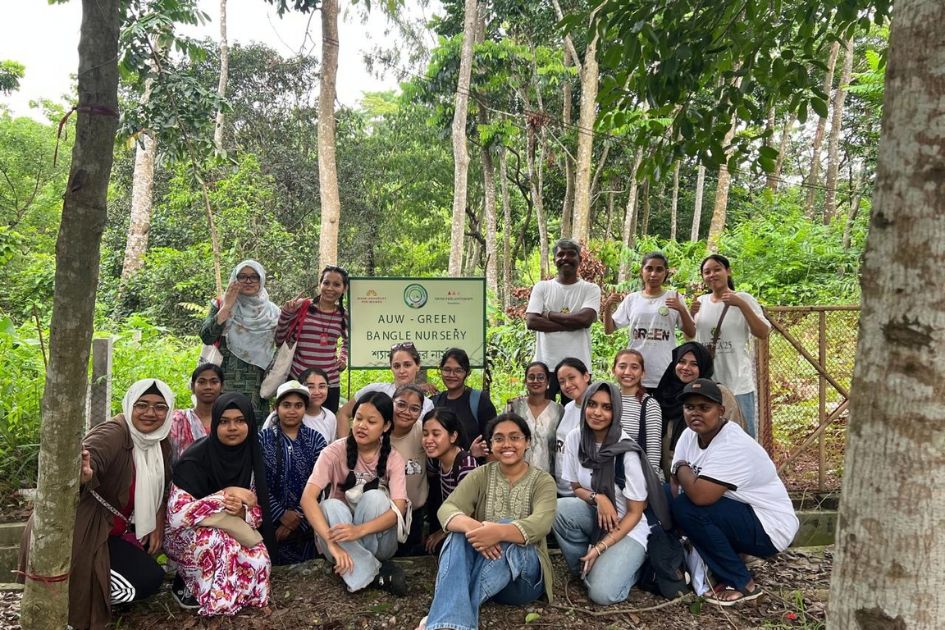



Asian University for Women’s Green Bangle Project engaged students and staff in innovative tree-climbing training, combining environmental science, experiential learning, ecofeminist values, and practical engagement with nature.
An innovative tree-climbing training programme aimed at strengthening environmental awareness and women’s engagement with nature has been launched by the Green Bangle Project at the Asian University for Women (AUW), an independent international university in Chattogram, Bangladesh.
The hands-on environmental learning activity, led by Dr. Mosae Selvakumar Paulraj, brought together approximately 30 participants, including Environmental Sciences students, faculty members and staff, on the university’s main campus.
Held on a designated short tree within the campus grounds, the training introduced participants to a specialized tree-climbing system using a climbing machine designed to combine physical coordination, environmental engagement and experiential learning.
Organizers said the activity sought to move environmental education beyond conventional classroom settings by allowing participants to interact directly with a living tree and gain a deeper understanding of the relationship between people and the natural environment.
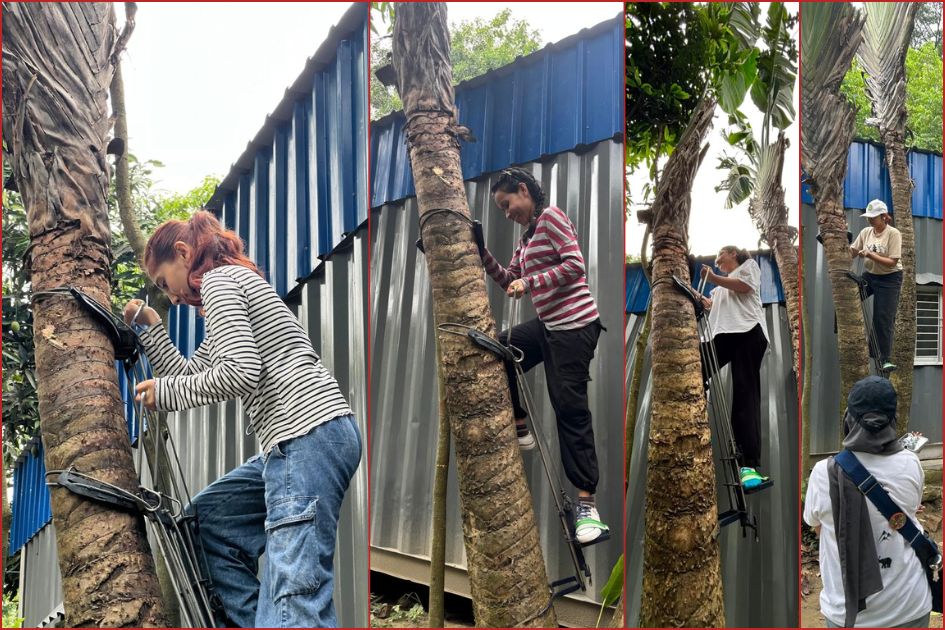
The climbing system required synchronized movement of hands, feet, balance and body control. Rather than relying primarily on physical strength, it emphasized technique, concentration, rhythm and problem-solving. Organizers said the approach made the activity accessible to individuals with varying physical abilities while fostering resilience, confidence and self-awareness.
The event also reflected ecofeminist approaches to environmental education, which emphasize inclusive access to nature, shared responsibility for environmental stewardship and greater opportunities for women in environmental and scientific fields. Organizers said the programme supports efforts to challenge traditional assumptions that have historically limited women’s participation in outdoor and technical environments.
The climbing machine was presented as an example of accessible environmental technology. Through structured instruction and appropriate equipment, activities that may initially appear physically demanding became achievable for a wider range of participants. Students learned that environmental engagement is shaped not only by physical strength but also by skill, adaptability, learning and determination.
From an Environmental Sciences perspective, the training encouraged participants to view trees as living ecological systems that provide essential ecosystem services, including carbon sequestration, air purification, temperature regulation, soil protection and biodiversity support. Organizers said direct physical interaction with a tree helped transform these concepts into lived experiences, strengthening environmental awareness and responsibility.
The programme also highlighted the importance of experiential learning in environmental education. Research has consistently shown that direct engagement with natural environments can enhance environmental understanding, strengthen stewardship behaviour and encourage long-term ecological responsibility. By combining scientific concepts with active participation, the training transformed theoretical knowledge into practical experience.
For many participants, the climb represented more than a technical exercise. It became an opportunity to overcome hesitation, build confidence and experience environmental learning from a new perspective. The process of coordinating movement, maintaining balance and gradually progressing upward reflected broader themes of growth, resilience and persistence.
Following the training session, participants visited the campus nursery, where they learned about ongoing plant care activities and met newly joined interns and volunteers. The visit provided insight into nursery management practices, plant propagation and maintenance, as well as the role nurseries play in supporting campus greening and environmental sustainability initiatives.
Dr. Mosae Selvakumar Paulraj said the purpose of the training extended beyond teaching climbing techniques.
“It is intended to build confidence, encourage curiosity and strengthen women’s engagement with the natural environment through both knowledge and practice,” he said.
The Green Bangle Project said it remains committed to advancing innovative approaches to environmental education that combine scientific understanding with experiential learning. By integrating Environmental Sciences, inclusive participation and hands-on training, the project continues to create meaningful opportunities for students to develop practical skills and environmental leadership.
Organizers said participants gained not only a new technical experience but also a deeper appreciation of the interconnected relationship between people, technology and the natural environment.
The event was coordinated by Green Bangle Project Assistant Project Manager Shaika Mohammad Chowdhury and Student Assistant Mithila Jahan.




