

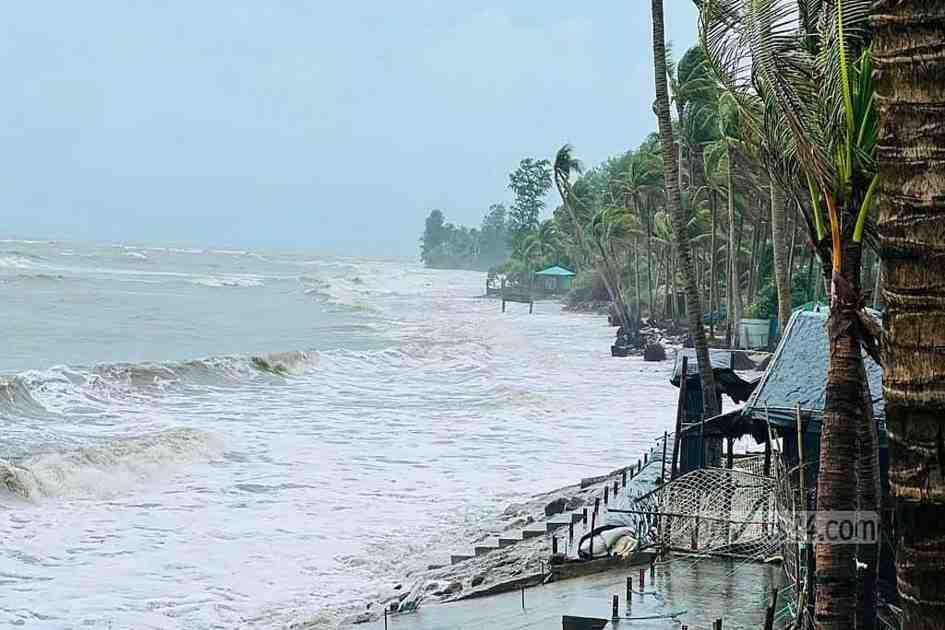

Erosion on Shah Porir Dwip is swallowing homes and threatening a cyclone shelter built after the 1991 disaster, leaving thousands of Teknaf islanders without safe refuge.
People on Shah Porir Dwip in Teknaf are losing homes to climate change, cyclones and river erosion, while the only cyclone shelter serving thousands near the Bangladesh-Myanmar border is itself now at risk of collapse, deepening fear and uncertainty across the coastal community.
About 40,000 people live in 13 villages across wards 7, 8 and 9 of Shah Porir Dwip under Sabrang union, a coastal settlement surrounded by the Naf River and the sea. Residents say they have had to survive through a constant battle with nature and that at least 5,000 people have lost their homes over the past decade because of severe erosion driven by cyclones and climate change. As a result, every warning of a new disaster now brings fresh panic.
In Jalia Para on the banks of the Naf River, about 13 kilometres from Teknaf town, more than 500 people from over 100 families are still living in extreme danger. Fresh erosion is now threatening not only their homesteads but also the area’s only cyclone shelter.
Almaz Khatun, 53, who lives in a fragile riverside house, said rising tidal water makes it impossible to stay at home. “When the water rises, we go to other people’s houses. When it falls, we come back. We have no permanent place to go. We just want one safe place to live,” she said.
Asked about shelter during cyclones, she said the building meant to protect them was itself under threat. “The shelter is also facing erosion. How can we trust it in this condition? My heart starts pounding as soon as a storm begins.”
According to the upazila Project Implementation Office, the three-storey cyclone shelter on Shah Porir Dwip was built in 1993 with Saudi funding to protect coastal residents after the devastating 1991 cyclone. The structure was built on 50 percent of the land, but most of the surrounding area has already been swallowed by the river. Now almost nothing remains apart from the building itself. Despite the danger, nearly 1,000 students continue to study there.
Shahena Akter, who lives with her disabled husband and four other family members, said life on the banks of the Naf River was a daily struggle. “Even a small high tide sends water into the house. Strong winds make us afraid. And when there is cyclone news, we cannot sleep because even the nearby shelter is not safe,” she said.
She said an area that once held more than 300 families is now under river water. Since the 1991 cyclone, she has lost her home four times. She fears her current settlement will not last much longer.
Another resident, Abdur Gafur, said the community was trapped between the river on one side and homes on the other. “The shelter has somehow been kept standing with geo bags. When a storm comes, we are terrified because we do not know where we will go,” he said.
He alleged that negligence by the authorities had allowed the situation to deteriorate this badly.
Sabrang Union Parishad member Abdus Salam said people living along the Naf River were gradually becoming homeless because of climate change. He said large sums were being spent every year to dump sand-filled geo bags in an attempt to stop erosion, but described that as only a temporary measure. A new shelter in a safer location is now urgently needed, he said.
Elsewhere in Teknaf, the Mathabhanga cyclone shelter in the Boro Deil area of Baharchhara has also become risky. Its condition has deteriorated because it has not been repaired for a long time. In the hill-surrounded area, heavy rainfall is also increasing the risk of landslides, adding to local fears.
Local Union Parishad member Farid Ullah said continuous rain raises the danger of hill collapse while the shelter itself remains unsafe. He said elderly people and persons with disabilities were among those most at risk.
Teknaf Upazila Nirbahi Officer Imamul Hafiz Nadim said steps had been taken to prepare all shelters in coastal areas ahead of the monsoon season. He said risky shelters were being inspected on the ground and efforts were under way to take the necessary measures. He added that the authorities were working in coordination with relevant departments to ensure the safety of people living in vulnerable areas.
Cox’s Bazar Water Development Board Sub-Divisional Engineer Salauddin Ahmad said geo bags were being used as a temporary measure to slow erosion, but the renewed riverbank collapse had made the situation more complicated. He said a major project would be needed for a permanent solution.
This article is republished from The Daily Samakal.




