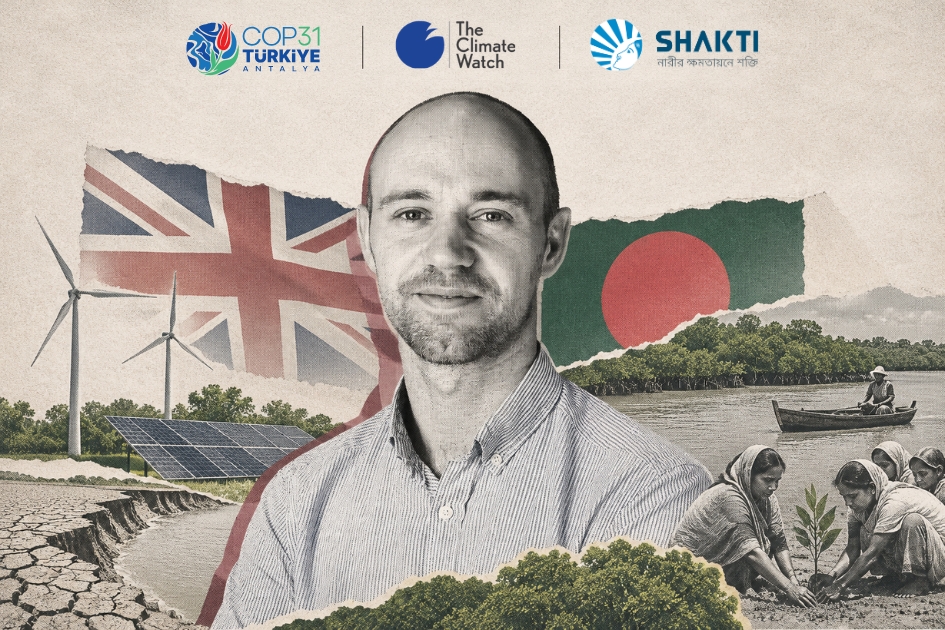



From locally led adaptation in the Sundarbans to climate finance reforms, Nathaniel Smith outlines how UK expertise, investment and community partnerships could shape Bangladesh’s climate response.
As Bangladesh prepares for the 31st UN Climate Change Conference (COP31) in Antalya, Türkiye, strengthening international climate partnerships, mobilising climate finance and accelerating locally led adaptation are emerging as key priorities for climate-vulnerable countries. The UK and Bangladesh have been working together on climate resilience, clean energy, weather forecasting and nature-based solutions, with initiatives such as NABAPALLAB supporting communities in the Sundarbans and Hakaluki Haor.
However, questions remain over how to scale up successful local initiatives, improve access to climate finance and ensure that vulnerable communities, particularly women, benefit from climate action. In an exclusive pre-COP31 interview with Md Ibrahim Khalilullah, Executive Editor of The Climate Watch, Mr. Nathaniel Smith, Head of Climate and Environment at the British High Commission in Dhaka, discusses the UK–Bangladesh climate partnership, the legacy of COP26, Britain’s priorities for COP31, locally led adaptation, women’s leadership, climate-related displacement and the need to turn international commitments into practical action.
The interview is part of the “Shakti–The Climate Watch COP31 Climate Dialogue Series: From Local Solutions to Global Climate Action,” which aims to bring critical perspectives on climate action and justice into the global climate conversation.
1. UK–Bangladesh Climate Partnership
The Climate Watch: The UK and Bangladesh signed the Bangladesh–UK Accord on Climate Change in 2023. How would you describe the partnership now? What has worked well for communities most exposed to climate risks, and where has it fallen short?
Nathaniel Smith: Climate action sits right at the heart of the UK-Bangladesh relationship. And with good reason. Bangladesh is one of the countries most vulnerable to climate change, but it is also home to extraordinary natural ecosystems. How Bangladesh responds to climate change will be fundamental to its future growth and prosperity, and we are hugely proud of what the UK and Bangladesh have achieved together.
One part of our partnership that of I’ve particularly enjoyed is the work we’re doing with local communities in the Sundarbans and Hakaluki Haor, places already grappling with the impacts of climate change, but where nature itself can also provide a powerful defence. Through our flagship climate project, NABAPALLAB, we’re helping communities adopt cleaner energy and more climate-resilient ways of farming, while protecting and restoring the natural environment around them. But our partnership goes much wider, from joint climate research to strengthening weather forecasting.
The big question now is how we take those successes to much greater scale. That means connecting what works locally with government planning and much larger sources of finance, so that many more people can benefit.
2. COP26 Legacy
The Climate Watch: Five years after Glasgow, what remains of the UK’s COP26 agenda in British climate diplomacy? Which commitments from that summit have actually delivered results, and what lessons should shape negotiations at COP31?
Nathaniel Smith: COP26 was an important moment and one that the UK is extremely proud of. It brought nearly 200 countries together around the Glasgow Climate Pact, strengthening the global focus on 1.5°C, and secured agreements across mitigation, adaptation and climate finance. It also completed important parts of the Paris rulebook and, for the first time, explicitly addressed unabated coal power and inefficient fossil-fuel subsidies.
But ultimately, what matters is what happens after the negotiations. I know the COP process can sometimes feel frustratingly slow. As a passionate climate advocate myself, I feel that too. But it is worth stepping back and looking at how far we have come. In 2015, projected warming was around 3–3.5°C. Today, current policies put us closer to 2.8°C, while fully delivering countries’ climate pledges could bring that down to around 2.3–2.5°C. That is still far too high, but it is a significant shift, and each COP is an opportunity to bring that trajectory down further.
The key lesson for COP31 is that we must keep pushing ambition while also focussing relentlessly on turning commitments into real-world action.
3. Next Phase of Cooperation
The Climate Watch: The UK announced a new international climate finance package in 2026. What are the priorities for working with Bangladesh from here? Are there plans for fresh support on adaptation, clean energy, women’s leadership or locally led projects?
Nathaniel Smith: Our climate partnership with Bangladesh is evolving. We know that UK grant funding alone will never be enough to meet the scale of the climate challenge, so increasingly our role is about bringing the best of UK expertise and partnerships to Bangladesh, while helping unlock much larger sources of finance.
Our new partnership with the UK Met Office is an excellent example of this. Through the partnership, we’ve integrated world-leading UK Met Office data into Bangladesh’s forecasting systems, helping deliver earlier warnings during this summer’s floods. I visited some of the remote haor communities affected by those floods, and it was fantastic to see how the partnership had translated into practical advice on the ground, giving people that little bit more time to prepare.
But this is just one example. We’re also developing new cooperation on carbon markets and climate finance, while thinking hard about where UK expertise and funding can help drive progress on locally led adaptation.
4. Priorities for COP31
The Climate Watch: The UK has said COP31 must turn promises into action. What are Britain’s three main goals for Antalya? What outcomes would count as real progress for Bangladesh and other climate-vulnerable countries?
Nathaniel Smith: Our overriding priority for COP31 is to keep 1.5°C in reach and turn existing commitments into action. That means accelerating the transition to clean energy, unlocking more climate finance and building greater resilience to the impacts of climate change.
For Bangladesh and other climate-vulnerable countries, adaptation has to be at the heart of that. One important test will be progress on the Global Goal on Adaptation, so that we have a clearer global framework for driving and measuring improvements in resilience.
Ultimately, success has to be measured beyond the negotiating room. Are countries cutting emissions faster? Are vulnerable communities becoming more resilient? And is finance actually reaching the places that need it most?
5. After COP29 and COP30
The Climate Watch: COP29 set new finance targets and COP30 pushed adaptation and implementation. What gaps still need closing? How can COP31 move past pledges and make sure money and support actually reach the countries that need them most?
Nathaniel Smith: Climate finance is understandably a totemic issue at COPs, and the UK is proud to have delivered its £11.6 billion international climate finance commitment.
I’m an economist by background and spent my early career working in investment banking, so I passionately believe we also need to put climate at the heart of finance more broadly. That is why I’m a strong advocate for Article 2.1(c) of the Paris Agreement, which is about making financial flows consistent with low-carbon, climate-resilient development. It’s an issue I’ve looked at closely in previous roles, including with the OECD.
We should rightly stay focussed on making climate finance work better for countries like Bangladesh, but we must also work hard to advance the policy reforms that can unlock the much larger flows of private investment we need. Here in Bangladesh, we’re working with the Government to help unlock more international climate finance, but we’ve also done some interesting work with Bangladeshi banks to explore how they can expand their own climate investments.
6. Voice of Vulnerable Countries
The Climate Watch: Bangladesh has long spoken for climate-vulnerable nations. How can Bangladesh and others increase their influence at COP31? What can the UK do to make sure those priorities shape the final decisions?
Nathaniel Smith: When Bangladesh talks on climate, the UK listens. Bangladesh has long been a powerful voice for climate-vulnerable countries, particularly on adaptation and climate finance, and we want to make sure those perspectives are heard clearly at COP31.
Last week, the UK supported a two-day workshop for Bangladesh’s COP delegation, combining discussion of the major COP31 issues with practical negotiation exercises. One thing that came through strongly was the opportunity for the UK and Bangladesh to work together, using our respective global networks and relationships, to help bridge some of the gaps in the negotiations and drive greater ambition. That is something I’m excited about.
And just this week, we had a very useful discussion with Dr Saimum Parvis, the Prime Minister’s Special Assistant on climate, about where our two countries can work together most effectively at COP31.
7. Getting Finance to Local Level
The Climate Watch: The UK has backed locally led adaptation and better access to climate money. Yet many grassroots groups still find it hard to get funds directly. What practical steps would change that? Has the UK seen measurable progress in Bangladesh?
Nathaniel Smith: The UK has been a strong global advocate for locally led adaptation for a simple reason – adaptation should be done with communities, not for them.
That principle has been at the heart of our work in Bangladesh. We supported the Government to develop its Locally Led Adaptation Framework, which puts communities much more firmly at the centre of how adaptation is planned and delivered. And now, through NABAPALLAB, we’re helping turn that framework into practice, working with local government and communities in the Sundarbans and Hakaluki Haor to test how it can work on the ground.
We’ve also supported some innovative work through the Global Center on Adaptation, where communities have developed their own People’s Adaptation Plans, identifying the investments that matter most to them, and those priorities are then fed into much larger infrastructure programmes. In one recent example, plans developed by 27 climate-vulnerable communities are informing an AIIB-financed programme covering areas such as drainage, water, transport and green infrastructure.
8. Women’s Leadership
The Climate Watch: Women in Bangladesh often face the sharpest climate impacts and are also driving practical adaptation work. How is the UK supporting women’s leadership in resilience efforts? What more is needed so women can access finance, technology and decision-making roles more directly?
Nathaniel Smith: Women’s leadership is central to our climate work in Bangladesh. I particularly remember my first visit to rural south-west Bangladesh, where I met a group of women who had helped develop their community’s People’s Adaptation Plan. They told me how they had identified access to water during the dry months as one of their biggest challenges, and then worked with the local authorities to get a water tank installed and the local pond re-excavated.
But what struck me most was that they saw the impact as much bigger than those individual projects. They told me the process had changed how they understood their relationship with local government. They had learnt how to make their voices heard, articulate what their community needed and push for change.
It was more than locally led adaptation. It was genuine empowerment. We need more of that. Women need access to finance and technology, but they also need a real voice in deciding how those resources are used.
9. NGOs and Local Solutions
The Climate Watch: Groups like Shakti Foundation and other local organizations work closely with communities on livelihoods, financial inclusion and climate resilience. How does the UK see their role in delivering solutions? Are there ways to build stronger partnerships that help successful local work grow to national or international scale?
Nathaniel Smith: I’ve been incredibly impressed by the NGOs I’ve worked with in Bangladesh. Organisations like Shakti Foundation have something that international organisations often can’t replicate. They have deep roots in communities, trusted relationships and a real understanding of what works locally.
NABAPALLAB itself is led by a consortium of NGOs. They are absolutely central to its success, and we’ll be showcasing that work together at the Bangladesh Pavilion at COP31 this week. One of those partners, Friendship, won the Earthshot Prize founded by Prince William last year for its work helping climate-vulnerable communities build resilience.
But I think we also need to break down some of the old ways of thinking about development. The sector is going through a generational shift, and Bangladesh is moving rapidly along its own development journey. Much closer partnerships between NGOs, government, the private sector and banks can enable NGOs to bring their decades of experience working with local communities into national policy, investment and delivery.
That is increasingly what donors want to see. Not just great individual projects, but innovative ways to put local expertise to work in shaping much bigger systems and investments.
10. Climate Displacement and Migration
The Climate Watch: River erosion, disasters and other environmental pressures are forcing more families in Bangladesh to move. How does the UK view climate-related displacement and migration in South Asia? What concrete forms of cooperation could help communities adapt, rebuild or relocate safely when they have no other choice?
Nathaniel Smith: This is something that has really stuck with me following my visits to south-west Bangladesh. I met families who told me they had been forced to move several times, as flooding, salinity and erosion made it increasingly difficult to stay where they were. It brought home just how profoundly climate change can disrupt people’s lives.
And the scale is sobering. The latest IOM assessment estimates that almost five million people in Bangladesh are currently internally displaced because of natural hazards.
This just reinforces why building resilience before people are forced to move is so important. Livelihoods are a huge part of that, and it’s an area where the UK has worked in Bangladesh for many years. We’ve helped vulnerable communities build more secure and resilient ways of earning a living, and that continues through our climate work today. Across the UK’s climate work in Bangladesh, last year alone we supported more than half a million people to better adapt to the impacts of climate change.
We won’t be able to prevent every displacement. But we can help give people more choices, including a better chance of building a secure future where they are.
This exclusive pre-COP31 interview is part of the “Shakti–The Climate Watch COP31 Dialogue Series.”