

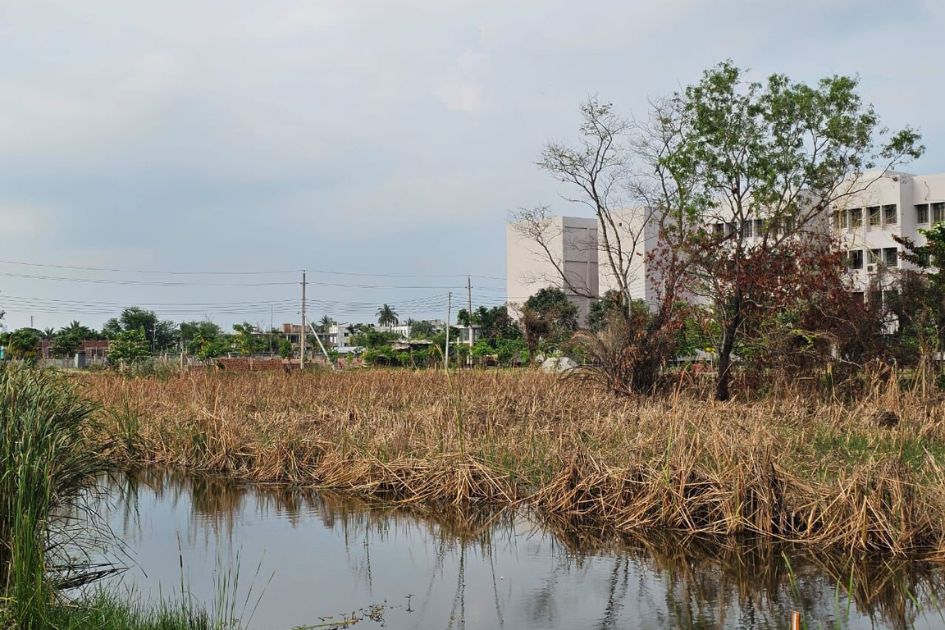



Burning of a floating reed wetland at Khulna University for a “Mini Sundarbans” project has triggered criticism over biodiversity loss, habitat destruction and environmentally harmful land-clearing practices in a climate-vulnerable region.
The burning of a floating wetland forest inside Khulna University has sparked criticism from students, environmentalists and academics, raising concerns over biodiversity loss and ecological damage in one of Bangladesh’s climate-sensitive regions.
The incident took place on April 23 in the university’s “Odommo Bangla” memorial area, where workers from the university’s estate office allegedly poured petrol on a floating hogla reed forest and set it on fire as part of a land-clearing operation. Students and witnesses said nearly two acres of wetland vegetation were destroyed.
University authorities said the area was cleared under a plan to establish a “Mini Sundarbans” project on campus aimed at planting mangrove species native to the Sundarbans, the world’s largest mangrove forest and a UNESCO World Heritage Site.
Officials said the project includes planting golpata palms and other coastal vegetation associated with the Sundarbans ecosystem.
Before the fire, the floating hogla forest served as a natural habitat for birds, aquatic animals, insects and other wetland-dependent species, according to students and local observers. Egrets, cormorants, kingfishers and other birds were regularly seen nesting and feeding in the area.
Students said the ecosystem changed dramatically after the fire.
“Different species of birds used to be seen there regularly,” said third-year student Fairuz Jahan Khan. “The hogla forest on the water provided nesting grounds and shelter for wildlife. After the fire, the birds and animals are no longer visible. The area could have been cleaned using environmentally friendly methods instead of destroying an existing ecosystem.”
Mohammad Ali, head of the university’s estate division, confirmed that the burning was carried out as preparation for the plantation project.
“As part of the Mini Sundarbans project, different mangrove species will be planted there,” he said. “The area was cleared following instructions from the university administration. There are plans to plant golpata trees in the location.”
Environmental experts, however, questioned both the ecological justification and the method used to clear the wetland.
Professor Dr. Abdullah Harun Chowdhury of the university’s Environmental Science Discipline said burning the wetland vegetation with petrol could not be considered an environmentally sustainable approach.
“This directly destroyed the habitat of birds, aquatic organisms and insects,” he said. “Petrol residues may also threaten aquatic plants, earthworms and beneficial microorganisms that are important for maintaining ecological balance.”
He added that hogla reeds and golpata naturally coexist in the Sundarbans ecosystem, meaning there was no environmental necessity to destroy the wetland before planting mangrove species.
“With proper consultation involving forestry and environmental experts, the project could have been implemented without harming biodiversity or damaging the wetland ecosystem,” he said.
The incident has intensified debate among students and environmental advocates over how development and beautification projects should be carried out in ecologically sensitive areas.
Bangladesh, widely recognised as one of the countries most vulnerable to climate change, depends heavily on wetlands and natural ecosystems for biodiversity conservation, flood regulation, water retention and climate resilience. Environmentalists warn that the destruction of small but functioning urban and campus ecosystems could have long-term consequences for wildlife and ecological sustainability.




