

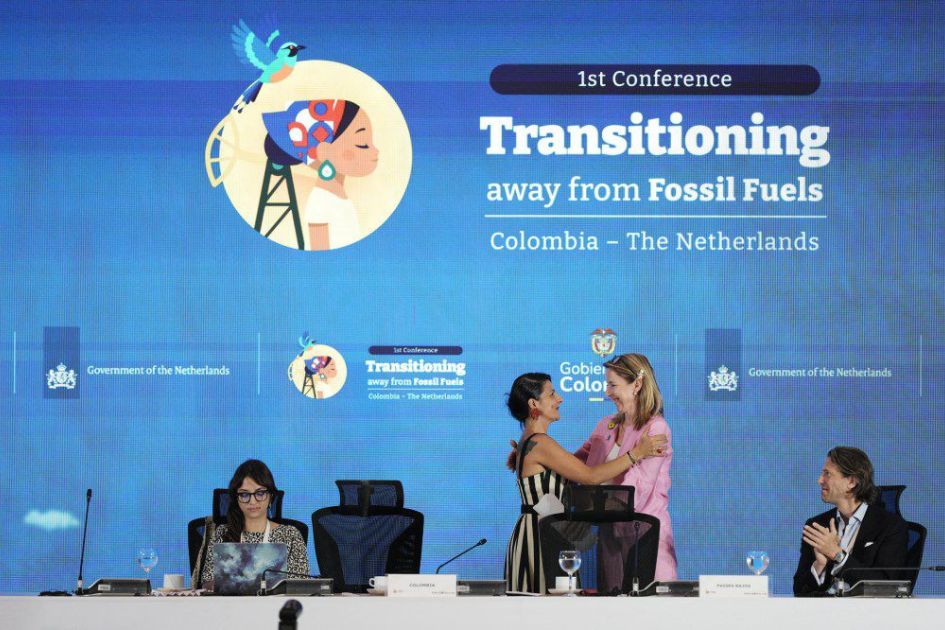

Over 50 countries gather in Colombia to accelerate fossil fuel phase-out, amid protests, energy security concerns, and growing urgency to shift toward renewables despite political divisions.
More than 50 governments convened Tuesday in Colombia’s Caribbean port city of Santa Marta for the first international conference dedicated exclusively to phasing out fossil fuels, amid rising geopolitical tensions and a deepening global energy crisis.
The two-day summit, co-hosted by Colombia and the Netherlands, marks a significant departure from traditional United Nations climate negotiations. It reflects growing frustration among countries over the slow progress in addressing fossil fuels, the primary driver of global warming.
Held in one of Colombia’s busiest coal export hubs, the conference brings together ministers and climate envoys seeking to accelerate a just and equitable transition away from oil, gas and coal.
“Delegates seem refreshed to engage in solutions without debating the necessity of action itself,” said Rachel Kyte, the UK’s special climate envoy, speaking on the sidelines of the summit.
Protests and Pressure
As delegates arrived, climate activists and Indigenous groups staged demonstrations across Santa Marta, calling for an immediate end to fossil fuel expansion. Protesters gathered along beaches and city streets, highlighting the urgency of the crisis as coal ships lined the horizon.
No Binding Deal, But Strong Signals
While the conference is not expected to yield legally binding commitments, it is seen as a crucial platform for shaping future global action. A scientific panel has already urged participating nations to adopt a 12-point policy framework, including a halt to all new fossil fuel exploration and infrastructure.
“There is no justification for new fossil fuel exploration,” said Carlos Nobre, a leading Brazilian scientist.
Broad Participation, Notable Absences
Attendees include major fossil fuel producers such as Canada, Norway and Australia, alongside emerging energy powers like Brazil, Nigeria and Angola. Energy-consuming blocs like the European Union and vulnerable small island nations are also participating.
However, the absence of major emitters such as the United States, China and India, along with oil-rich Gulf states, underscores the political challenges facing a global fossil fuel phase-out.
Energy Crisis Adds Urgency
The backdrop of escalating tensions linked to the Iran conflict has intensified concerns over energy security. Organizers say the crisis has reinforced the need to reduce reliance on fossil fuels.
“Fossil fuels are increasingly a source of instability,” Kyte noted, emphasizing the urgency of transitioning to renewable energy.
Financing Gap Remains
Despite record investments in clean energy, a recent analysis by the International Institute for Sustainable Development found governments still spend five times more public funds on fossil fuels than on renewable energy.
Delegates are expected to discuss reforming subsidies and ensuring a fair transition for economies heavily dependent on fossil fuel revenues.
Climate Clock Is Ticking
Scientists warn that even without new fossil fuel projects, existing reserves could push global temperatures up to 2.5°C by mid-century. The planet has already warmed approximately 1.4°C above pre-industrial levels, dangerously close to the 1.5°C threshold identified by climate science.
Crossing that limit could trigger irreversible impacts, including the loss of coral reefs and the melting of major ice sheets.
As the Santa Marta conference unfolds, it signals a growing coalition willing to confront fossil fuels head-on, even as global consensus remains elusive.




