




Pollution in shared rivers across the India-Bangladesh border is destroying fisheries, threatening public health and livelihoods, and revealing urgent failures in cross-border water governance affecting millions amid delayed action today.
Severe pollution in two transboundary water systems along the India-Bangladesh border is pushing communities into an escalating environmental, livelihood and public health crisis, exposing deep gaps in cross-border water governance in South Asia.
From the Mathabhanga River, which flows from Bangladesh into India’s West Bengal, to the Katakhal canal, which carries untreated wastewater from India’s Tripura state into eastern Bangladesh, residents on both sides of the border are bearing the consequences of weak regulation, delayed infrastructure and fragmented accountability.
Taken together, the two cases reveal a stark reality. Transboundary water pollution in the region is no longer a one-directional problem but a shared challenge that demands shared responsibility.
Mathabhanga River Pollution Flows Downstream, Livelihoods Wash Away
For years, residents and authorities in India’s Nadia district have alleged that untreated industrial effluents from the state-owned Carew and Company sugar mill in Chuadanga, Bangladesh, are being discharged into the Mathabhanga River. The river enters India through Krishnaganj before merging with the Churni River at Pubakhali.
Fishing and farming communities along the river say the pollution has devastated aquatic life, rendered river water unusable for irrigation and forced thousands to abandon livelihoods passed down through generations.
Fish Deaths and Public Health Fears
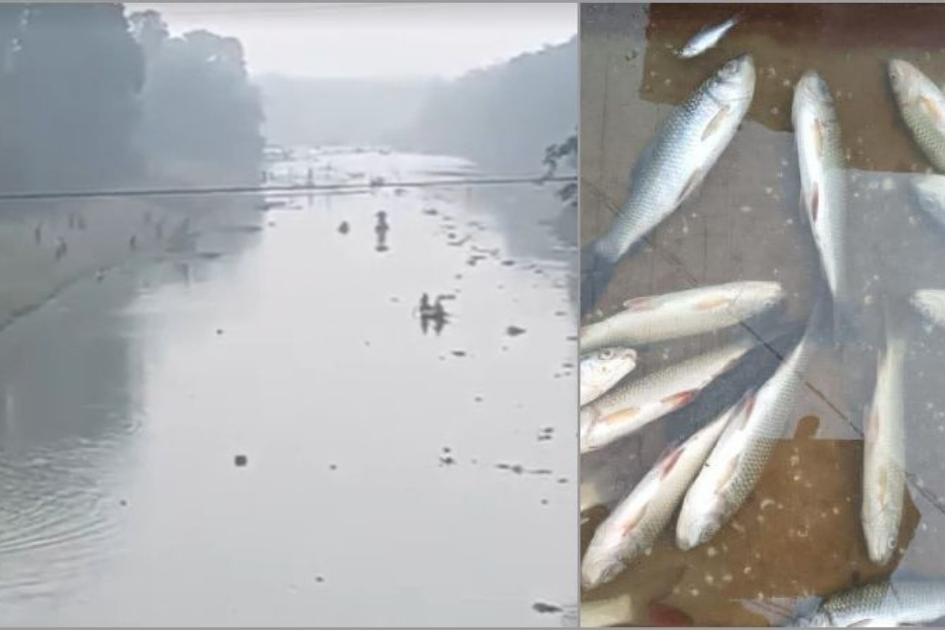
The crisis resurfaced sharply on 23 January, when a two-member Indian central government delegation conducted a field inspection in the area. According to local residents, heavily polluted water was released into the river the day before the visit, triggering mass fish deaths and spreading a strong chemical stench along the riverbanks.
By Friday morning, long stretches of the river were reportedly covered with dead fish. Anger spread quickly among river-dependent communities.
“When the water turns black, we know what is coming,” said fisherman Ratan Biswas from Krishnaganj. “By morning, the fish are floating and our income for the season is gone.”
Environmental activists warn that prolonged exposure to contaminated water may pose serious public health risks, including skin diseases, waterborne infections and potential heavy metal contamination.
“Our River No Longer Feeds Us”
Fishermen and farmers staged protests in front of the visiting delegation, demanding immediate intervention.
“Nearly ten thousand fishing families depended on this river from Krishnaganj to Payradanga,” Biswas said. “Now people are leaving the area or working as day labourers. Every year we hope the pollution will stop, and every year the river is poisoned again.”
Farmers echoed similar concerns, saying crop production has declined sharply as contaminated river water can no longer be safely used for irrigation.
“What sustained our families for generations is now destroying our future,” said a farmer from Payradanga.
Political and Legal Deadlock
The pollution of the Mathabhanga has become a contentious political issue in West Bengal. Chief Minister Mamata Banerjee has publicly accused Bangladesh of failing to take corrective action. The dispute has reached both India’s High Court and Supreme Court, but a lasting solution remains elusive.
Swapan Kumar Bhowmik, secretary of the Churni Mathabhanga River Protection Committee, said court directives have not been enforced.
“The tribunal ordered Bangladesh to install an effluent treatment plant immediately,” he said. “It also ruled that if Bangladesh failed to do so, India should install one on its side. Neither has happened.”
Local legislator Ashish Kumar Biswas confirmed raising the issue in the West Bengal assembly but said the matter has seen little progress.
Social activist Partha Pratim Swarnakar said the visiting delegation had witnessed the river’s condition firsthand. “They have seen the dead fish and the polluted water,” he said. “Now the question is whether the report will lead to action.”
Attempts were made over several days to obtain comments from Carew and Company and relevant Bangladeshi authorities, but no response was received at the time of publication.
Darshana Residents Face Pollution at the Source
On the Bangladesh side, residents living near the Carew and Company sugar mill in Darshana say pollution is also affecting their daily lives, pointing to a crisis that extends beyond the river itself.
Locals allege that foul-smelling wastewater from the factory frequently spills into surrounding residential and commercial areas, disrupting daily movement and posing health risks.
“At night, the water enters our homes,” said a resident of Bazarpara. “Even in winter, we are forced to live with polluted water inside the house.”
Residents say the situation has worsened since new units were added under the mill’s modernization project. Factory employees living in staff quarters said they remained silent for years out of fear of losing their jobs.
“When drains overflow, mosquitoes and insects spread everywhere,” said another resident. “Children and elderly people suffer the most.”
Efforts to reach the mill’s managing director were unsuccessful. However, General Manager of Administration Omar Al Faruk Galib acknowledged increased wastewater discharge.
“The volume of wastewater has increased because old and new mills are operating at the same time,” he said. “We are cleaning drains regularly and trying to control overflow, but the situation is made worse because the factory drainage is connected to municipal drains.”
Environmental activists warn that without permanent infrastructure upgrades, the pollution could cause long-term ecological damage and public health emergencies.
A Mirror Crisis: Pollution Flows Into Bangladesh
While communities in India suffer from pollution flowing downstream from Bangladesh, eastern Bangladesh faces a similar crisis in reverse.
In Akhaura, a border town in Brahmanbaria district, the Katakhal canal carries untreated municipal and industrial wastewater from Agartala, the capital of India’s Tripura state, before draining into the Titas River. For decades, the canal has functioned as a sewage outlet, affecting schools, farmland and aquatic ecosystems.
At Abdullahpur Government Primary School, classrooms sit beside the canal.
“The smell is unbearable,” said teacher Mahmuda Akhter. “Children cannot concentrate, and we constantly worry they might go near the water.”
Ecological Stress and Toxic Risks
According to Bangladesh’s Department of Environment, recent water quality tests confirm serious ecological stress. An April analysis found dissolved oxygen levels below the minimum 5.0 milligrams per litre required for aquatic life. Biochemical oxygen demand and chemical oxygen demand also exceeded permissible limits.
“These results are deeply concerning,” said a Department of Environment laboratory official, speaking on condition of anonymity.
Previous studies detected cadmium, lead, chromium and manganese in canal water. Scientists warn that long term use of polluted water for irrigation can contaminate soil and food chains.
Despite the risks, farmers in Akhaura continue to rely on canal water due to limited alternatives.
“The water causes skin irritation, but I have no choice,” said rice farmer Zahed Chowdhury. “If I stop using it, I cannot farm.”
Infrastructure Gaps and Missed Deadlines
Hopes briefly rose in December when an eight megalitre per day sewage treatment plant was inaugurated near Agartala. However, pollution persists. Official Tripura government documents show that four treatment plants with a combined capacity of 31.5 MLD were planned, but construction deadlines have already been missed.
Bangladesh says it has repeatedly raised the issue through diplomatic and institutional channels. Border Guard Bangladesh regularly shares concerns with Indian counterparts, while discussions continue under the Joint Rivers Commission framework.
Anwar Kadir, a member of the Indo-Bangladesh Joint Rivers Commission, said water quality must now be treated as seriously as water sharing.
“For years, our focus has been on floods and flow volumes,” he said. “But pollution has become an equally urgent threat. We have informed the relevant ministries and pushed for permanent technical solutions so that no untreated waste crosses the border.”
“We are pursuing resolution through bilateral and multilateral mechanisms,” said Syeda Rizwana Hasan, adviser to Bangladesh’s Ministry of Water Resources. “At the same time, we are planning a treatment plant on our side to reduce immediate risks.”
Shared Rivers, Shared Responsibility
Bangladesh and India share 57 transboundary rivers, yet cooperation has largely focused on water sharing and flood forecasting. Experts say water quality management must now receive equal attention as climate stress, urbanisation and industrial expansion intensify.
Bangladesh’s accession in June 2025 to the UN Convention on the Protection and Use of Transboundary Watercourses and International Lakes has raised expectations for enforceable cooperation.
Environmental analysts note that both countries are signatories to the 1992 Rio Declaration, which obliges states to prevent environmental harm beyond their borders.
“We cannot stand by while communities and ecosystems disappear,” said Sohanur Rahman, executive coordinator of YouthNet Global. “Protecting shared rivers is a shared responsibility, and states must ensure justice, health and survival for those who depend on them.”
A Crisis Beyond Diplomacy
For people living along the Mathabhanga and Katakhal, the crisis is not about treaties or geopolitics. It is about survival. Once lifelines for fishing, farming and daily life, these waterways now symbolize the human cost of delayed action.
As pressure mounts on both governments, activists warn that without transparent monitoring, enforceable standards and genuine cross-border cooperation, shared rivers across South Asia risk becoming shared tragedies with consequences neither side can afford to ignore.




