

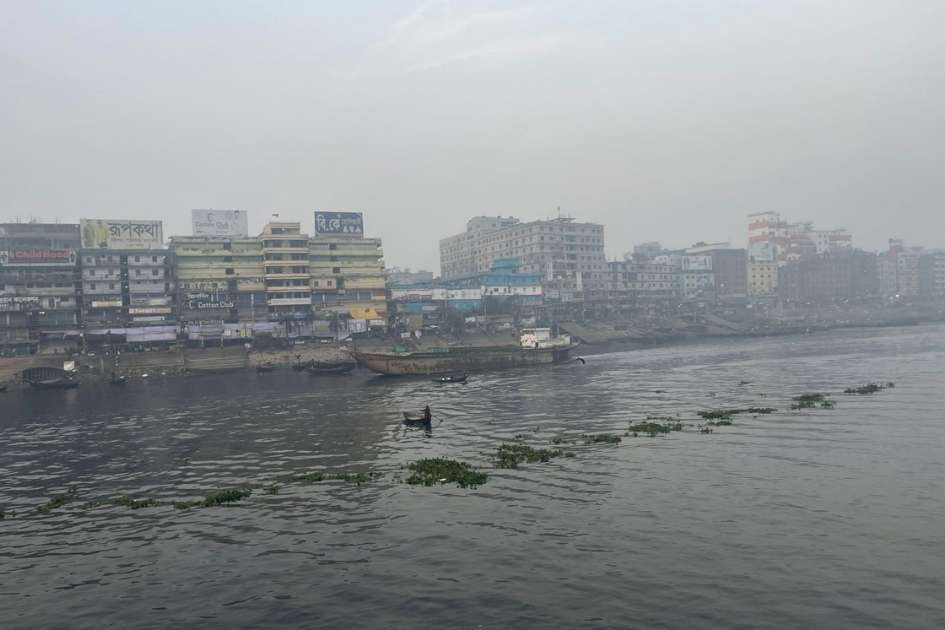



Despite decades of laws and projects, Dhaka’s rivers are dying from untreated industrial waste and sewage, exposing weak enforcement, fragmented governance and rising public health risks for millions of residents.
The rivers encircling Dhaka, the Buriganga, Shitalakkhya, Turag, and Balu, are steadily turning toxic despite decades of environmental laws, regulatory agencies, and multibillion-taka projects aimed at protecting them. Once vital lifelines of the capital, these rivers are now suffocating under untreated industrial waste and sewage, exposing deep-rooted failures in enforcement and accountability.
On the ground, observations show untreated liquid waste, black in some stretches and brightly coloured in others, flowing directly into the Buriganga, Balu and Turag rivers. Sewerage outlets discharge waste without any treatment, while a strong stench can be detected from nearly half a kilometre away. Local residents say pollution has intensified since the end of the monsoon.
Bangladesh’s Environment Conservation Act 1995, amended in 2010, and the Environment Conservation Rules 2023 require all industries discharging liquid waste to operate Effluent Treatment Plants and Sewage Treatment Plants. In practice, many factories have not installed ETPs at all, while a significant number of those that have fail to keep them operational. As a result, untreated industrial effluents continue to flow directly into rivers.
In February last year, the Department of Environment issued final notices to 2,046 industrial units in Dhaka, Gazipur, Narayanganj and Narsingdi, warning of strict legal action if ETPs were not operated round the clock. More than ten months later, there has been no visible improvement in river water quality. Instead, pollution has worsened.
How many factories were shut down and how many were fined remains unclear, as no official data has been made public. Attempts to contact the Department of Environment for comment were unsuccessful.
Scientific evidence confirms the severity of the crisis. Tests conducted by the River and Delta Research Centre show that rivers near industrial zones no longer contain sufficient dissolved oxygen to sustain aquatic life. International standards require at least 6.5 milligrams of dissolved oxygen per litre of water. The Buriganga recorded only 0.85 milligrams, the Turag 1.1, the Balu 1.5 and the Shitalakkhya just 0.75 milligrams, effectively rendering these rivers biologically dead.
Industrial waste is not the sole culprit. Poor sanitation has emerged as another major source of pollution. According to data from the International Toilet Conference 2025, around 65 million people in Bangladesh lack access to safe sanitation. In Dhaka alone, an estimated 230 tonnes of human waste are discharged into open water bodies every day. Experts estimate that inadequate sanitation causes annual losses of about 4.2 billion US dollars through environmental damage, health costs and lost productivity.
The public health impact is already evident. Communities living along riverbanks report rising cases of skin diseases, diarrhoea, cholera, dysentery and typhoid. This is even though Dhaka’s four rivers were declared Ecologically Critical Areas in 2009. Fifteen years on, the designation has produced little measurable improvement.
The problem is not confined to the capital. In Rajshahi, the Barnai River has been heavily polluted by hospital and industrial waste, with reports suggesting that at least 100,000 people across three upazilas are suffering from skin diseases linked to contaminated water.
Against this backdrop, the government has announced a new river restoration initiative with financial assistance from the World Bank. Environment Adviser Syeda Rizwana Hasan said a project is being undertaken to restore five major rivers surrounding Dhaka, namely the Buriganga, Shitalakkhya, Balu, Turag, and Dhaleshwari, as well as eight rivers across the country’s eight administrative divisions.
Rizwana Hasan said government assessments have identified 179 industrial units responsible for pollution in the Turag River alone. She added that more than 450 riverside industrial establishments have been found responsible for polluting Dhaka’s four major rivers.
She said the navigability of these rivers would be restored through waste removal and dredging aimed at reviving river flow, improving water quality and reducing long-standing pollution pressures.
Environmentalists argue that while projects are launched and funds are spent in the name of river protection, field-level accountability remains weak. Without strong authority, coordination among agencies and transparent public reporting, pollution will continue unabated.
Experts warn that unless Bangladesh enforces its existing laws alongside restoration initiatives, the country risks losing not only its rivers but also its ecological and public health future. For a nation shaped by waterways, the cost of inaction may be irreversible.
Environmental advocates also caution that dredging alone will not solve the crisis without strict enforcement of environmental laws.
Sohanur Rahman, executive coordinator of YouthNet Global, said river restoration efforts must focus on stopping pollution at its source. He said rivers cannot be saved by dredging alone and without enforcing environmental laws, ensuring transparency and holding polluters accountable; these projects risk becoming cosmetic solutions. He added that youth and river-dependent communities must be meaningfully involved if lasting change is to be achieved.
Dr Tuhin Wadud, a teacher at Begum Rokeya University and director of Riverine People, described the situation as a systemic governance failure. He said that if ETPs were operated properly, river water would not turn black, and added that directives exist on paper but enforcement is lacking.
He said fragmented institutional responsibility has allowed pollution to continue unchecked, noting that river protection is divided among multiple agencies so no one takes ownership. The National River Conservation Commission, he said, can only make recommendations and has no real authority.
Dr Wadud stressed the need for a single empowered authority with magistracy powers to ensure accountability, saying laws already exist but oversight and political will are missing.




