

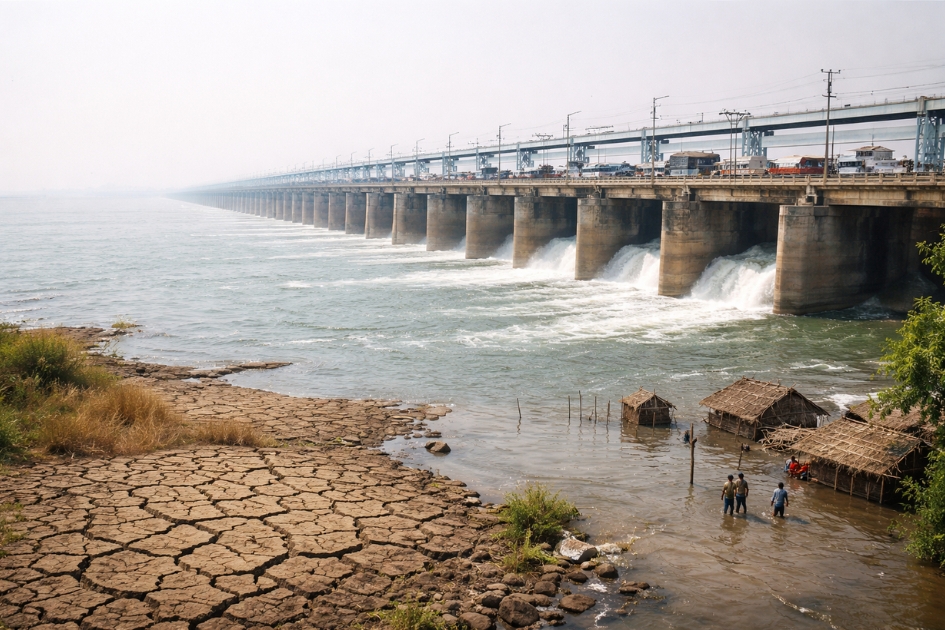



With the 1996 Ganges Water Treaty expiring in 2027, climate change, sediment loss and extreme floods force Bangladesh to reconsider water governance with India and demand a climate-adapted basin framework.
The 1996 Treaty: Designed for a Different Climate
The 1996 Ganges Water Treaty between Bangladesh and India addresses dry-season water flow, how to share the Ganges during January through May when irrigation demand peaks and natural discharge declines. The treaty establishes allocation formulas and minimum flow guarantees at Farakka.
For thirty years this framework has governed one river during one season allocating one resource: water flow. It contains no provisions for sediment no mechanisms for monsoon extremes no climate adaptation protocols and no enforceable consequences for violations.
The treaty was designed for a 20th-century climate: predictable monsoons manageable dry seasons and infrastructure capable of handling normal precipitation variability.
That climate no longer exists.
Climate Change Has Invalidated the Treaty
The Ganges basin is experiencing its worst droughts in 1,300 years, droughts well outside natural climate variability. At the same time climate change has quadrupled the frequency of extreme monsoon events with atmospheric rivers accounting for 73 percent of floods.
The treaty allocates dry-season water but cannot manage atmospheric river events that deliver “water bombs” overwhelming all infrastructure. The August 2024 floods, which affected 5.8 million people and were the worst in 37 years, demonstrate this failure.
Climate has transformed the treaty’s assumptions:
Predictable dry seasons → worst droughts in 1,300 years
Manageable monsoons → quadrupled extreme events
Static climate → unprecedented variability
Adequate infrastructure → catastrophic failure under new extremes
The treaty expires in 2027. Bangladesh faces an important decision: either renew a framework established under outdated climate conditions or advocate for a revised approach that reflects present realities.
Climate Amplifies What the Treaty Ignores: Sediment
Climate extremes accelerate upstream erosion filling dam reservoirs faster than anticipated. This reduces storage capacity and forces emergency releases during monsoons creating catastrophic floods. Meanwhile sediment that should build Bangladesh’s delta remains trapped.
The treaty’s major omission is the absence of sediment provisions. The Ganges-Brahmaputra-Meghna historically delivered about 1 billion tons annually. Research shows sediment could decline 15 to 80 percent if planned dams are built. China’s Yarlung Tsangpo mega dam threatens 50 percent of the Brahmaputra sediment supply.
Climate makes this catastrophic. As reservoirs fill dams release water during climate-amplified extremes creating floods. As sediment stays trapped the delta subsides at 5 to 7 mm each year. A global study found that 18 of 40 major deltas are sinking faster than sea-level rise.
Water shortages force 32 cubic kilometers of annual groundwater extraction with aquifer levels falling 15 to 20 mm yearly. Saltwater has advanced 15 to 20 km inland increasing 64 percent since 1973. Seventy-nine rivers are dead or dying. Climate extremes amplify every crisis while sediment starvation removes delta resilience.
Mississippi Delta: Sediment Starvation Plus Climate Change
During my postdoctoral research at Louisiana State University I witnessed what happens when sediment starvation combines with changing climate conditions. Louisiana has lost 1,900 square miles since the 1930s. Research shows that before straight channels and levees eliminated sediment delivery the delta was growing. After sediment was cut off it began losing about 7 square kilometers annually.
Climate change now accelerates the collapse through intensified hurricanes sea-level rise and saltwater intrusion attacking a delta that lost resilience when sediment stopped flowing.
Mississippi levees prevent sediment delivery and the delta dies. Bangladesh faces a similar risk if upstream dams trap sediment and reduce delivery to the delta. Climate multiplies damage in both cases. The United States could not prevent the collapse. Bangladesh will not prevent GBM collapse without addressing sediment and climate simultaneously.
What a Climate Adapted Framework Requires
Sediment management: Climate-driven events fill reservoirs faster. Sediment bypass during monsoon periods can extend dam lifespans maintain hydropower and deliver the sediment Bangladesh needs benefiting both nations under a changing climate.
Atmospheric river integration: Dam operations must coordinate with climate forecasting to release water before atmospheric rivers arrive preventing catastrophic emergency releases.
Climate adapted infrastructure: All infrastructure must be evaluated using 21st-century climate data rather than 20th-century design standards with continuous assessment as climate conditions evolve.
Integrated solutions: New channels can distribute sediment deliver irrigation water to reduce groundwater extraction and recharge aquifers. This approach addresses the climate-driven compound crisis simultaneously.
Enforcement: The 1996 treaty produced 79 dead rivers under a stable climate. Under accelerating climate change voluntary cooperation becomes less reliable. The treaty needs third-party monitoring binding arbitration and enforceable consequences.
Basin-wide climate framework: Climate affects all tributaries across all seasons. Address the Ganges Brahmaputra and Meghna year round engage China regarding the Yarlung Tsangpo and recognize that climate extremes including droughts and floods require integrated management.
Climate Will Not Wait
Climate change continues to accelerate. Seventy-four percent of Ganga basin monitoring stations show declines of about 17 percent per decade and climate models have underestimated the severity. Each year brings harsher droughts larger floods increased sediment buildup more land subsidence and greater risk.
The Mississippi example shows that once sediment starvation advances under changing climate conditions collapse becomes extremely difficult to reverse. The GBM delta has not yet reached that point. Climate change is accelerating the trajectory while the treaty remains silent.
Bangladesh’s decision in 2027 is clear: demand a climate-adapted framework that addresses unprecedented droughts increasing extreme events sediment starvation and infrastructure failure or renew provisions designed for climate conditions that no longer exist.
Climate change has already broken the assumptions of the 1996 treaty. Continuing with outdated frameworks will deepen the crisis. By adopting climate-adapted strategies including sediment management updated infrastructure and enforceable governance both countries can build resilience for the future.
The 2027 renewal is not simply about extending an old agreement. It is about building climate-adapted governance for atmospheric rivers unprecedented droughts and sediment-starved deltas that define the realities of the 21st century.
About the Author
The writer is an adjunct faculty position at Jefferson Community and Technical College, Louisville, Kentucky.




