

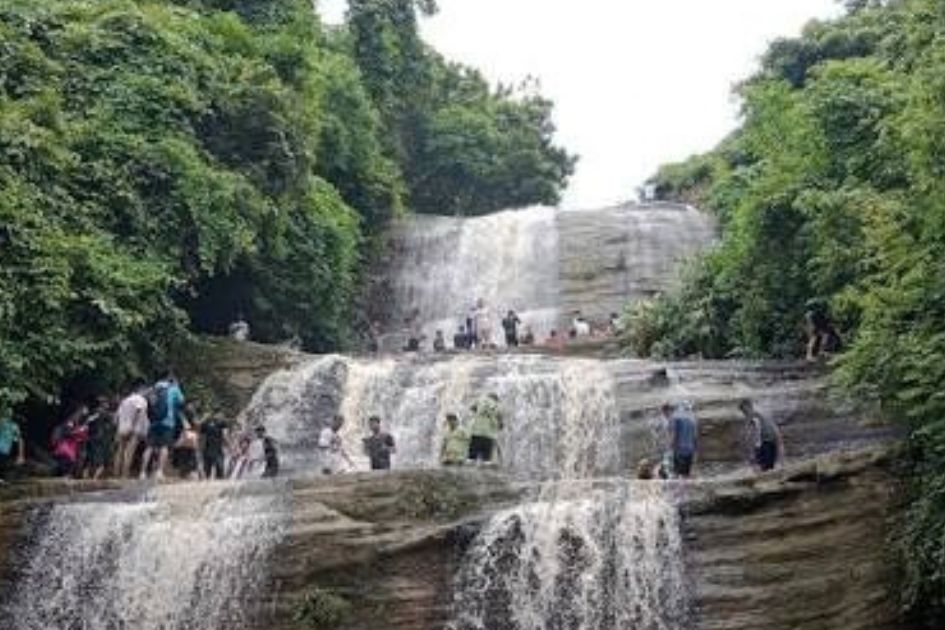



Khoiyachora Waterfall draws growing numbers of visitors with its nine cascades, rich biodiversity and scenic trekking route, while rising tourism threatens its fragile ecosystem.
It is like a stream of unbridled love flowing continuously through the chest of the stone, a stream of nectar flowing in hundreds and thousands of streams. In the deep embrace of nature and love, a thrilling image emerges in the mind of the beloved, “I have gazed at Bengal’s face and hence the world’s beauty I no longer go to seek”! “Khoiyachora Jharna” is a waterfall located in the deep hills of Mirsarai, Chittagong. This waterfall is known as Chatal to the locals. Compared to other waterfalls of Mirsarai such as Kamaldaha Jharna, Napittachhara Jharna, Sahasradhara Jharna and Jharjhari Jharna, Khoiyachora Jharna and its waterfall path are quite large. According to tourists from home and abroad, fascinated by its form and beauty, fashion and style, it is the largest waterfall in the country, surpassing Madhabkunda and Shuvolong in length and width, water depth and natural diversity. There are a total of nine big steps, or cascades, and many isolated steps in the Khoiyachora waterfall, which is not seen in any other waterfall in Bangladesh. That is why it is called the ‘Queen of Waterfall’. Since it is located in Khoiyachora Union of Mirsarai Upazila, it has been named “Khoiyachora Waterfall”.
If the goal is to see the waterfall, then it must be assumed that it is a hidden treasure hidden deep in the heart of the mountain, an insatiable addiction to discovering natural scenes. Green fields of crops, the courage to cross the winding mountain paths and inaccessible gorges, immense patience, numerous high and low mountains and countless unknown trees on the mountain, the green mountain seems like a carpet of greenery. It is as if the mountain has embraced the queen of the waterfall with intense love in its green embrace. And from the heart of this green mountain, wild waterfalls are springing up with a gurgling sound.
Drawing a kiss of affection on the chest of the unpopulated, secluded and peaceful mountain, after crossing almost nine steps, the clear water of the waterfall climbs from rock to rock, creating countless waterfalls and then the crashing stream comes down to the plains with a gurgling sound. Various species of creepers, shrubs, bamboo forests, wild flowers and fruit trees have lovingly surrounded this waterfall, a wonder of creation, a collection of natural beauty. It is as if nature has poured all its beauty into the top of this rugged mountain with the sweetness of its mind, pouring all its beauty into the colours of the rainbow. The heavenly beauty that one has to observe with both eyes and enjoy like a mesmerised person. And Khoiyachora is also welcoming nature lovers who have come to breathe fresh air after washing away all the fatigue and boredom of daily mechanical life. The waterfall appears with its highest form during the rainy and flood seasons. And all the beauty of the waterfall lies in the flow of water. The best time to see Khoiyachora Waterfall is the rainy season.
If we list the largest and most diverse waterfalls in Bangladesh, the Khoiyachora Waterfall of the Mirsarai Pahar Range will be at the top of the list. The waterfall is located 4.2 kilometres east of the Dhaka-Chittagong highway, north of Baratakia Bazar in Khoiyachora Union of Mirsarai Upazila of Chittagong. According to locals, the Khoiyachora Waterfall has been flowing for about 50 years at a place called Bhuiyan Tila. Due to the uninhabited hilly area and the dominance of deep bushes, there was not much traffic there. As a result, it took a long time to discover its actual location. Perhaps at some point, nature’s will led to the emergence of this natural aesthetic scene as a result of a mountain rain.
Tracking is required to reach each step of the Khoiyachora Waterfall. The steep hill rises past the first step, followed by the remaining eight steps. After climbing the steep hill, if you go down a little, you can see the second step, which is completely different from the first. The stream flowing from the narrow place has expanded after coming down a little. The third step is more unique than the second step. The height of the first step of the waterfall is 60 feet, the second is 40 feet and the third is 120 feet. The flow of all three steps can be seen from the third step. There is a large reservoir. Then again, the steep hill rises past the waterfall to the fourth step. From here, the height of the fifth, sixth and seventh steps is relatively low. The eighth step of the waterfall is again quite high and wide. From here, the steep hill rises again to the ninth step, just below which is a medium-sized reservoir. This is the last step of Khoiyachora, located about 2,000 feet above sea level. From here, you can climb the mountain even higher and you can see the distant sea from the top of the mountain.
The waterfall is located deep inside the mountain. As a result, it is not possible to reach its foot using any vehicle as there is no direct communication system. It is possible to reach the village near the waterfall by walking from the side of the Dhaka-Chittagong highway or using CNG. But to reach the main stream of the waterfall through the village at the foot of the mountain, the only hope is to walk. The remote mountain trek to see the waterfall is completely different from all other recreational trips. The thought of crossing the gorge with comfort and ease does not fit this expedition at all. The bites of unknown insects or falling down, covered in mud, are enough to take you back to your childhood. Along with the irresistible desire to go deeper into the mountain, sometimes you say to yourself, “Frailty of mine, please pardon, O’ my master.”
This mountain path is enough to confuse anyone who is visiting for the first time in their life. Because a tourist who has just set foot will not be able to understand how many turns this exciting slippery journey will take before it ends. Although the entire thrill is being given away with both hands by the queen of waterfall, Khoiyachora. The path to the main foot of the waterfall is quite inaccessible. As a result, bamboo sticks, good-quality grip shoes or anklets are suitable for tracking. With the help of tree roots, you have to climb up in small holes. As you walk along the path, you will see the green, winding paths of the village, small rivers, bamboo bridges, field paths and various shaped paths.
At least four small and large hills have to be crossed to reach the specific destination. Mango, coconut and papaya gardens stand tall next to the houses and fields of the local people. Then just keep moving forward along the jhiripath. Suddenly, a procession of colourful grasshoppers, including red and blue, appears! The soothing greenery sways on the wings of the grasshoppers. The further the path goes, the more the hum of the grasshoppers can be heard. The sound of water can be heard on the way. The sound of falling water can be heard from the Mirsarai Thakurda Dighi. Here, only one person captivates everyone with the timeless melody, the rest are her enchanted listeners; she is this queen of the waterfall. Suddenly, the call of a deer is heard.
On the way, you will be introduced to wild orchids, leeches, almost invisible green algae clinging to the rocks, the sweet call of unknown birds and a valley covered with a green carpet of velvety grass. Walking a little further, just around a bend, the Khoiyachora Waterfall will appear before your eyes, proudly flowing with its vast abundance. The water is flowing uninterruptedly from a great height. Finally, all the beauty seems to be captured in your mind. But the beauty begins here, above it there are eight more steps, which have already been mentioned. There is a spacious space on each of the nine steps. On a full moon night, where you can pitch a tent and spend the entire night in a flash. Along with the body being purified in the waterfall bath, the heart purified in the moonlight bath suddenly feels a wave – “All that my heart wishes for, You are the one, That you are…”
In this hill, which is rich in biodiversity, monkeys and deer can be seen in a somewhat quiet and peaceful environment. The musical sound of the flowing water, the call of crickets, the magical presence of fireflies and the sweet fragrance of wild flowers make the eyes close in a moment due to fatigue and the body and mind fall into a dreamy sleep. If desired, thirsty visitors can drink fresh water from the fountain. Local lore has it that there is a hill in Khoiyachora where a fire burns perpetually, never going out, not even in the rain! Though the exact location of the hill has yet to be determined! The 2933.61-hectare hilly land in the area from Baroiyadhala Block to Kunder Haat (Baratakia) was declared a government national park in 2010. That’s when this waterfall was included as the main natural landmark of this park. In 2017, the government launched an eco-tourism development project to conserve the waterfall. The project includes Ramgarh, Sitakunda and Reserve Forests of Chittagong North Forest Division.
This waterfall, which flows carelessly unnoticed by the tourism department, is now beckoning travellers to the waterfall. The number of tourists has also increased in the last few years. But the biodiversity of Khoiyachora Waterfall is now under threat due to various reasons. Lack of effective maintenance, greed of unscrupulous groups such as cutting down mountains, cutting down trees, hunting wild animals and human ignorance such as throwing plastic and non-biodegradable materials, food packets, chips packets, cigarette filters and other dirty garbage everywhere are destroying its ecosystem.
If biodiversity protection, safe communication system, construction of quality hotels, restaurants, cottages, etc., along with infrastructural development and proper patronage are ensured, it can be a new source of potential in terms of revenue generation due to the great gathering of domestic and foreign tourists. Some local school students and unemployed youth have already started working as guides. Some shops have been set up on individual initiative. As a result, their financial needs are being met to some extent and unemployment is decreasing. Therefore, it is now the imperative demand of the time for the responsible authorities to take appropriate steps to further attract and captivate domestic and foreign tourists with the beauty and charm of Queen of the Waterfall, Khoiyachora.
The Author is a Media Worker and Article Writer.




