




Rajshahi’s latest mosquito survey found Aedes larvae in 24 of 75 homes, highlighting growing dengue concerns amid changing weather and urban conditions.
Three civil society and research organisations have called for coordinated measures to tackle dengue risks linked to climate change and changes in the urban environment, including regular entomological surveys, greater public awareness and stronger public health initiatives.
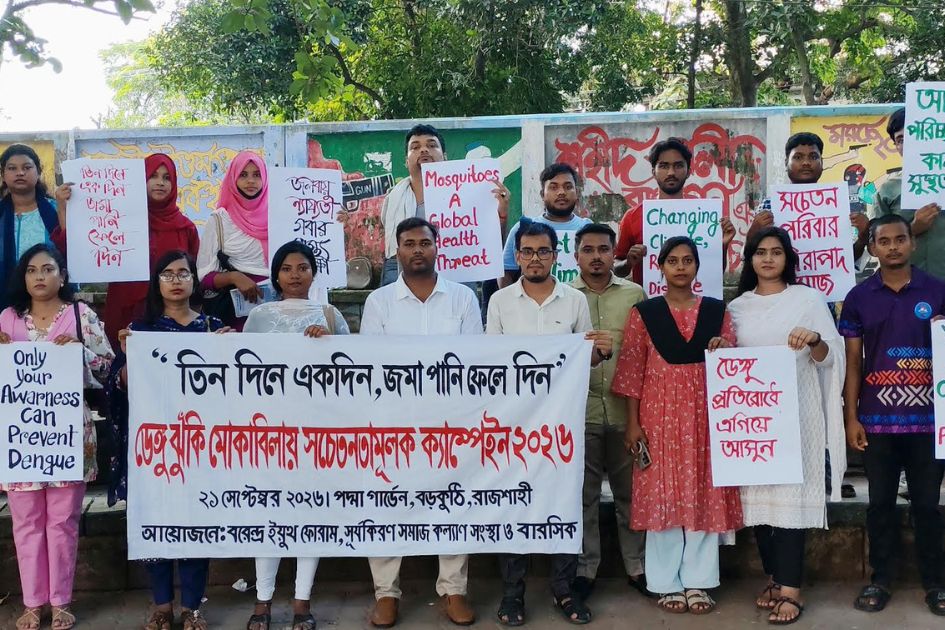
The call came at a dengue awareness campaign held at 5:00 pm Monday in the Padma Garden area of Rajshahi, a major city in northwestern Bangladesh. The campaign was organised by Barendra Youth Forum, Suryakiran Samaj Kalyan Sangstha and research organisation BARCIK under the slogan, “Once every three days, throw away stagnant water.”
A study conducted from 2020 to 2022 by Bangladesh’s Directorate General of Health Services, Rajshahi University and a team of researchers across all 30 wards of Rajshahi City Corporation identified the presence of two Aedes mosquito species, Aedes aegypti and Aedes albopictus, in urban areas. The study also found that weather variables affected mosquito populations.
In a separate entomological survey conducted from Aug 3 to 10, 2026, by the Rajshahi divisional office of the Directorate General of Health Services, Aedes mosquito larvae were found in 24 of 75 houses surveyed in the city’s Kazihata, Chandipur, Uparbhadra, Namobhadrā and Hazrapukur areas.
The house index was 32 percent, while larvae were found in 46 of 68 water-holding containers, producing a container index of 67.65 percent. According to World Health Organization guidelines, a Breteau index above 20 indicates a high risk of dengue in an area. Rajshahi’s latest index was 61.33, more than three times the threshold for high risk.
Of the 685 larvae collected from different breeding sites during the survey, 505 were Aedes albopictus, 86 were Aedes aegypti and 94 were larvae of other mosquito species.
The larvae were found in a range of locations, including flower vases, plastic and ceramic plant pots, earthen and tin containers, coconut shells, drums, waterlogged floors, paint buckets and plastic buckets.
Speakers at the campaign said changes in temperature, rainfall, humidity and extreme weather conditions were affecting the breeding, survival and spread of Aedes mosquitoes as well as their ability to transmit dengue virus.
According to the World Health Organization, they said, climate change can increase temperatures and create warmer and more humid conditions while also contributing to irregular rainfall, drought and water shortages, extreme heat and dryness. Such conditions can accelerate the development of Aedes mosquito eggs, larvae and pupae, allowing mosquito generations to develop more rapidly in suitable environments.
They said faster feeding and breeding cycles could increase mosquito biting rates in certain environments and create greater opportunities for transmission. Changes in temperature and rainfall patterns could also alter the geographic range of mosquitoes by creating suitable habitats in new areas, increasing mosquito presence or dengue risk in places that were previously less suitable.
However, they said regular mosquito surveys, weather monitoring and integrated analysis of epidemiological data were needed to determine local risks.
Mohammad Atikur Rahman, president of Barendra Youth Forum, said climate change was not only an environmental crisis but also a public health crisis.
“Alongside addressing climate risks, breeding grounds for Aedes mosquitoes must be destroyed and people at the community level must be alerted and made aware. Effective and realistic plans must be developed to prevent dengue,” he said.
Sabitri Himbram, general secretary of the Indigenous Youth Council, said dengue prevention should not be limited to mosquito-control activities but should instead be treated as a coordinated effort involving environmental management, public health protection and citizen participation.
Rakib Hasan, president of Leo Club of Rajshahi Metropolitan, said regular identification of breeding grounds in every ward of Rajshahi, evidence-based measures and active public participation were essential.
The campaign issued five demands and calls: regular entomological surveys for Aedes mosquitoes in every ward of Rajshahi City Corporation and publication of their findings; stronger public awareness activities on removing stagnant water, destroying breeding sites and managing water; integrated urban risk assessments and prevention plans combining climate, weather, mosquito survey and dengue epidemiological data; coordinated dengue and chikungunya prevention efforts involving the health authorities, city corporation, educational institutions, youth and civil society organisations; and a long-term action plan to build a clean, climate-resilient and public health-friendly Rajshahi.
Samrat Raihan, executive director of the Social Welfare Organisation, Amit Sarker, associate programme officer at BARCIK, Tahura Khatun Lily and Raihan, a member of the Nabajagaran Foundation, also spoke at the event.
The organisers said dengue prevention required not panic but awareness, scientific information, social participation and effective administrative action.




